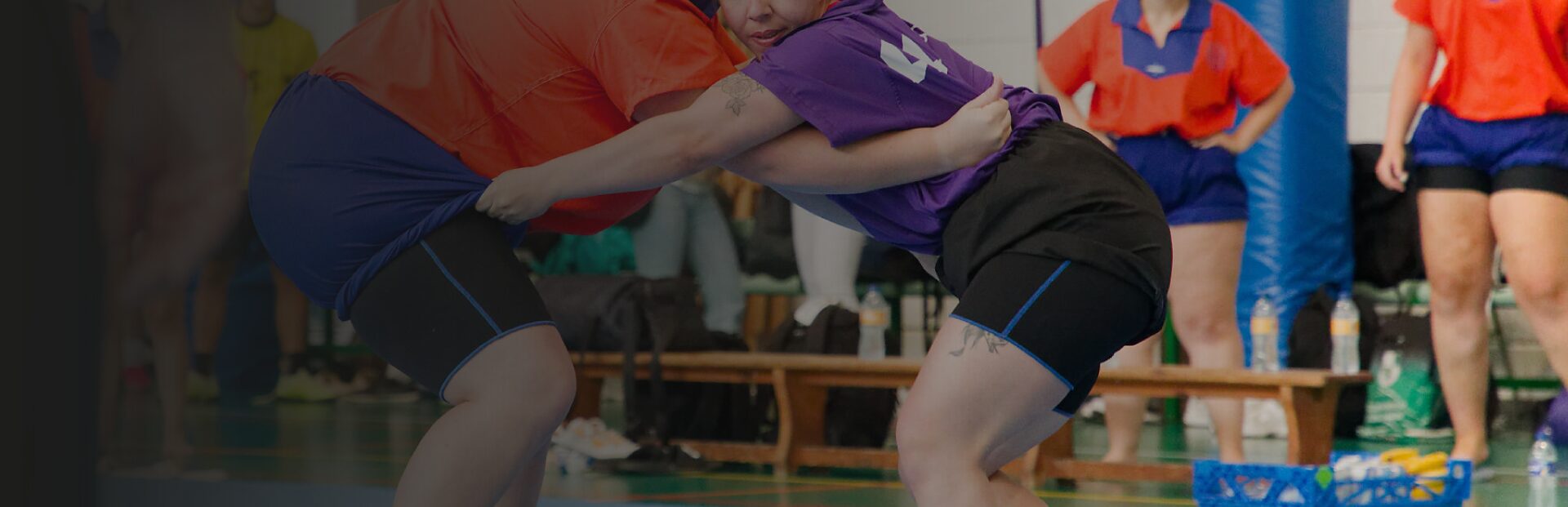
Comprehensive training in Canarian wrestling

Comprehensive training in Canarian Wrestling

Overview

This Microcredential is designed to teach and apply the principles of comprehensive training adapted to Canarian Wrestling, considering all the factors that influence a wrestler's performance. It will also analyze the specific characteristics of training during the formative stages and how these differ from high-performance training.

Goals

Understanding the fundamentals of comprehensive training and its specific application to Canarian Wrestling.

Identify the differentiating characteristics of training in the formative stages versus high performance.

Integrate physical, technical, tactical, psychological and nutritional components into the training plan for Canarian Wrestling

Access requirements

  • Being a national of the Spanish territory.
  • Be between 25 and 64 years of age at the start date of training.
  • Applicants must hold at least a high school diploma or equivalent professional certificate. A university degree is not required; however, applicants must hold one of the following qualifications, listed in order of preference:
    • Higher level technician in Canarian Wrestling
    • Intermediate level technician in Canarian Wrestling
    • Canarian Wrestling Instructors (with a higher vocational training qualification)
    • Registered Canarian wrestling fighters (with a higher vocational training level)
    • Graduates of degrees related to the comprehensive training of Canarian Wrestling (CAFyD, Psychology, Physiotherapy, Nutrition and Dietetics, Physiotherapy, Medicine, etc.).
    • Professionals and athletes linked to Canarian Wrestling with degrees related to the comprehensive training of Canarian Wrestling (CAFyD, Psychology, Physiotherapy, Nutrition and Dietetics, Medicine, etc.).

Academic program

Contents

Block 1: Roots of Terrero – Fundamentals of comprehensive training

  • Course presentation. Principles of sports training.
  • Concept and evolution of the integral approach.
  • Specifics of training in combat sports

Block 2: Between the Arena and Training – Stages of the wrestler

  • Physical and psychological development in childhood and adolescence.
  • Transition to high performance.
  • Criteria for phased planning.

Block 3: Beyond Strength – Applied Physical and Technical Preparation

  • Specific conditional abilities in Canarian Wrestling.
  • Technical teaching and improvement by levels.
  • Design of integrated physical-technical tasks.

Block 4: Head and Heart in the Arena – Tactical and Psychological Preparation

  • Fundamentals of tactics in Canarian Wrestling.
  • Development of tactical thinking in training.
  • Psychological preparation: motivation, concentration, emotional control.

Block 5: From Design to Action – Planning, Nutrition and Prevention

  • Structure of the comprehensive training plan.
  • Injury prevention strategies.
  • Nutrition and recovery fundamentals for the wrestler.

Methodology and activities

  • Lectures/expository method: presentation or explanation by the teaching staff.
  • Practical classes: activities supervised by the teaching staff in the classroom, laboratories, clinics.
  • Seminars: completing exercises, solving problems or practical cases, others.
  • Individual work: individual preparation of assignments/projects/reports, portfolio, …
  • Group work: group preparation of assignments, projects/reports, …
  • Active methodologies: cooperative learning, project-based learning, flipped classroom, service learning, game-based learning, case studies, problem solving… These are aimed at making learning a participatory process and are based on student agency.
  • Field trips, visits: activities that take place outside the center and allow students to acquire the professional skills associated with a subject.

Evaluation criteria

  • Attendance, participation or attitude in teaching activities, seminars, tutorials, etc.: monitoring student attendance and participation in teaching activities, carrying out activities during teaching sessions.
  • Portfolios, journals, notebooks, or practice materials, etc.: a collection of student work that demonstrates their progress and achievements. A compilation of evidence of self-reflection.
  • Observation techniques (records, checklists, attitude scales, etc.): application of methods to describe and record the manifestations of student behavior.

General information

Credits: 3 ECTS

Duration: 75 hours

Teaching modality: Mixed

Location: Faculty of Education of the University of La Laguna, Las Canteras Wrestling Arena and Virtual Campus of the University of La Laguna

Registration

More information

Flexibility

Short courses available in various formats (in-person, online, or hybrid). Ideal for learning without interrupting your professional life.

Employability

Content created and delivered by professionals and experts in the field, designed for immediate application.

Certification

Endorsed by the University of La Laguna. You will receive an official ECTS certificate, valid in the European Higher Education Area.


Teaching staff

Francisco Javier Batista Espinosa

Daniel Barres Arricivita

Adelto Francisco de Borja Hernández Álvarez

Norberto Marrero Gordillo

Salvador Pérez Soliño

Antonio Ramos Gordillo

Francis Pérez Machín

Eduardo Carballeira

Francisco Santana

Alejandro Triviño de la Rosa

Tuition

Registration link

Registration fee with or without discount

€65.25 subsidized by the “Plan for the development of university microcredentials”, investment 6 of component 21 of the Addendum to the “Recovery, Transformation and Resilience Plan – financed by the European Union – Next Generation EU», for the year 2025.

Share this microcredential