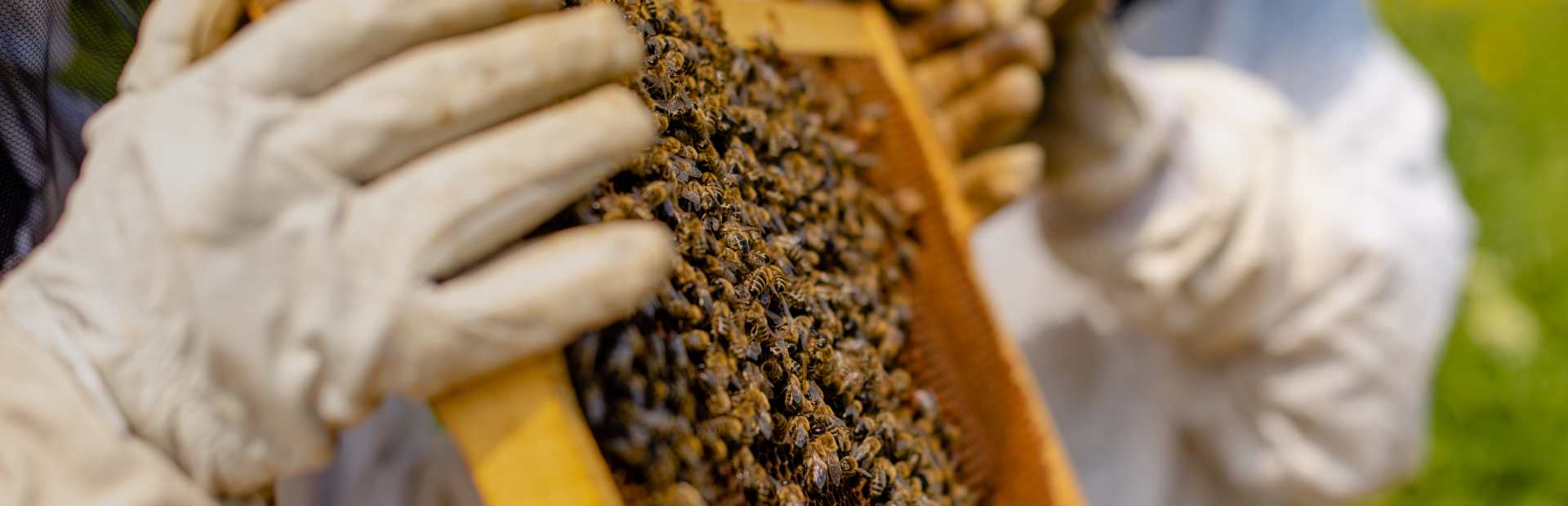
Introduction to Beekeeping and Apiary Management

Introduction to Beekeeping and Apiary Management

Overview

This micro-credential offers training in bee biology and hive management, including hive installation, transport, and swarm management. The program covers the extraction and quality of bee products, industry regulations, flora of interest, and the valorization of honey with a quality seal, as well as traceability and diversification of beekeeping production.

Goals

  • Provide qualification in beekeeping management, apiary location and hive orientation.
  • To train in the growth of the apiary through the multiplication of the swarm.
  • Knowledge of local flora of interest to beekeeping, the process of producing quality honey and the applicable regulations to develop a legal and safe activity.

Access requirements

To benefit from this subsidized training course, you must meet the following requirements:

  1. Be between 25 and 64 years of age at the start date of training.
  2. A university degree will not be required to access this micro-credential. However, students wishing to access it must meet the following access requirements: They must hold, at a minimum, a high school diploma or advanced vocational training qualification.

Academic program

Contents

Topic 1: Introduction to beekeeping. History of beekeeping and pollination.
Topic 2. The Bee and its Colony. Apicultural Anatomy and Biology.
Topic 3. The beehive. Location of the apiary. Legislation for Beekeeping Operations.
Topic 4. Beehive management techniques. Feeding, apiary multiplication.
Topic 5. Flora of interest to beekeeping. Transhumance. Transport and animal welfare.
Topic 6. Apicultural Health and Pathology. Hygiene and prophylaxis of hives. Field notebook.
Topic 7. Beehive Products. Honeys from Tenerife.

Methodology and activities

The training activities to be carried out during the delivery of the micro-credential will be:

  • AF1: Theoretical classes: expository, explanatory or demonstration sessions of the contents and knowledge.
  • AF2: Practical classes: sessions of practical application of the contents developed in the theoretical classes, through the resolution of exercises, problems or theoretical-practical scenarios.
  • AF10: Assessment: continuous assessment tests and final exams. Tests may be in person or virtual, and may be written, oral, or consist of practical exercises.
    Regarding the way to organize the teaching to achieve the objectives set out in the micro-credential, the organizational modality summarized below will be followed:
  • MD1. Lectures/expository method: presentation or explanation by the teaching staff.
  • MD2. Practical classes: activities supervised by the teaching staff in the field.

Evaluation criteria

Objective tests (true/false, multiple choice, test-type, fill-in-the-blank, ordering, etc.): These are measurement instruments that allow for the evaluation of knowledge, skills, performance, aptitudes, etc. The answers are closed-ended, thus promoting objectivity during the scoring process.

General information

Credits: 2 ECTS

Duration: 18/05/2026 – 29/05/2026

Teaching modality: In person

Location: Sección de Ingeniería Agrícola de la Universidad de La Laguna, Carretera de Geneto 2. CP 38200. Horario: 16:00 a 18:00 horas.

Registration fee: €57.60

Valued at: €192.00

Registration
More info and registration help

The cost of tuition for this Microcredential will be subsidized by the 'Plan for the development of university microcredentials', investment 6 of component 21 of the Addendum to the 'Recovery, Transformation and Resilience Plan', financed by the European Union – Next Generation EU, year 2025.

Flexibility

Short courses available in various formats (in-person, online, or hybrid). Ideal for learning without interrupting your professional life.

Employability

Content created and delivered by professionals and experts in the field, designed for immediate application.

Certification

Endorsed by the University of La Laguna. You will receive an official ECTS certificate, valid in the European Higher Education Area.

Teaching staff

María de los Ángeles Camacho Pérez

Doctor. Agricultural Engineer
Full Professor at the University (ULL)
Animal Production Area
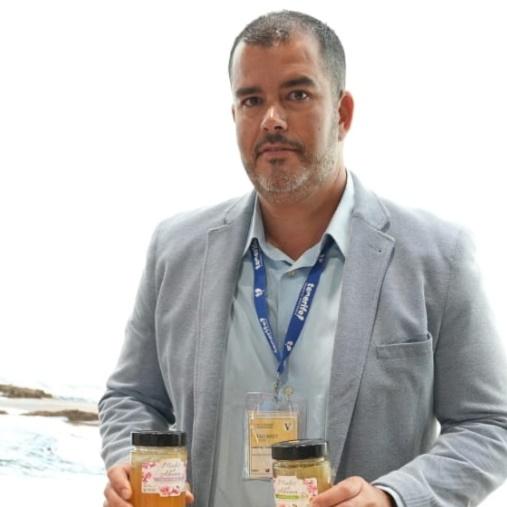
Adasat Valentin Peña Dorta

Agricultural Technical Engineer – Professional Beekeeper.
Beekeeping Entrepreneur, Mieles de Abona
Operator of the Protected Designation of Origin Honey of Tenerife

Share this microcredential

// Common variables (we improved the encoding for email) const pageUrl = window.location.href; const pageTitle = document.title; // Sharing functions (those for social networks with window.open remain the same, but we added return false to avoid page breaks) function shareFacebook() { window.open(`https://www.facebook.com/sharer/sharer.php?u=${encodeURIComponent(pageUrl)}`, '_blank', 'width=600,height=400'); } function shareLinkedIn() { window.open(`https://www.linkedin.com/sharing/share-offsite/?url=${encodeURIComponent(pageUrl)}`, '_blank', 'width=600,height=500'); } function shareTelegram() { window.open(`https://t.me/share/url?url=${encodeURIComponent(pageUrl)}&text=${encodeURIComponent(pageTitle)}`, '_blank', 'width=600,height=400'); } function shareWhatsApp() { window.open(`https://api.whatsapp.com/send?text=${encodeURIComponent(pageTitle + ' ' + pageUrl)}`, '_blank'); } // Email share function (copy to clipboard + Gmail fallback) function shareByEmail() { const pageUrl = window.location.href; const pageTitle = document.title.trim(); // Text ready to paste into email (with line breaks) const emailText = `${pageTitle}\n${pageUrl}\n\nI'm sharing this interesting article with you.`; // We try to copy to the clipboard if (navigator.clipboard && navigator.clipboard.writeText) { navigator.clipboard.writeText(emailText).then(() => { // Success message (you can use alert, toast, or a temporary div) alert('Link copied to clipboard!\nPaste it into your email (Ctrl+V).'); }).catch(err => { console.error('Error copying:', err); fallbackToGmail(); }); } else { // If clipboard is not supported (very old browsers) fallbackToGmail(); } } function fallbackToGmail() { const pageUrl = encodeURIComponent(window.location.href); const pageTitle = encodeURIComponent(document.title); const body = encodeURIComponent(document.title + '\n' + window.location.href + '\n\nI'll share this with you:'); // Open Gmail compose window.open(`https://mail.google.com/mail/?view=cm&fs=1&su=${pageTitle}&body=${body}`, '_blank', 'width=800,height=600'); }