
The rector of the University of La Laguna, Rosa Aguilar, was chosen by the Conference of Rectors of Spanish Universities (CRUE) to moderate one of the debates convened yesterday, Wednesday, January 18, by the Ministry of Social Rights and Agenda 2030 about the progress in a just ecological transition.

Minister Ione Belarra opened the event.
The session was opened by the Minister, Ione Belarra, who described the meeting as a "wake-up call against those who try to convince us that everything is predetermined," adding that the 2030 Agenda represents a break from that dystopia. The Minister stated that they have not used the country's difficult economic situation as an excuse not to implement the SDGs; on the contrary, the agenda has become a roadmap.
The presentation of the main findings of the 2022 Progress Report then took place, delivered by the Secretary of State for the 2030 Agenda, Lilith Verstrynge, who stated that this document analyzes the country's progress in addressing key social and economic challenges. She explained that the protection of citizens from the consequences of the crisis is reflected in the report through significant investment in social protection, even though rates of exclusion and poverty remain substantial.
Verstrynge indicated that the catalog of new social advances has led to increased equality, as have the policies on rights that address job insecurity and those related to family. Finally, the document discusses a sustainable transformation of the production model, further reducing the tax gap to protect the most vulnerable, and implementing policies that address generational issues and the challenges faced by young people.
The panel discussion moderated by Rosa Aguilar included Elena Pita, director of the Biodiversity Foundation, attached to the Ministry for Ecological Transition and the Demographic Challenge; Juan

Lilith Verstrynge, Secretary of State for the 2030 Agenda
Pedro Yllanes, Vice President and Minister of Energy Transition, Productive Sectors and Democratic Memory of the Government of the Balearic Islands; Concepción García, from the Confederal Secretariat of Ecologists in Action and Vanessa Millán, Councilor for Ecological Transition and CEO of Rivas Vaciamadrid.
The rector of the University of La Laguna opened the debate, which was attended by numerous councilors from regional governments as well as agents of civil society, indicating that it is not only about the necessary boost to renewable energies, decarbonization or the circular economy, "but that the ecological transition itself also implies a change of a more holistic production model, which affects competitiveness and also implies higher quality employment, through a technological transformation of production processes.".
Pita, from the Biodiversity Foundation, highlighted the package of energy measures implemented during this period, as well as others related to sustainable tourism and urban planning, including women's rights. "The challenge lies in integrating all these advances into the territorial model and ensuring a productive sector willing to contribute," she noted. A cultural shift is necessary, despite significant progress in waste management and the overall package.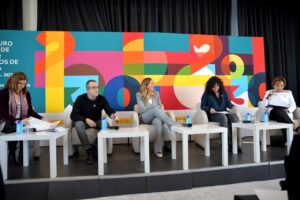 legislative and strategic, both nationally and internationally. “We have to address the causes of biodiversity loss, while also analyzing the new job opportunities associated with the ecological transition.”.
Juan Pedro Yllanes, from the Balearic government, focused on the need to achieve energy sovereignty in the region, which requires increased renewable energy production, which has already tripled, although it remains insufficient. “We demand the right of citizens to generate their own energy” through the creation of energy communities and self-consumption. Regarding the challenges, the largest source of greenhouse gas emissions is related to tourism, which in turn contributes 501% of the regional GDP. “The tourism sector must get involved in decarbonization and energy conservation,” he stated.
For her part, Vanessa Millán, from the Madrid municipality of Rivas Vaciamadrid, pointed out that the challenges facing her town involve all citizens, facilitating socialization between communities. Urban gardens, communal composters, recycling, agricultural and livestock entrepreneurship projects, as well as the installation of photovoltaic panels in all schools, were some of the elements highlighted by Millán. The challenge for the town council is to generate its own urban agenda, with decentralized, local services and to make a more livable city, he said.
Concepción García, from Ecologists in Action, pointed out that she misses greater ambition, despite such a complicated global context. “We are in an increasingly voracious capitalism that does not help to develop just ecological processes. It is a collapse of an economic and social system, for which a new organization of life is imperative,” she stated. The environmentalist affirmed that talking about a just ecological transition means talking about social inequality, poverty, and social exclusion, and therefore advocated for working on these issues in a more cross-cutting manner.

 Spanish
 English
 French