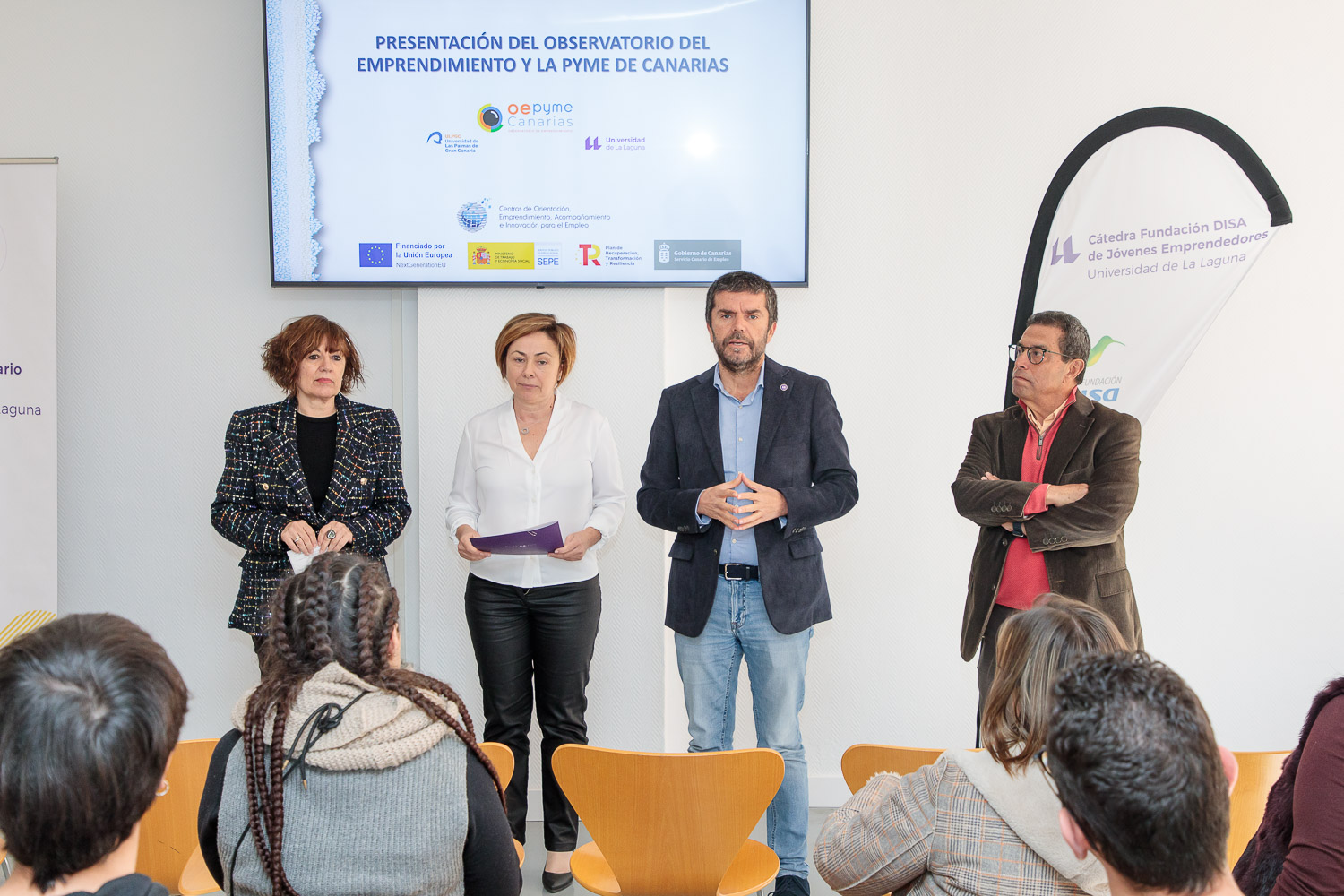
The seminar series of University Institute of Business The Institute of Economics, Business and Tourism (IUDE) of the University of La Laguna held a new session this week at the Faculty of Economics, Business and Tourism entitled “Entrepreneurship in the Canary Islands: some current results and challenges for the future”, during which the following was presented: Canary Islands Observatory for Entrepreneurship and SMEs (OEPYME).
This new information tool, offered by researchers from the two public universities of the Canary Islands, shows research results relevant to academics, educators, public managers, entrepreneurs, business organizations and other institutions interested in the entrepreneurial phenomenon and its evolution in the region.
This observatory involves six researchers from the University of La Laguna, four of them belonging to the IUDE, the organizer of the event (Esperanza Gil Soto, Inés Ruiz de la Rosa, Desiderio Gutiérrez Taño and Francisco Javier García Rodríguez), as well as researchers Alicia Correa Rodríguez and Ana L. González Pérez.
The event was inaugurated by the Rector of the University of La Laguna, Rosa Aguilar Chinea, along with Dunia Rodríguez Viera, Director of the Canary Islands Employment Service of the Government of the Canary Islands, a collaborating entity on the project; Francisco Javier García Rodríguez, Professor of Business Organization and Director of the IUDE (University Institute of Business and Economics); and Ángel Chinea, Vice Dean of the Faculty of Economics, Business and Tourism. All agreed on the importance of fostering innovation and entrepreneurship in the educational context, especially at the university level, as well as on the observatory's potential to contribute to this objective and improve the design and monitoring of public policies aimed at it.
The new observatory

Rosa Mª Batista
Rosa María Batista Canino, professor of Business Organization at the University of Las Palmas de Gran Canaria and director of the Observatory of Entrepreneurship and SMEs in the Canary Islands, was in charge of presenting this open access tool that allows you to sketch the situation of entrepreneurship in general in the Canary Islands and the main variables that influence its development.
Likewise, Inés Ruiz, tenured professor of Financial Economics and Accounting at the University of La Laguna, member of OEPYME and director of the DISA Foundation Chair for Young Entrepreneurss, shared some of the conclusions related to student entrepreneurship at the Tenerife academic institution, obtained as a result of the development of the project Global University Entrepreneurial Spirit Students'Survey (GUESSS), in which a total of 1,196 students from the University of La Laguna participated in its last edition of 2021.
Among the main findings, it is worth highlighting a considerable increase in the intention to pursue entrepreneurship as a career alternative from 2018 to 2021. This intention has also materialized in a significant increase in active entrepreneurship during the same period, an aspect that may be a consequence of the pandemic itself. Furthermore, it is observed that the majority of new projects (68 %) are individual ventures and that, as in the rest of Europe, it is necessary to promote female entrepreneurship.

Inés Ruiz.
Finally, only 3.51% of students at the University of La Laguna reported having engaged in any entrepreneurial activity while studying, a percentage lower than the Spanish average. This suggests that experiential entrepreneurship training programs, particularly focused on testing potential business models, may need to be implemented. Lastly, Ruiz presented some of the tools being developed by the chair he directs specifically to address these shortcomings identified in the studies.
Finally, José Francisco Gómez González, professor of Industrial Engineering at the University of La Laguna and coordinator of the European project Ideation, in which several researchers from the center also participate and which aims to promote the creation of startups at the University of La Laguna, presented his main lines of work and the planned schedule for said project.

 Spanish
 English
 French