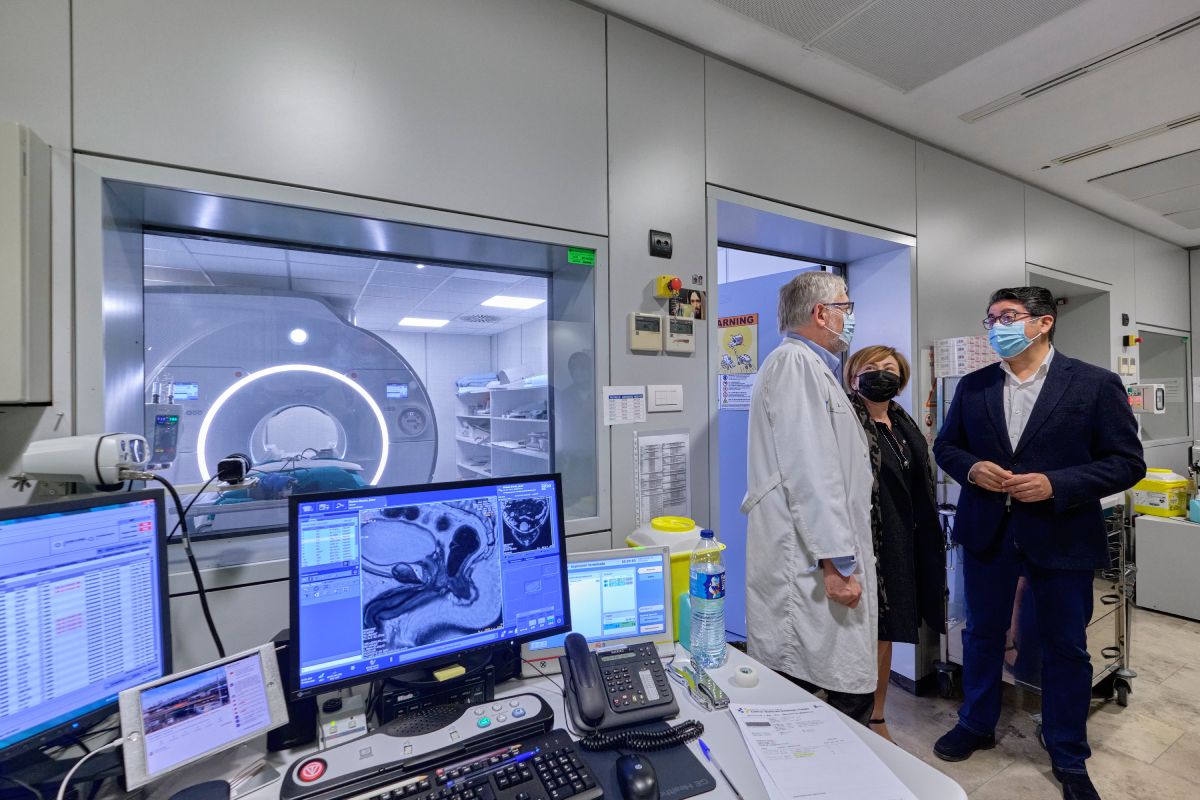
The president of the Island Council of Tenerife, Pedro Martín, and the rector of the University of La Laguna, Rosa Aguilar, presented yesterday, Thursday, February 9, the new magnetic resonance machine that has recently been incorporated into the Tenerife Medical Institute (Imetisa), and which is the most advanced model currently available.
Also participating in the presentation were the third vice president and councilor for Social Action, Marián Franquet; the director of the Tenerife Health Area, Ignacio López Puech; the manager of Imetisa, Néstor Sánchez; and the head of the scientific team, the professor of Physiology at the University of La Laguna, José Luis González Mora.
Martín assured that it is “the most modern and advanced machine in any public health center in Spain, with which we achieve a double objective: “to improve the health services we provide to the population and expand, at the same time, our research capacity in medical sciences,” since its use will be shared with the University of La Laguna so that, during the morning, it works with patients and in the afternoon it is used for scientific studies.
He added that in this Imetisa service, owned by the Cabildo, with the exception of one % scanner belonging to the Canary Islands Health Service, more than 10,500 MRI tests are performed annually, an average of 40 per day, which now, with the new equipment, are improving in image quality and speed.”.
The rector, for her part, emphasized the importance of collaborating with the Tenerife Island Council and the Canary Islands Health Service to participate with Imetisa in this project and to have such a vital infrastructure to continue developing the high-level research being conducted at the University. “Only by collaborating will we be able to solve the major challenges we face in the Canary Islands.”.
Aguilar also highlighted the participation of Professor José Luis González Mora, head of the scientific team at the University of La Laguna of Imetisa and the main driving force behind this project.
Franquet emphasized that “collaboration between the Canary Islands Health Service and the Tenerife Island Council is essential to make progress on all public health issues, as well as with the University of La Laguna, which is also key, and of course with the staff of Imetisa, who have put in the effort and enthusiasm to make this happen.”.
 New equipment
The Signa Premier XT machine, manufactured by GE Healthcare, not only allows for a significant acceleration in the speed at which studies are carried out, thanks to its fully digital equipment, but also enables the implementation of many tests that were not previously possible, according to Professor Mora, who added that, thanks to this new machine, it is possible to "work at the same level, both in research and in clinical practice, as the best hospital in the world.".
Its acquisition has involved a total investment of 1.4 million euros, of which 70% is contributed, through a grant awarded to the University of La Laguna, by the Ministry of Science and Technology, and the rest corresponds to Imetisa and the institution's own funds.
Currently, 16 research groups from the University of La Laguna are collaborating with Imetisa on its research projects. The main lines of work focus on the neuronal study of the various categories of autism, the use of sensory implants for robotic limbs for patients with amputations or physical disabilities, and the application of magnetic resonance imaging and artificial intelligence.
The scientific team at the University of La Laguna maintains collaborations with other research groups from national and international institutions such as Harvard University (USA), University of Cambridge (UK), King's College London (UK), University of Toronto Scarborough (Canada), University of Hull (UK), Fraunhofer Institute for Medical Image Computing MEVIS (Germany) and the Karolinska Institute (Sweden), among others.

 Spanish
 English
 French