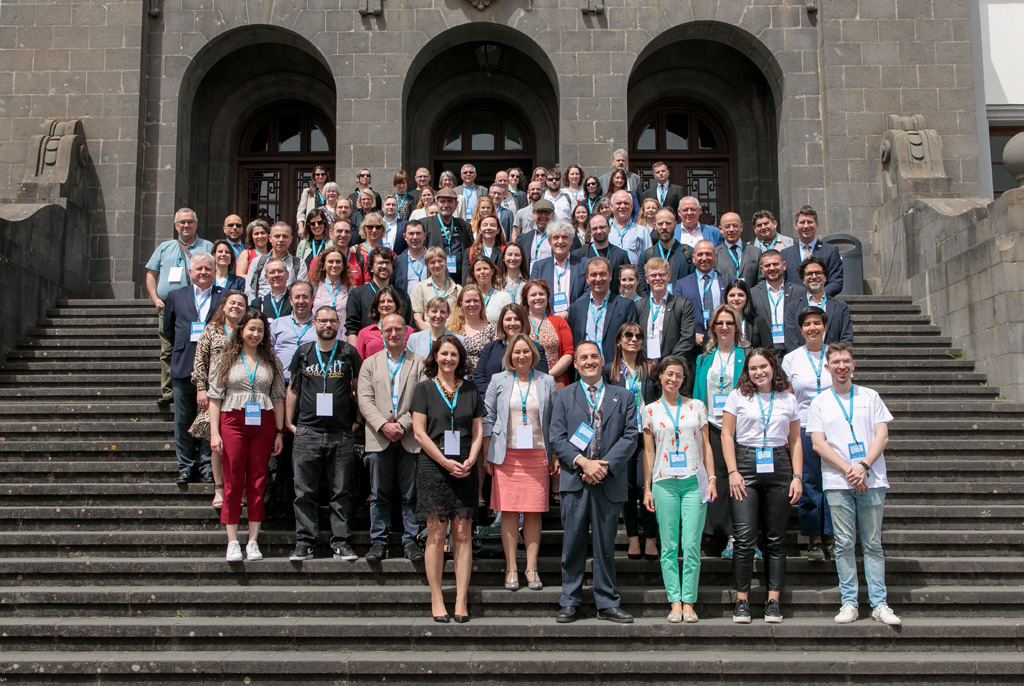
Rima Dijkstra, coordinator of the alliance STARS EU The University of La Laguna, a member of Hanze University, took the floor after the break to delve into the alliance's strengths and challenges. The speaker explained all the work carried out in 2022 to strengthen the network and the objectives this initiative faces, which aims to offer a new, student-centered future by focusing on innovation, flexibility, and the diversity of its members.
The nine universities that comprise it collectively have 77 faculties spread across Europe. Their strength lies in their location outside major capital cities, their strong focus on regional growth, and their complementary nature. This alliance must address challenges such as demographic change in an increasingly aging society, while also tackling new challenges like fostering entrepreneurship, digital skills, technological advancements, and sustainability.

Rima Dijkstra, coordinator of the European network.
The aim is to foster interregional connections between universities, seeking solutions to regional problems while also exercising European leadership, highlighted Rima Dijkstra, who explained some of the cooperation structures on which it is based. The areas of interest include digital transformation, creative arts, health, the circular economy, living spaces, the energy transition, entrepreneurship, and innovation and creativity. All these areas must be interconnected, noted the coordinator, who also explained how the working groups and the network's governance system function.
Dijkstra outlined her four-year plan, highlighting the possibility of continued networking through seminars, workshops, and conferences; further development of joint undergraduate and postgraduate degree programs; promotion of student exchanges between campuses; and continued curriculum development to create micro-credentials valid at different universities, in addition to internships and interregional cooperation. The coordinator emphasized the importance of maintaining the sustainable collaborative network model among universities. Bremen, Czech Republic, and Bezançon will host the next meetings of this network between now and March 2024.
Arqus Alliance
The STARS EU meeting at the University of La Laguna continued with the participation of the Vice-Rector for Internationalization of the University of Granada, Dorothy Kelly, who presented via videoconference the experience of another alliance called Arch, which recently received funding from the European Universities call. She was a strong advocate for networking among higher education institutions to foster a more flexible curriculum, achieve a more interdisciplinary approach to university studies, and conduct more internationalized research in Europe.
The speaker went into detail about the European call for proposals to create these international working networks, endowed with 1.1 billion euros for the period 2021-27. This is an initiative

Dorothy Kelly, Vice-Rector for Internationalization at the University of Granada, during her videoconference address.
The speaker noted that the aim is to strengthen the European dimension of universities and their research, while also consolidating the role of universities as a beacon of the European lifestyle, empowering them as key players in regional growth.
Regarding Arqus, he pointed out that it is a network of 9 universities expanded to 28 centers, bringing together 340,000 students and 19,000 professors, of which Granada is the only Spanish one, with international experience and a strong regional presence in medium-sized cities.
The alliance aims to establish common policies among participating universities on matters such as equality, inclusion, recognition of academic qualifications, and research impact, among others. It also seeks to share resources among partners, implement a multilateral mobility policy, establish a training program for management positions, and offer research stays for both junior PhDs and more established research networks.
However, the vice-rector also explained that the network faces several challenges, including varying legal regulations for universities, diverse internal structures, cultural and linguistic diversity, different regional contexts, critical externalities such as the Covid-19 pandemic and inflation, and critical internal risks such as changes in university governance and the diversity of university strategies. The day concluded with a musical performance of Canarian music by Entrecuerdas.

 Spanish
 English
 French