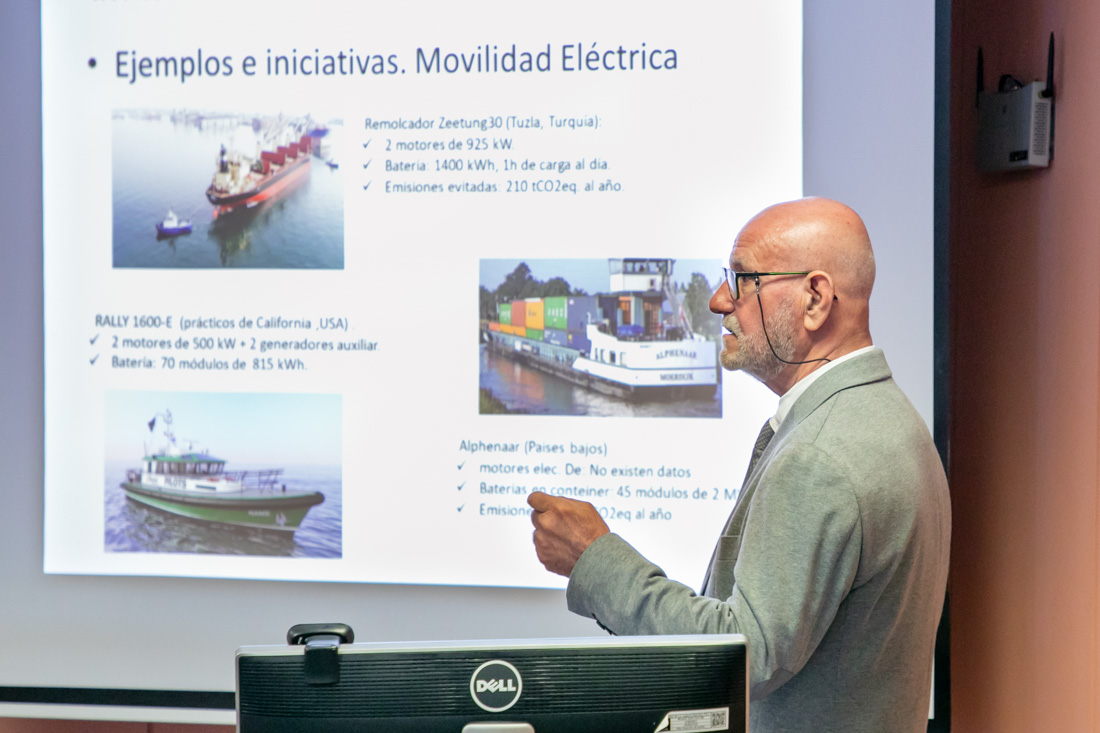
Universities promote lifelong learning so that graduates can update their knowledge through postgraduate studies. This practice usually focuses on master's degrees and university-specific qualifications, although some also choose doctoral programs. What is unusual is for this training to take place after retirement age, as was the case with Argelio Mauro González Morales, who, at 71 years old, presented his doctoral thesis at the University of La Laguna last Friday, May 26th. His work is of paramount importance and focuses on the implementation of renewable energy systems in Canary Island ports and on certain types of vessels.
The thesis, entitled “Electric mobility of inland traffic in the Canary Islands ports. An analysis”, He received a Summa Cum Laude distinction from the panel chaired by Professor Juan Albino Méndez Pérez of the University of La Laguna, and including members Jesús García Rubiano of the University of Las Palmas de Gran Canaria and Catalina Rus Casas of the University of Jaén. The defense took place in the Physics and Mathematics building's graduation hall, which was unusually full of González Morales's family and friends, as well as his thesis co-directors, Manuel Rodríguez Valido and María de la Peña Fabiani Bendicho, both from the Department of Industrial Engineering.
If completing a doctoral thesis is already a daunting task, in this case the circumstances have been even more complex: in addition to the work stoppage caused by the Covid-19 pandemic, Argelio González himself had to undergo surgery, which further delayed his research. However, he has finally been able to complete a project born from his professional interests, since he, a graduate in Naval Radioelectronics, spent more than ten years working at the Port Authority of Santa Cruz de Tenerife and, subsequently, teaching engineering-related subjects at the secondary level.
As I explained after learning his grade, when he retired, he soon discovered that he was bored with the activities retirees are supposed to do and missed an intellectual challenge. As fate would have it, he had been a teammate of Professor Rodríguez Valido, who would eventually become one of his thesis co-directors and who encouraged him to take this academic step so that he could continue developing the engineering-related activities that still interested him so much.
Thesis content
In his thesis, González Morales conducted a comprehensive study of the possibilities for using renewable energy and eliminating polluting fuels in local maritime transport. In his preliminary state-of-the-art study (the starting point of any thesis), he identified the use of drop-in fuels (green biofuels), biomethane or methanol, hydrogen, and fully electric motors as the most promising avenues to date for generating clean energy.
His work focused on studying the pilot boats operating in Santa Cruz de Tenerife, collecting data for two years on their routes, trip durations, berthing periods, and energy consumption, among other parameters. By cross-referencing this data with information from official sources on alternative energy generation, he was able to calculate that this type of port traffic could very well be carried out using vessels equipped with electric motors and batteries. While the range of these journeys would be reduced, with proper organization, some vessels could sail while others use berthing time to recharge their batteries without affecting the overall service.
Obviously, the generation of that electrical energy would have to be produced using alternative sources to be sustainable, so the doctoral thesis details, in the cases of wind and solar photovoltaic energy, what type of devices, in what quantity and arranged in what way would be necessary to supply that consumption.
Following these calculations, Dr. González Morales concludes that the use of renewable energy at the Port of Santa Cruz de Tenerife could generate an estimated 185 gigawatt-hours of energy annually, significantly more than the 3.3 gigawatt-hours consumed in 2020. The surplus energy could be sold to meet the port's industrial needs, fed into the electrical grid, or stored, as is done in other European ports. This would prevent the annual emission of approximately 43,000 tons of CO2.2 equivalent to the atmosphere.

 Spanish
 English
 French