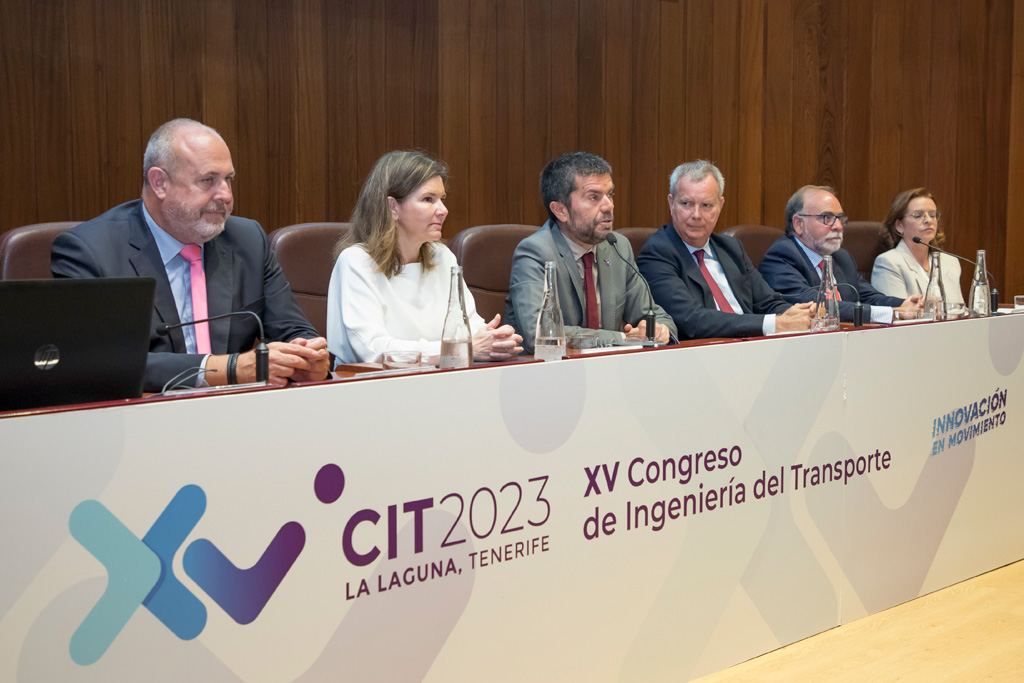
The Aula Magna of the Faculty of Economics, Business and Tourism is hosting, from today, June 14th, the fifteenth edition of the Transportation Engineering Congress, A national forum has been organized, bringing together more than 250 experts from various countries who will present nearly 200 research papers. At the opening ceremony, presided over by the Rector of the University of La Laguna, Francisco García, the multidisciplinary nature of the sector and its capacity for innovation and close connection with industry were highlighted, as well as its value as an essential element of social cohesion for facilitating access to other public resources.
This scientific meeting was opened by the president of the organizing committee, Professor Rosa Marina González, who expressed her gratitude for the participation of the extensive list of public institutions and private companies that support this event. Andrés Monzón, president of the Transportation Engineering Forum, thanked the University of La Laguna for hosting this meeting, the first in-person event organized since the pandemic. He noted that creating research networks around transportation, an eminently multidisciplinary field, is the objective of this forum, and he expects a high level of collaboration with the productive sector.
Enrique Arriaga, a councilor for the Tenerife Island Council, pointed out that the Canary Islands, and Tenerife in particular, is a great laboratory for addressing this issue. “Behind the mobility problems lies a great deal of unseen and unknown research. These are solutions that are difficult to implement, take time, and make use of innovations such as big data. We are changing, and forums like these help to create and strengthen professional and research networks.”.
Sebastián Franquis, Minister of Public Works, Transport, and Mobility for the Canary Islands Government, pointed out that innovation is essential for improving transportation. He noted that the regional government has promoted sustainable urban mobility plans, while also mentioning the efforts of public administrations to decarbonize primarily land-based transport, in addition to measures implemented to strengthen public transport and the digitalization of the sector.
 The social value of transport
María José Rallo, Secretary General of the Ministry of Transport, Mobility and Urban Agenda, recognized the importance of transport engineering as a highly cross-cutting, multidisciplinary, and growing field, highlighting its synergies with other areas "and its real contribution to the challenges of the future." The ministry representative emphasized the social component of transport, which includes accessibility and affordability. "We are in a time of great global uncertainty, but also of great opportunity, and that is why innovation is a key element," she noted.
The ministry, Rallo explained, has moved beyond the name "Public Works," whose sole objective seemed to be the construction of public works, and now addresses other elements to align with social policies. "Mobility is a right of citizens, enabling them to exercise other rights such as healthcare, education, and leisure," he said. European funds have allowed for an investment of 13 billion euros, managed by public administrations, to accelerate the necessary transformation in this area, he noted.
Rallo also commented that, given the imminent election, there wasn't enough time to approve the Sustainable Mobility Law, a national objective that must be addressed regardless of which government wins. “It is the definitive impetus for the digitalization of all mobility networks, as well as for fostering innovation through a controlled testing environment to try out new solutions that create public value.” The Secretary General also added that accountability for public policies, using data, is fundamental, and this congress is very much aligned with that objective. Along those lines, she maintained that it is crucial to create shared agendas with the academic community.
 The rector of the host institution, Francisco García, closed the opening ceremony by highlighting that the Canary Islands is an outermost region, with the associated challenges of resource procurement and limited access to international logistics systems. “Our main industry is tourism, which is clearly dependent on transportation. And yet, this region has two million inhabitants with a private vehicle fleet of almost the same size,” which he considers unsustainable.
He emphasized the importance of social cohesion, and public transportation plays a key role in this. “Our university is also on the move (in line with the congress's theme), with a very active chair and a Regional Development Institute boasting a high level of scientific output.” He noted that the University of La Laguna is working on a Sustainable Mobility Plan, sponsored by the chair, which has already completed the survey phase. “We want to revive this plan, be part of the solution, contributing information and leading by example.”.

 Spanish
 English
 French