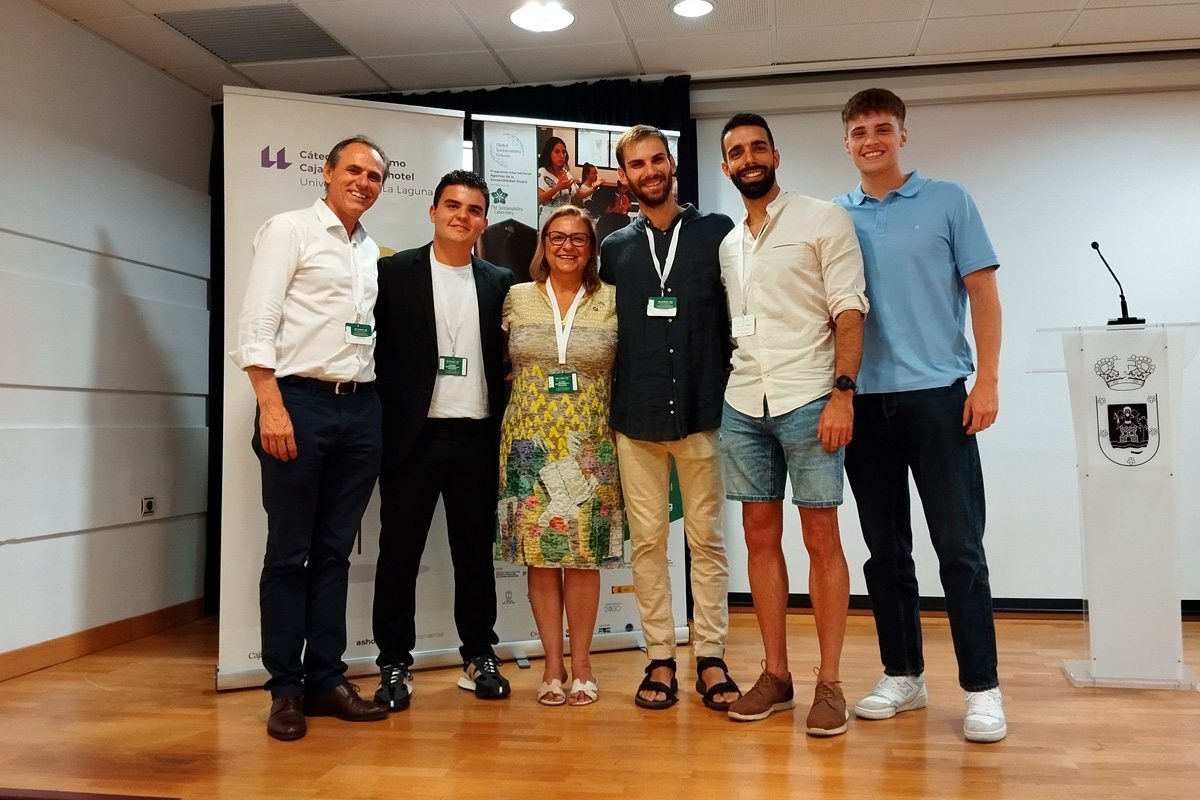
The Global Sustainability Agents program (Global Sustainability Fellows – GSFThe conference in La Palma was closed last Friday at the Benahorita Archaeological Museum in Los Llanos de Aridane; with the presentation of the results of the work carried out on the Island, which give life to the master document proposed by the future leaders in sustainability for the development of La Palma.
The closing ceremony was attended by Michael Ben-Eli, founder of the Global Sustainability Fellows and the New York Sustainability Lab; Vanessa Armendáriz, director of the GSF Program; María Inmaculada González Pérez, Vice-Rector for Internationalization and Cooperation at the University of La Laguna; Carmelo León; Sergio Moreno Gil, Director of the University Institute of Tourism and Sustainable Economic Development at the University of Las Palmas de Gran Canaria (ULPGC); Raquel Rebollo, Tourism Councilor for the Island Council of La Palma; and Verónica González Acosta, Councilor for Local Development for the Los Llanos de Aridane City Council. The event was also attended by the professor and director of the UNESCO Chair in Tourism and Sustainable Economic Development at the University of Las Palmas de Gran Canaria.
The closing of the Global Sustainability Fellows – GSF La Palma has been divided into two parts, the first for the presentation of the vision and the main conclusions reached during the three weeks of work in La Palma and a second for the institutional closing.
During the presentation of the results, which was also attended by professionals from different sectors of La Palma, the agents participating in the program presented their visions, challenges and main lines to bring the island closer to the new paradigm of sustainable development that is sought, based on fieldwork that has focused on interaction with the social, economic, environmental and cultural reality of La Palma, through contact with relevant actors of the island and the region.
María Inmaculada González Pérez, Vice-Rector for Internationalization and Cooperation at the University of La Laguna, has highlighted the “enthusiasm” surrounding the celebration of this program and the participation of the two public universities of the Canary Islands, emphasizing its importance due to “the courage to face humanity’s greatest challenge, to address global problems in an interdisciplinary manner, to communicate between different dimensions, and to articulate theory and practice.”.

María Inmaculada González, Vice-Rector for Internationalization and Cooperation at ULL.
Paula Clemente, representing the young global sustainability agents, outlined an overview of the project carried out in La Palma. She highlighted the diverse and multifaceted nature of the work program, the sustainability approach followed, and the methodological tools used. She also expressed the value of the results obtained, given that it is an approach framed within a training process and subject to time constraints. In her opinion, it will form a document of reflections on managing the sustainability process on the island, and, moreover, through the participating sustainability agents and the Laboratory, it provides a set of “useful tools for working in other countries.”.
Clemente explained how the three-week work camp in La Palma unfolded. The group began by learning and understanding “more theoretical concepts and the methodology, to grasp how the Global Sustainability Fellows program works,” before delving into local experiences and knowledge. They focused on five key dimensions: spiritual, social, life, material, and economic, integrating all these elements to offer the holistic vision the program seeks and which the Laboratory advocates as an approach to addressing global sustainability. “It is essential that all the elements are connected—because everything is interconnected—if we want to face the sustainability challenges the island is experiencing,” Clemente emphasized.
In this approach to the environment and through contact with local actors to understand the idiosyncrasies of the Island, according to Clemente, the following general and common elements in the reality of La Palma could be detected: “the need for economic diversification; the demographic challenge: migration of young people and aging population, the challenge of territorial cohesion and access to affordable housing.
These observations were addressed through a systematic analysis of each of the dimensions considered, which resulted in several strategic lines that were subsequently presented. The island was envisioned as becoming “a laboratory for a healthy island ecosystem, with high well-being and quality of life,” all combined with best practices for social and economic development.
In his speech, Michael Ben-Eli, precursor of the Global Sustainability Fellows and founder of the Sustainability Lab, emphasized La Palma's potential to "go beyond traditional services, towards true sustainable development, establishing the concept of sustainability as the guiding principle of the island's organization.".
Ben-Eli proposes that “the community of La Palma, its citizens, businesses, and authorities can collaborate to create the La Palma Pact, committed to a shared vision and an agreed-upon direction for the island's future development.” With this, “La Palma could find its destiny and open up a different path of development and new socioeconomic opportunities.” For Ben-Eli, “La Palma could be a unique model for showcasing initiatives relevant to the sustainability of island ecosystems anywhere in the world, positioning itself at the forefront of sustainability agendas.”.
Vanessa Armendáriz, director of the GSF Program, pointed out that “we are called to restore order, given all the disorder we generate with our current lifestyle, and we are grateful to all the people of La Palma, with whom we found this shared vision. We deeply believe that La Palma, with its current conditions and the crossroads at which it finds itself, can be a great laboratory to inspire and learn sustainable living practices applicable to any other system.” What has happened in La Palma, Armendáriz notes, “is no different from what we will face in other places due to climate change.” Therefore, ”the people of La Palma, from their experience, can help us understand what it means to be part of this web of life and develop high-level technology that helps us become more aware and begin to organize new scenarios for life.” She also expressed her interest in establishing a long-term collaborative process with the island.
The Director of the University Institute of Tourism and Sustainable Economic Development at the University of Las Palmas de Gran Canaria, Sergio Moreno, stated that “more than a closing, this is an opening” because “a transformative event like this is an important step forward, one that demands continuity.” Moreno also took the opportunity to emphasize the significance of developing a program like this in La Palma, the participation of the Canary Islands universities, and the provision of solutions to challenges that are suddenly emerging.
The Tourism Councillor, Raquel Rebollo, expressed her gratitude and pride that a program like this was held on the Island of La Palma and pointed out that this is "the beginning of a new path that all the people of La Palma and the administrations must take towards a future for the Island of La Palma.".
The program has involved the presence on the island of 20 sustainability agents, a team of 12 professors who have integrated the faculty and the intervention of 60 specialists, experts in their fields, public and private agents and people affected by the recent volcanic eruption, and has been developing since July 9.
The program, promoted by the New York Sustainability Lab, was co-organized by the University of La Laguna, through the Ashotel-CajaCanarias Chair of Tourism, and by the University of Las Palmas de Gran Canaria, through the Institute of Tourism and Sustainable Economic Development. It received support from the La Palma Island Council, through its Departments of Tourism and Environment; the La Palma World Biosphere Reserve Foundation; the Presidency of the Government of the Canary Islands; the Departments of Agriculture, Livestock and Fisheries and of Ecological Transition of the Government of the Canary Islands; the Santa Cruz de Tenerife Chamber of Commerce; the Association for Rural Development of the Island of La Palma; the Isla Bonita Rural Tourism Association; and the Canary Islands Institute of Astrophysics.
Note provided.

 Spanish
 English
 French