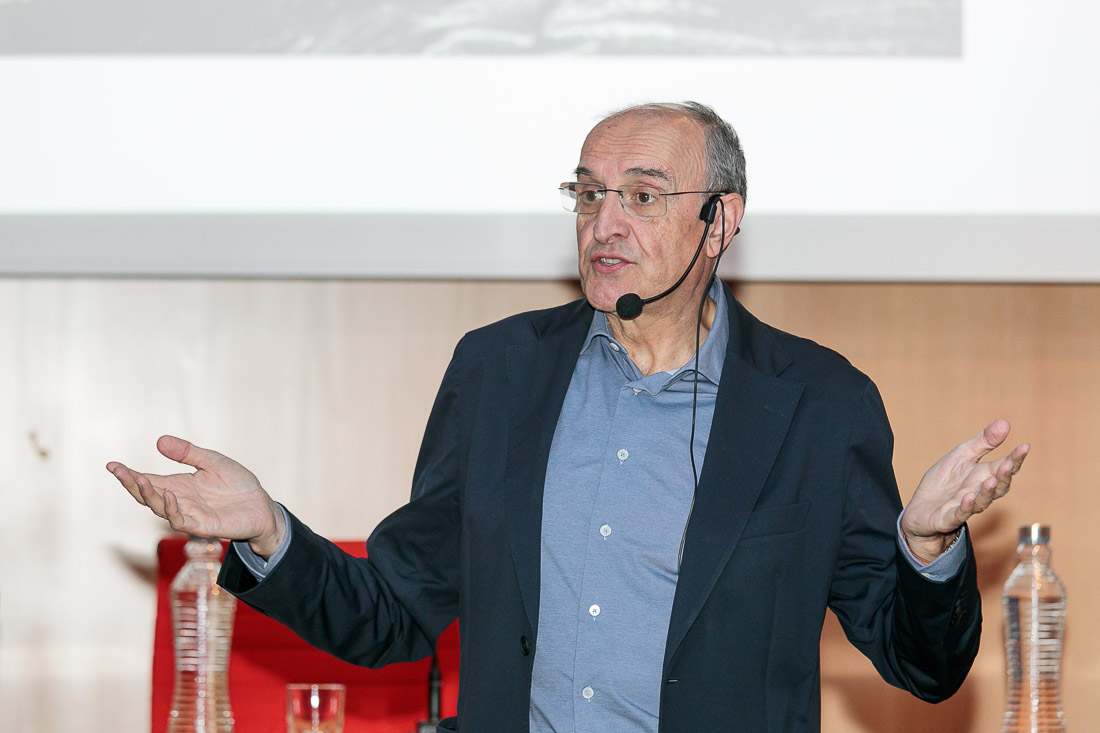
Xavier Marcet, a consultant in Strategy, Innovation and Corporate Entrepreneurship, was the guest speaker at the renewal ceremony of the Cajasiete Chair of Big Data, Open Data and Blockchain at the University of La Laguna, The event, held today, Tuesday, September 12th, in the Blas Cabrera Auditorium of the Faculty of Sciences, revealed that, in the expert's opinion, "innovation has been exaggerated and trivialized as if it were something easy," when in fact it is very complex because its aim is for companies to differentiate themselves, requiring total commitment from the entire organization and empathetic leadership, "because influencing is more important than commanding.".
Before this intervention, the event was inaugurated by the rector of the University of La Laguna, Francisco García; the president of Cajasiete, Fernando Berge; and the academic director of the chair, the professor of the Department of Computer and Systems Engineering, José Luis Roda.
The rector praised the productivity of the endowed chair, “not only for the quantity but also for the quality” of the training, outreach, and research activities carried out last year, as well as those included in the work plan for the new period now beginning. “The endowed chairs and corporate chairs are a breath of fresh air for the university. Since we launched the program in 2015, it has continued to grow; there are now more than twenty, which is an indicator of how beneficial they are to the institution.” He also thanked Cajasiete for its commitment, which makes it a “strategic partner” for the academic center.
The director of the financial institution emphasized the importance of renewing its support for this chair because it has direct applications, largely thanks to the significant participation of leading companies and professionals in the Canary Islands. Therefore, he advocated for its continuation to help boost the competitiveness of Canarian businesses and, by extension, improve society.

Fernando Berge, Francisco García and José Luis Roda at the opening.
Following the opening ceremony, the academic director, José Luis Roda, and the chair's deputy director, Carlos Alberto González, director of Strategy, Data and Sustainability at Cajasiete, presented the report on activities from the previous academic year and the work plan for the current academic year, which includes two major projects: the second edition of the BOB Canarias Map, a large-scale survey that provides detailed information on the level of digitalization of companies and institutions in the Canary Islands, in whose first edition more than 300 organizations participated; and the launch of the Master's Degree in Continuing Education in Digital Business Management, whose director, Judit Mendoza, was in charge of presenting it.
Innovation and risk
Xavier Marcet's presentation highlighted the importance of innovation in organizations, as it is the element that will allow them to differentiate themselves and position themselves better with their clients. It is a complex activity because it consists of "bringing the future to the present agenda," something very difficult to fit into the daily routine of a management team that is usually overwhelmed with meetings. Furthermore, innovation requires taking risks, although the speaker clarified that these risks must be taken in a calculated and reasoned manner. Even so, in his opinion, "what is not intelligent is not taking risks." He also pointed out that it is an activity that requires passion.
Marcet reviewed how business management has evolved since the beginning of the last century with figures like Henry Ford. The first stage focused on efficiency and productivity, and the second, in the 1960s, shifted the focus to strategic planning, at a time when demand exceeded supply. However, when supply and demand balanced, the third period emerged, marked by marketing, as the challenge was to serve a clientele with numerous options in the market. Finally, influenced by Japanese industry, the current phase is one of quality management.
Ability to learn
 In Marcet's opinion, we are about to enter a new phase of business management, characterized by people's ability to learn. In a context where artificial intelligence capable of autonomous learning is on the horizon, humans must keep pace to maintain control. "When people think, technology empowers; if they don't think, technology mimics, leading to the same place.".
At that point, he argued that innovating and learning are fundamentally human activities, and then he recalled several necessary conditions for being able to innovate, many of them related to learning: you have to think more than mimic, to discern what the market needs; observe more than ask, especially the circumstances of the customers; and realize new opportunities, which requires "persevering more than dazzling".
In his opinion, innovation lies more in perspective than in technology: there are astonishing technological advances, but you have to know how they will benefit customers. “You can be ten steps ahead of the future, you’ll be considered a pioneer, but you won’t be useful to your customers.” Therefore, he reflected that innovation lies not so much in anticipating the future, but in being attentive to the “middle step,” that is, the space between the present and that disruptive idea. As an example, he recalled that at the beginning of the century he advised a large company to sell clothing online. History has shown that it was a forward-thinking idea, but it failed because at that time the public was still afraid to pay by credit card online: the idea, therefore, had not been able to overcome the challenges of that “middle step.”.

 Spanish
 English
 French