The Earth, with its countless mysteries buried in the layers of its history, has long been a treasure trove for passionate fossil hunters and tireless seekers of answers about life that existed long before our own existence.
This journey includes a mandatory stop in the Canary Islands, a place where dinosaurs never roamed, but where contemporary remains of these majestic animals have been found. Paleontology, as the discipline that defies the passage of time and explores prehistoric life, has found fertile ground in this land.
A passion that goes far beyond simply collecting fossils. Paleontology studies our most distant past to understand what life was like on Earth and even, perhaps, predict what it will be like in the future. The fossils of the Canary Islands, silent witnesses to an ancient past, reveal secrets buried beneath their volcanic soil. They are more than mere geological curiosities. They are fundamental pieces in the puzzle of the evolution of life on these volcanic islands. Scientists have been working tirelessly to unravel the mysteries surrounding these prehistoric creatures and the environments in which they lived.
Far from the cinematic spectacle of dinosaurs, the fossils on these islands are much more modest, but only in terms of size. From a scientific point of view, they are equally important. That's why our two protagonists are working tirelessly to unearth and study these windows to the past, aiming to piece together the prehistoric puzzle of the Canary Islands—the world that existed long before humans arrived in the archipelago, even before the islands were formed as we know them today.
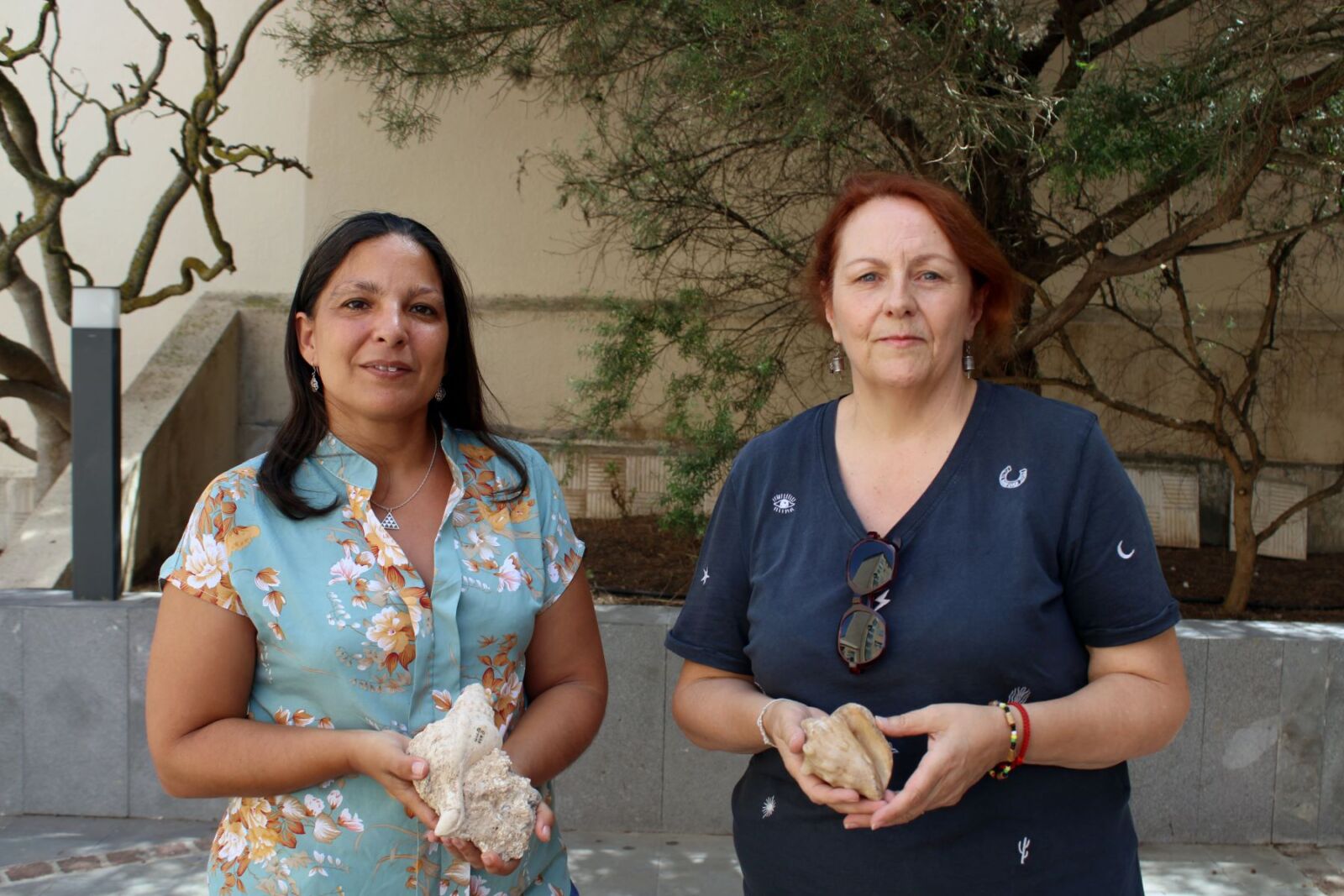
At first glance they look like stones, but what are so many stones doing in a Zoology department? If we look more closely, we find the answer. Embedded in these rocks are animals. Creatures that inhabited our territory millions of years ago and that now are only, for example, an impression of their shell on a stone. There are also fossils of plants, lizards, rats, and even fossilized eggs. Amidst all these witnesses to history are... Carolina Castillo Ruiz, tenured professor in the Paleontology department at the University of La Laguna, and Penelope Cruzado Caballero, assistant professor with a doctorate in the same area. Thanks to her work, the fossil wealth of the islands and their unique characteristics are becoming increasingly well known.
 The fossil record of the Canary Islands
The Canary Islands' fossil record is incredibly diverse, dating back to the Mesozoic Era, the time when dinosaurs roamed the Earth. "We have marine fossils dating back more than 145 million years, such as ammonoids, ammonites, faraminifera, algae, and more. They are so important that they have been used to date the age of the land. We're talking about the seabed of the Proto-Atlantic, that is, what was once Africa and South America when they were joined together.".
How can we find marine fossils on the surface of islands? The answer lies in the passage of time and the movements of the Earth's crust. What are now ravines, mountains, and valleys were once part of the seabed millions of years ago. Over millennia, these areas have emerged, and now we can walk on materials that once lay hundreds of meters below the surface.
Fuerteventura is a prime example of emerged territories, as almost the entire island was once submerged beneath the seabed. This is why we can now find fossils of animals that lived in those waters. “23 million years ago, Fuerteventura already existed and began to be colonized by the animals and plants that we now find as fossils, and which were very different from what we see today, which is now uncertain.”.
To study paleontology, one must not be afraid of timescales; talking about millions of years is commonplace. The span of time a person lives is so insignificant that it doesn't even enter their frame of reference. A century is such a fleeting moment that it's unmanageable; they only work with thousands and millions of years. Therefore, the idea that all the biodiversity surrounding us now is recent seems surprising to us, but not to a paleontologist.
Endemic fossils
We all know about the great biodiversity of the Canary Islands. This is a privileged enclave of nature. In such a small territory, there are more endemic animal and plant species than in the entire Iberian Peninsula. Species need a certain amount of time, and not a short time, to differentiate themselves genetically from their counterparts in other territories. Did the Canary Islands already have unique species millions of years ago? The fossil record suggests that they did.
“The most common endemic fossils we find are terrestrial. We have endemic lizard species, both relatives of currently living species and of two extinct species: the giant lizard of El Hierro and the giant lizard of Tenerife, originally described only for Tenerife, and the giant lizard of La Palma. In addition, among the mammals, there are two giant rats, one from Tenerife and the other from Gran Canaria. We also have extinct birds and many terrestrial invertebrates,” the researchers explain.
From structures built by beetles to giant lizards, it seems these islands quickly teemed with life. Not only was the land inhabited by unique animals, but the surrounding waters also contained endemic gastropod species that have survived to this day as fossils.
Murids, which include rats and mice, also have their representatives in this world of the islands' past. A well-known example is the Giant Rat of Tenerife, discovered by the famous geologist Telesforo Bravo. This rat, dating from the Pliocene and Pleistocene epochs, was the size of a rabbit and gives us an idea of the evolutionary gigantism exhibited by some species found in the Canary Islands.
But there are other mice that didn't arrive alone. Dating the remains of some animals can help us pinpoint when humans arrived on our shores. This is because there are animals that are our traveling companions, whether we like it or not. One of those that's where we are is the house mouse.
“If you find the Mus musculus The common mouse, for example, implies that it must have arrived with humans, which means that this commensal can help date the arrival of humans, not necessarily to live here, perhaps just passing through, but it's giving us the message that humans were here. But we can also study how these new exotic species affect the island ecosystems; we see that impact.”.
Fossils can help us understand how animals and plants interacted in each era and how new species settled into each niche. But they can also...

3D printing of lizard remains scanned in one of the projects. Photo by Emeterio Suárez.
Remains can tell us about the predator/prey relationship. “We have seen birds with small wings that, over the years, reduce the diameter of their wings. This indicates that they felt safe, they did not feel threatened by the presence of other predators, and they did not need to use such an energetically costly instrument as the wing. They went from flying to walking because it was no longer necessary to flee from predators.”.
The type of organisms found tells us a lot about their natural environment. For example, a place with many gastropods indicates that it once had a rich ecosystem with abundant flora and fauna, and fertile soil, since these organisms help improve nutrient levels. "These paleosols can tell us about climate change and the temperatures of a place millions of years ago.".
The deposits are in danger
As with their archaeological cousins, the paleontological sites of the islands are in danger. Tourism, construction, and, let's face it, neglect and ignorance, mean that these fossil-rich sites are abandoned, at best, or buried under a building, at worst. Some are well-preserved, like the Llano cave in Fuerteventura, while others on the same island have already disappeared. There is also a legal problem, as there is no specific legislation to protect paleontological sites.
Paleontological heritage had always been considered part of historical heritage. In 2000, the law transformed it into cultural heritage, closely associated with archaeological heritage. It was agreed that it would be included under natural heritage, meaning that if we want to protect a site, we can only do so through the designation of Natural Monument, "but the problem is that there are very important sites that are very small in area.".
An alternative could involve “Paleoparks,” a concept that began in the Azores with very positive results. On Santa Maria Island, there is a paleopark that is a major tourist attraction. “Having a paleopark means having a designation exclusively for paleontology. We proposed this system, and the new Canary Islands biodiversity law included this possibility, but since that law has not yet been approved, we don't know what will happen. We want to guarantee the development of the three main aspects of paleontological heritage: the scientific, the sociocultural, and the socioeconomic,” Castillo and Cruzado added.
In the world of paleontology, each fossil is a link in the chain that connects us to our planet's past. As scientists unearth and study these fossil treasures, the picture of Earth's history of life becomes clearer and more fascinating. As we move into the 21st century, technology continues to play a vital role in paleontological research. New dating methods, chemical analyses, and the growing capacity for 3D modeling are revealing astonishing details about prehistoric creatures and their environments. For example, the Paleontology Department at the University of La Laguna pioneered the application of 3D printing of Canary Island fossils in research and outreach.
Looking to the future, it is clear that paleontology will continue to play a vital role in our understanding of the natural world. Fossils will continue to inspire scientists, students, and natural history enthusiasts, challenging our assumptions and revealing stories we have yet to imagine. Ultimately, these remnants of the past remain a source of wonder and humility, reminding us of the vastness of geological time and the marvelous diversity of life that has populated our planet. The search for fossils will never cease, as each discovery brings us a little closer to unlocking the mysteries of the past and understanding our place in the world.
Scientific Culture and Innovation Unit (Cienci@ULL)

 Spanish
 English
 French