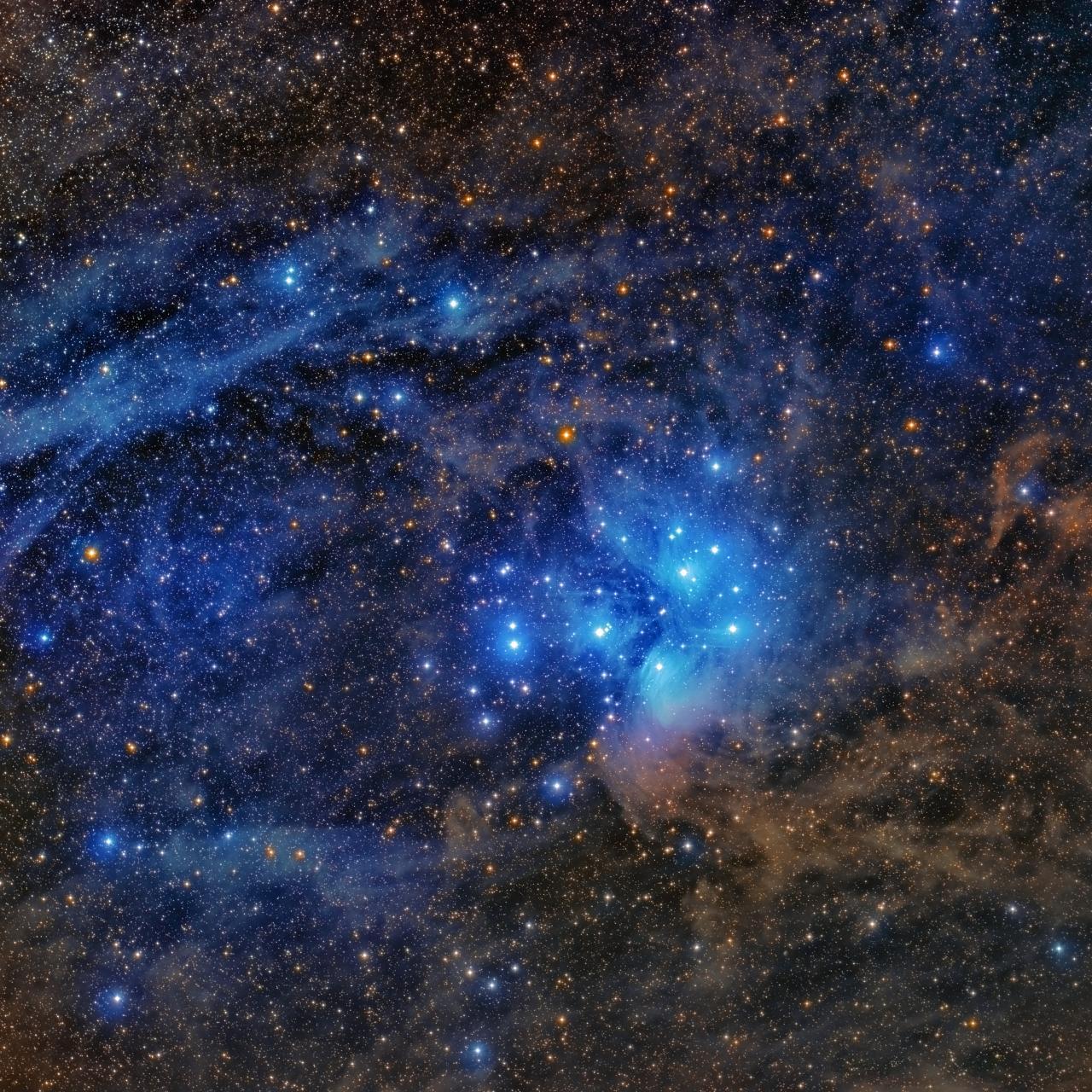
After comparing a sample of nearly 50 open star clusters of varying ages in the Milky Way, research led by the Canary Islands Institute of Astrophysics (IAC) and the University of La Laguna, in collaboration with the Polytechnic University of Cartagena, reveals that as these star clusters age, they lose a significant portion of their less massive components. This finding confirms that open clusters exhibit internal dynamic processes, resulting from their long journey through the galaxy, which cause the ejection of low-mass stars. The study, published in the journal Astronomy & Astrophysics, The research used data from the European Space Agency's (ESA) Gaia space mission. It is complemented by an interactive website for professionals, enthusiasts, and students.
Open clusters are groups of stars formed from the same molecular cloud. The most famous examples are the Pleiades and the Hyades, visible to the naked eye in the winter sky. They consist of a few hundred to several thousand stars that are gravitationally bound together, though less so than in globular clusters. Because all the stars in a cluster share the same origin, age, and chemical composition, their properties can be determined more easily than in isolated stars, making clusters very useful in the study of star formation and evolution.
The stars in open clusters also share a common motion through space, resulting from the movement of the molecular cloud that gave rise to them. Studying this motion allows research teams to distinguish the stars within a cluster from those along the same line of sight but not part of it, and to know with certainty that they were born at the same time, are located at the same distance from Earth, and are related to each other as a group.
A scientific team led by IAC researcher Maruska Zerjal has used the latest measurements from the ESA's Gaia space satellite to study the movements of stars belonging to nearly 50 open clusters in the solar neighborhood. When selecting the sample, the team set a distance limit (up to 1,500 light-years) and an age limit (up to 1 billion years, or 4.6 times less than the Sun) that would allow them to detect so-called low-mass stars—that is, stars with less than half the mass of our Sun—which are much more difficult to find than other, more massive and brighter stars.
“We have set a limit on distance, because low-mass stars are too faint to be observed individually when they are very far away from us; and on age, because we know that in very old clusters the presence of this type of star is almost undetectable, so we have focused on those stages in which they can still be detected and thus obtain precise information on the different types of stars that make up each cluster,” explains the researcher.
Once the clusters were identified, the team classified them into three groups and analyzed the distribution of stellar brightness within them: “We have analyzed three groups of open clusters in our galaxy,” explains Nicolas Lodieu, a researcher at the IAC and co-author of the study. “Using the analogy of the different stages of a human being’s life, some clusters would be in the childhood stage, others in adolescence, and others in adulthood.”.
After analyzing each cluster, the research team found that in the oldest clusters studied, between 100 million and 800 million years old, there is a progressive loss of their less massive components. In contrast, the younger clusters exhibit a very similar stellar distribution, with the same proportion of star types, from the most massive and brightest to the least massive.
“We discovered that the brightness distributions in young clusters, 50 million years old, are more similar to each other and show a high degree of similarity. At the same time, the luminosity distributions in clusters as old as the Pleiades and the Hyades are more diverse,” Zerjal points out.
According to the scientific team, two important conclusions can be drawn from this finding. First, the distribution of stellar mass in young clusters appears to be a universal phenomenon. Second, the result confirms that open clusters have internal dynamic processes, resulting from their long movement through the galaxy, that cause the ejection of low-mass stars.
“As open clusters age, interactions occur along their path through the galactic medium, either between stars within the cluster, or with molecular clouds or other clusters. Since their stars are not gravitationally bound enough, these encounters tend to disperse the less massive components of the cluster,” Lodieu explains.
New candidates are expected to be studied in the coming years. “Although it appears to be a universal phenomenon, further research will be needed in the future to provide stronger evidence of the existence of these dynamics,” Zerjal adds.
The catalog of the analyzed clusters is available in the public astronomical library Center de Données astronomiques de Strasbourg (CDS). In addition, to make the results even more accessible to the public, the team developed a interactive website with all the clusters and their member stars. “The goal of this page is to facilitate new discoveries among professionals and amateurs, but also to encourage students to explore, discover and learn, and to inspire a new generation of astronomers,” concludes Lodieu, principal investigator (PI) of this project, which has been funded by the Government of the Canary Islands.
(Press release provided).

 Spanish
 English
 French