He University Institute for Regional Development from the University of La Laguna, in collaboration with CajaCanarias Chair of Economics and Mobility, Today, November 10th, a conference dedicated to data science and its development in the Canary Islands was held. The objective of this event was to analyze the opportunities and challenges that this multidisciplinary approach, based on the ability to acquire, process, and extract knowledge from large volumes of data, offers for the economic, social, and environmental development of the islands.
“Data is the raw material for generating knowledge,” stated Rector Francisco García at the beginning of the session. He also noted that productivity in the Canary Islands has stagnated for twenty years, making the proper use of data to inform effective and efficient policies essential. In contrast to the traditional approaches of increasing production or reducing wages, the Rector pointed to this third option: leveraging data and digitalization processes. He also praised the interdisciplinary nature of the research institute, “an example from the social sciences of how things should be done.”.

From left to right, José Adrián García Rojas, dean; Francisco García, rector; and Juan José Díaz, director of the Institute of Regional Development.
Juan José Díaz, director of the organizing institute, pointed out that these are a basic and effective research tool. “We are interdisciplinary centers and we want to demonstrate to society our capacity for collaboration.” For his part, the dean of the Faculty of Economics, Business and Tourism, José Adrián García-Rojas, also participated in the welcoming ceremony, noting that the center he leads is incredibly vibrant, with ongoing activity from its research centers, institutes, and groups.
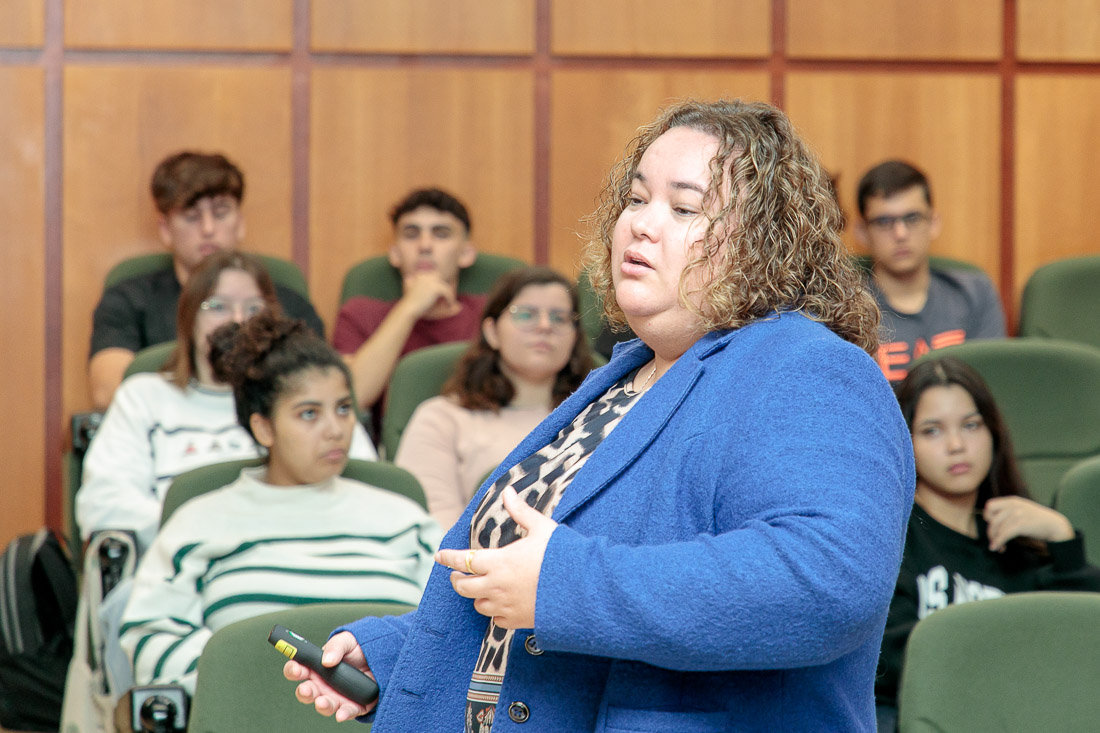
Melanie Calero, CEO of Big Data Company and head of the Data Office at Toyota, a graduate of the University of La Laguna, spoke as an expert after the opening session. She pointed out that the use of algorithms is not as relevant as "having a clear purpose, what I want to achieve with my company." She affirmed that data science is a way to generate value from this information. Therefore, she specified that the company must first have a clear descriptive analysis—that is, how much I've sold, how many clients I have, what my profit margin is—before moving on to using data and artificial intelligence to predict future scenarios.
That's why data quality remains crucial, the foundation for future developments. "Artificial Intelligence needs past data; it doesn't learn by osmosis," he explained, citing the fully autonomous operation of a car as an example. This relies on a wealth of prior data to enable the vehicle to make the right decisions, but above all, it has the capacity to store and process all the information generated after each experience. This is called reinforcement learning. "We're at a disruptive moment, where we need to experiment to see what adds value.".
Following the opening conference, various applications of data science in the Canary Islands were reviewed in the areas of transport (TITSA), healthcare (Canary Islands Health Service), water management (Canaragua), and public administration. Finally, the training opportunities available in this field, offered by the Canary Islands' public universities, were presented.

 Spanish
 English
 French