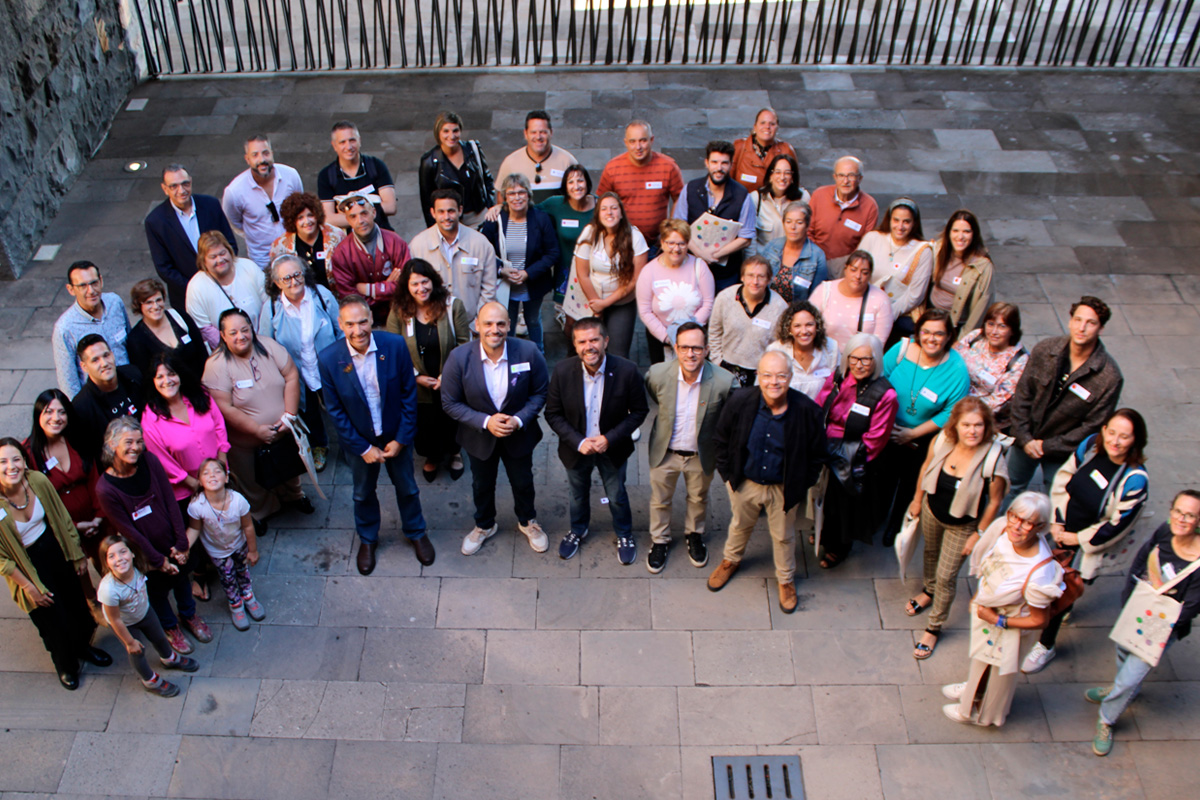
The BarriODS project, a local initiative of the Canary Islands Government and the University of La Laguna, aimed at implementing the Canary Islands Sustainable Development Agenda 2030, held a regional community meeting to foster collaboration among the driving forces from the eight towns where the project is currently in its pilot phase. The event took place at the Government Headquarters in Santa Cruz de Tenerife and was attended by the Deputy Minister of the Presidency, Alfonso Cabello Mesa, and the Rector of the University of La Laguna, Francisco García Rodríguez.
Also present were Octavio Caraballo de León, Director General of Organic Coordination and Strategic Projects of the Government of the Canary Islands, the department promoting and overseeing the BarriODS project, and Julio Brito Santana, Managing Director of the General Foundation of the University of La Laguna, the entity that manages it administratively, thus highlighting the importance of the alliance established between the Government and ULL to promote initiatives with a strong social and community focus linked to the development of the Canary Islands Agenda 2030.

Francisco García, rector of the ULL, together with the deputy minister of the Presidency, Alfonso Cabello.
Around 60 people reconstructed the work process followed during the last eight months, which began by establishing relationships with the participating entities in each of the selected neighborhoods and towns, to move towards shared knowledge of the localities and the development of diagnoses that led to the participatory proposal of embryonic action plans aligned with the Canary Islands Agenda 2030. In the afternoon session, they reflected together, through a group dialogue dynamic, on key issues in the development of the project with a view to its systematization for the transfer of the experience.
During the meeting, the excellent work carried out in all the participating locations was highlighted, through the formation of intergenerational steering groups that applied a similar methodology, albeit adapted to the specific characteristics of each neighborhood and town. In this regard, Vicente Zapata, the project director, emphasized that the people who have spearheaded the initiative “are the vanguard of our society, pioneers of a different way of understanding and applying the community approach in their respective localities,” also stressing “the importance of consolidating these ongoing processes and even expanding them to more places, now that we have a validated method.”.
For his part, the Rector of the University of La Laguna, Francisco García, emphasized the necessary commitment of public universities to sustainability, linked to their respective territorial frameworks of action, “where we must test new strategies to overcome the multiple and complex challenges facing society, fostering creativity and innovation together with the public.” According to the Rector, BarriODS “represents an original and demonstrative experience, with the added value of having been built through community participation, adapting to the particular reality of a wide range of towns in our region,” and he also congratulated the people who have been instrumental in the project.
BarriODS has recorded 1,102 participants during its eight months of interaction with local communities. 128 people participated in the initial preparatory training, and 213 took part in the community meetings held in all participating locations. Currently, 62 people are directly involved in the active steering groups. The online training offered through courses and seminars within the project has been particularly effective in disseminating information. Specific community actions have also been carried out in some neighborhoods and towns, all of which have an initial action plan aligned with the Canary Islands 2030 Agenda to continue their work.
The participating towns are the following, listed from west to east: El Pinar de El Hierro, San José de Breña Baja, Playa de Santiago in Alajeró, La Postura in Adeje, Bañaderos in Arucas, Guisguey in Puerto del Rosario, La Peñita in Puerto del Carmen de Tías, and Caleta de Sebo in La Graciosa. They represent very diverse socio-territorial contexts, as do their population sizes and economic profiles, further highlighting the experimental nature of the project, which will soon conclude with the systematization of the process followed and its results.

 Spanish
 English
 French