September 9, 1947. The gigantic computer, if you can call it that, the Mark II, wasn't working properly. For several days, this mammoth machine had been constantly malfunctioning, but that Tuesday it had reached its limit. It shut down. Grace Murray Hopper, 41 years old at the time, volunteered to check the machine. Relay by relay, she examined the electromechanical contraption in search of the problem. Snagged and crushed in a connection, she found the source of the malfunction. A moth had brought one of the most advanced machines of the time to a halt. She took out her notebook, described the problem, and attached the moth to the report with adhesive tape. Nowadays, these kinds of system failures are known as bugs.
The protagonist of this anecdote from the annals of computing is also one of the most important programmers in history. Creator of the first compiler for a programming language, she is considered one of the founders of programming languages. In Hopper's honor, her birthday and World Computer Science Day are commemorated every December 9th.
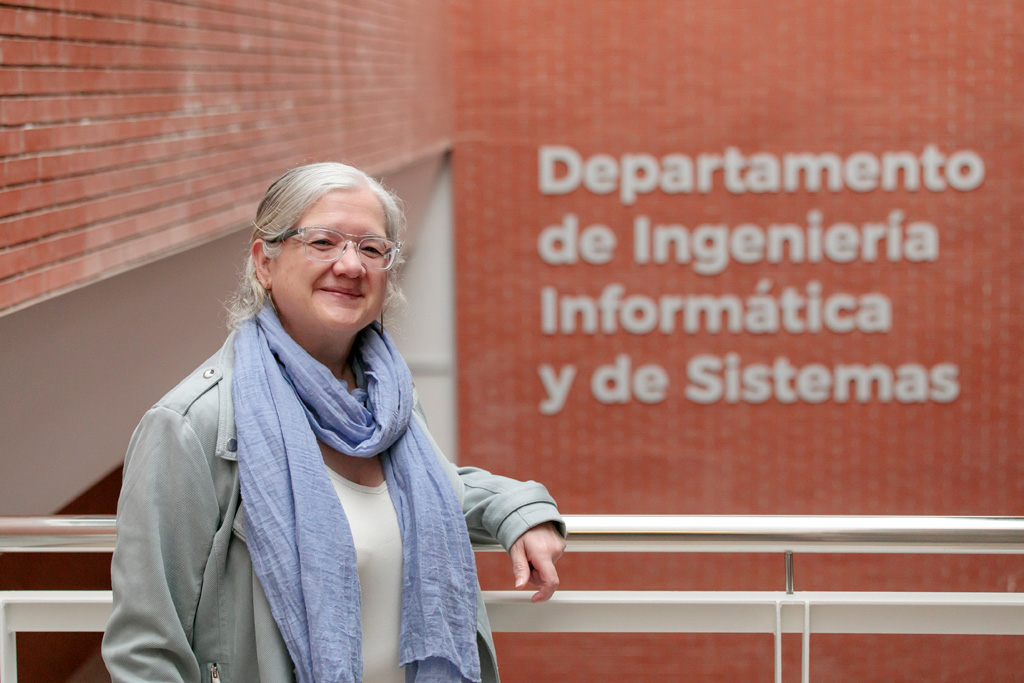
 Coromoto León, Professor [Name], from the Department of Computer and Systems Engineering at the University of La Laguna, shares Hopper's passion for computer science and for developing compilers, which are the intermediaries between our language and the famous zeros and ones of the binary system. The professor welcomes us into a spacious room where the brick walls are decorated with all the graduation photos of students from the faculty. In the first one, from 1992, she is already listed as a professor. She acknowledges that when she studied Mathematics, which is where her education comes from, the ratio between boys and girls was similar; there wasn't a great disparity. Perhaps the problem with career choices, she reflects, stems from when the degree began to be called engineering.
Young computer scientists
Regarding the admission of female students to the Bachelor's Degree in Computer Engineering She acknowledges that the situation has worsened in recent years. “We're doing poorly, because in engineering we don't have much female representation; it doesn't even reach 15% of students in the first three-year technical program. And in computer science, we don't even reach 10% of students in the first three-year technical program in terms of girls wanting to study computer engineering.” Of the engineering fields, Chemistry has the most female students, and Computer Science the fewest. Whether or not the change in terminology is the reason, the professor notices that many girls in secondary school tell her that this degree isn't for them. However, she notes that specializations that combine computer science with biology or health sciences, such as bioinformatics, don't suffer from this problem.
This bias that seems to associate engineering with boys is something that educational institutions are combating. Initially, this was done with students closest to university, in high school. However, experience showed them that by that stage of life, decisions have already been made. “In high school, the die was cast; almost all the students knew what they wanted and didn't want to study. We had to go further down the grades, to lower grades.”.
Think Computationally
That was the spark that ignited the Piensa ComputacionULLmente project, an initiative that emerged “as a research project analyzing the potential advantages of Computational Thinking.” Its main objective is to support students, their families, and their teachers in integrating Computational Thinking into formal and informal learning to educate a new generation with a much deeper understanding of our world.

The project talks about computers and computer science, but only uses pencil and paper. Coromoto León is convinced of the need to explain to young people how a computer thinks so that they can then get machines to do what we need—in other words, to write code. The professor argues that we shouldn't settle for being mere users of technology; we must learn to program. “We are making a great effort to go to primary and secondary schools to explain that studying computer science is really about learning to solve problems using the devices we have at our disposal.”.
Computer science studies don't aim to create better users; they're designed to teach students how to create programs and their content. It's a new kind of literacy, but instead of using the alphabet, they use zeros and ones. Coromoto León compares it to writing and reading. “Just because a student learns to read and write doesn't mean they'll become a writer. The same is true in computer science. We want students to learn to write code, not just to be users, but to design content; we want young people to not just play video games, but to create their own content. It's a way to contribute to society.”.
These outreach campaigns in schools, such as the Computer Science Olympiad, also aim to prevent students from entering the field with misconceptions about what it is. Many young people drop out of engineering in their first year, according to the professor, because they believe computer science is something else entirely, simply about operating computers. However, obtaining a degree in this field requires extensive knowledge of physics and mathematics.
Artificial Intelligence and the teaching of computer science
Artificial intelligence is here to stay. It's a technological revolution that represents a paradigm shift. It's not just another technological development, not simply a software advancement. We have before us a new tool that, in the best-case scenario, will enhance human capabilities. And tools are meant to be used. As paleontologist Juan Luis Arsuaga acknowledges, "Human beings have always used the tools at their disposal; no one with a hammer continues to hammer a nail with a rock, so we won't renounce using AI either.".
 And we certainly haven't given up. AI is already present in many facets of our lives, from the street sweeper with a Latin dance name to the processes that identify cancerous cells in a blood sample. But how is AI affecting the teaching of computer science? The professor, who teaches the subject of Programming Language and Paradigm, faces this every day. “It's like when you write a letter. You can write it in a more formal, colloquial, or accessible style. The same thing happens in programming; you can program with a style that can be very functional or closer to mathematics, where you define a function and that has to be translated into whatever you want.” AI cannot yet imitate these programming styles. It can write programming code, but this has a danger that students don't always perceive.
“Every week I assign an exercise that involves writing code. Let's say, for example, I ask the students to program a cow. A few students, a few, come to me with their code about the cow, written using GPT chat, and ask me if it's okay. If you want to learn, you have to try it yourself, and if you don't write the code, you'll never learn to write. That's what I try to convey to the students.” However, she's not against new tools or AI; on the contrary, the use of programming assistants is commonplace. The problem, according to the teacher, lies in the possibility that they might replace the student's learning process. Therefore, she acknowledges that exposing students to constant challenges is fundamental to their learning.
Coromoto León explains it with a very simple program. “I can ask my students to write a program that greets a user. You have to translate the commands so that the program greets. I can't tell you how the instructions are written print hello Because then I'm telling you everything. Sometimes they expect you to provide the answer in the problem statement, but the real world isn't like that. Out there, you'll encounter a client who asks you to program, for example, a chat function for a company's website. They're not going to tell you what to put in the code; you'll have to figure it out yourself. That's why allowing AI to replace your learning does you a disservice.”.
Information technology and the job market
Computer Science is the degree with the best job placement rate: higher employment rates, full-time positions, permanent contracts, and the highest average annual social security contributions, according to a 2023 study by the Knowledge and Development Foundation (CYD). This makes Computer Engineering graduates highly sought after by companies. Many of them recruit talent from schools and faculties, hiring students who begin working without finishing their studies. The danger: the temptation to not complete the degree grows as time goes on and your financial dependence is met by a company that doesn't require a degree. However, this phenomenon has a low impact at the University of La Laguna. “Under the previous system, a percentage of students entered the workforce without completing their final degree project; many left their degree unfinished, lacking only this one requirement. But now, practically all of them complete their final degree project (TFG) because it is structured like any other course. Furthermore, they complete the TFG in collaboration with companies that may hire them upon completion.”.

The university's ability to retain talent in this sector is a different matter. Demand from the business sector means that public institutions are unable to match the opportunities students find in the private sector. “We're simply not competitive. Students have to complete their doctorates with a meager grant, perhaps not exceeding €1,000. Then they get another postdoctoral grant, not much better than the first, before finally applying for a permanent position. We can't compete with the salaries and working conditions offered by companies.” This makes research and teaching in this field a truly vocational pursuit.
Information technology and the environment
The use of ones and zeros and our dependence on the digital world comes at a cost that is rarely discussed. The environmental impact of our computer use is alarming due to its escalating effects in recent years. The energy consumption of computers and servers, the generation of electronic waste, the dependence on scarce natural resources, water consumption, and carbon dioxide emissions are just some of the environmental problems we create by using electronic devices. To make matters worse, the indiscriminate use of the cloud and artificial intelligence has amplified this impact. The enormous amount of data we generate daily requires an equally vast amount of electricity and water to cool the servers where we store our Word documents or last night's selfies.
A published study A study by the Massachusetts Institute of Technology (MIT) estimates that the cloud consumes more than 200 terawatt-hours (tWh) of energy annually. That's more energy than many countries in the world. The fact that more than forty million WhatsApp messages are sent every minute, or that 600 hours of videos are uploaded to YouTube, has a significant impact. This feeling that cyberspace is infinite and, moreover, largely free, has led us to be indiscriminate when it comes to storing our information. We've gone from 24-photo rolls of film to thousands of images on our phones that we'll never look at again, sending pointless files, and experiencing a digital hoarding syndrome that prevents us from throwing anything away, filling our devices and the cloud with information we don't even know we have. Is it possible to program this efficiently?
“Yes, it can be done. When computing began, we had very little storage space. We learned to program using very little space; we made programs that barely took up any memory. We know how to do it. It's also possible to program to minimize environmental impact, and we teach that to our students as well.”.
Scientific Culture and Innovation Unit (Cienci@ULL)

 Spanish
 English
 French