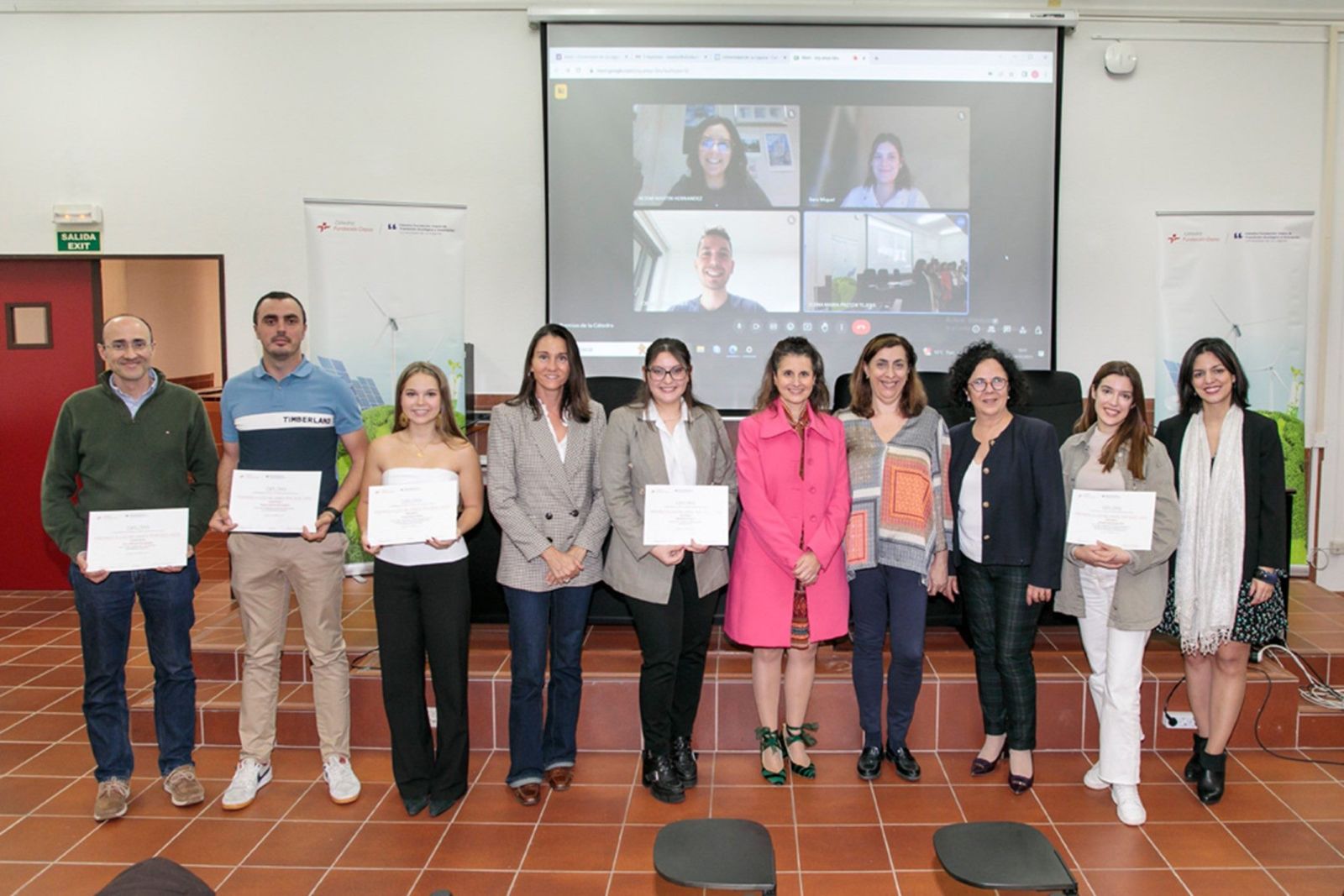
The Cepsa Foundation Chair of Ecological Transition and Innovation at the University of La Laguna has celebrated the award ceremony for the fourth edition of its Awards for the Best Final Degree Projects (TFG) and Final Master Projects (TFM), corresponding to the academic year 2022/2023.
The first prize in the final degree projects category went to Jorge Veiras, a Physics student, for his work "From Space to Sea: Evaluating the Capacity of Satellite Data to Map Benthic Habitats Using Machine Learning Algorithms." The second prize was awarded to Noemí Martín, a Chemistry student, for "Noble Metal-Free Catalysts for Hydrogen Production." The third prize in this category went to Agustina Escariz, an Early Childhood Education student, for her work "Bringing the SDGs to the Early Childhood Education Classroom.".
In the case of Master's theses, the first award went to Jennifer Rodríguez, a student in the Master's program in Chemistry, for her study "Nickel chalcogenides supported on nickel foams as catalysts for the green hydrogen production reaction." The second award was obtained by Sara Miquel, from the Master's program in Renewable Energies, for her work "Wind direction disambiguation in Doppler lidar systems," while the third award was not given.
The award ceremony, which took place in the Lecture Hall of the Chemistry Section of the Faculty of Sciences of the University of La Laguna, was attended by the Vice-Rector for Culture and University Extension, Isabel León; the Director of the Cepsa Research Center, Joana Frontela, a member of the technical committee that decided the awards; the Director of the Chair, Elena Pastor; and the head of the Cepsa Foundation in the Canary Islands, Belén Machado.
Vice-Rector Isabel León expressed her satisfaction with the recognition these awards represent for the achievements and contributions of the university community. These awards, she said, “demonstrate the ability of young researchers to solve problems that affect us all and overcome, with remarkable resilience, obstacles of various kinds, optimizing economic, human, and time resources to contribute to making our planet a better place.” She added that “awards like these help to highlight and recognize individuals who ask questions and who want to contribute to the benefit of society as a whole through their work and dedication to research.”.
After congratulating the award winners, Joana Frontela, who was accompanied at the event by Mariam Romero and Begoña Lamothe, heads of Fundamental Chemistry and Advanced Analysis respectively at the Cepsa Research Center, highlighted that “the award-winning works align with the objectives of the Chair, addressing some of the greatest challenges of our era such as decarbonization and CO2 capture2, the fight against climate change and technological innovation.” He also emphasized that “they are a small sample of the high scientific and technical quality of all the participants,” and that “it has been a highly competitive competition.”.
Belén Machado emphasized the high quality of the 30 projects submitted, noting that these awards recognize the acquisition of skills and initial exposure to research. She predicted a prosperous professional future for the five winners thanks to "research that is undoubtedly aimed at facilitating the advancement of society," highlighting that these awards, in their four editions, have promoted training and research activity, as well as innovation and the dissemination of results, while also sparking interest in future academic projects, both among the award recipients and the rest of the student body.
For her part, Elena Pastor emphasized that research excellence should be recognized and rewarded, and congratulated the award winners while thanking the members of the selection committee, the students, and their tutors for their work.
Selected themes
Jorge Veiras' study, winner of the first TFG prize, 'From space to sea: evaluation of the capacity of satellite data to map benthic habitats using machine learning algorithms', focused on the role played by seagrass meadows in the Canary Islands as one of their best allies for a cleaner and greener future, with an important function in the fight against climate change by acting as carbon sinks, as well as the need to monitor and conserve them.
'Noble metal-free catalysts for hydrogen production' is the title of Noemí Martín's final degree project, winner of the second prize, which deals with obtaining hydrogen, considered as an alternative energy resource to fossil fuels, from the electrolysis of water using renewable energies, employing materials that accelerate the reactions involved in this process that are cheaper than platinum or palladium.
"Bringing the SDGs to the Early Childhood Education Classroom" is the project that has led Agustina Escariz to address the Sustainable Development Goals (SDGs) and the 2030 Agenda in a way adapted for young children, through interactive and innovative stories. This approach is based on the premise that if children are made aware of these issues from such an early age, in a way they can understand, they will grow up caring for the planet, reducing polluting waste, improving energy efficiency, and combating climate change.
Regarding the awards for the best Master's theses, Jennifer Rodríguez, who won first prize with 'Nickel chalcogenides supported on nickel foams as catalysts for the green hydrogen production reaction', presents a study that promotes the production of high-performance, cost-effective and environmentally friendly electrocatalysts capable of competing with the use of noble metals.
The winner of the second prize in this category, Sara Miquel, has analyzed in her work 'Disambiguation of wind direction in lidar doppler systems' the technology of offshore wind based on Floating Lidar Systems to bring about, by improving the accuracy of wind measurements, the optimal functioning of wind turbines and the efficiency of wind farms.

 Spanish
 English
 French