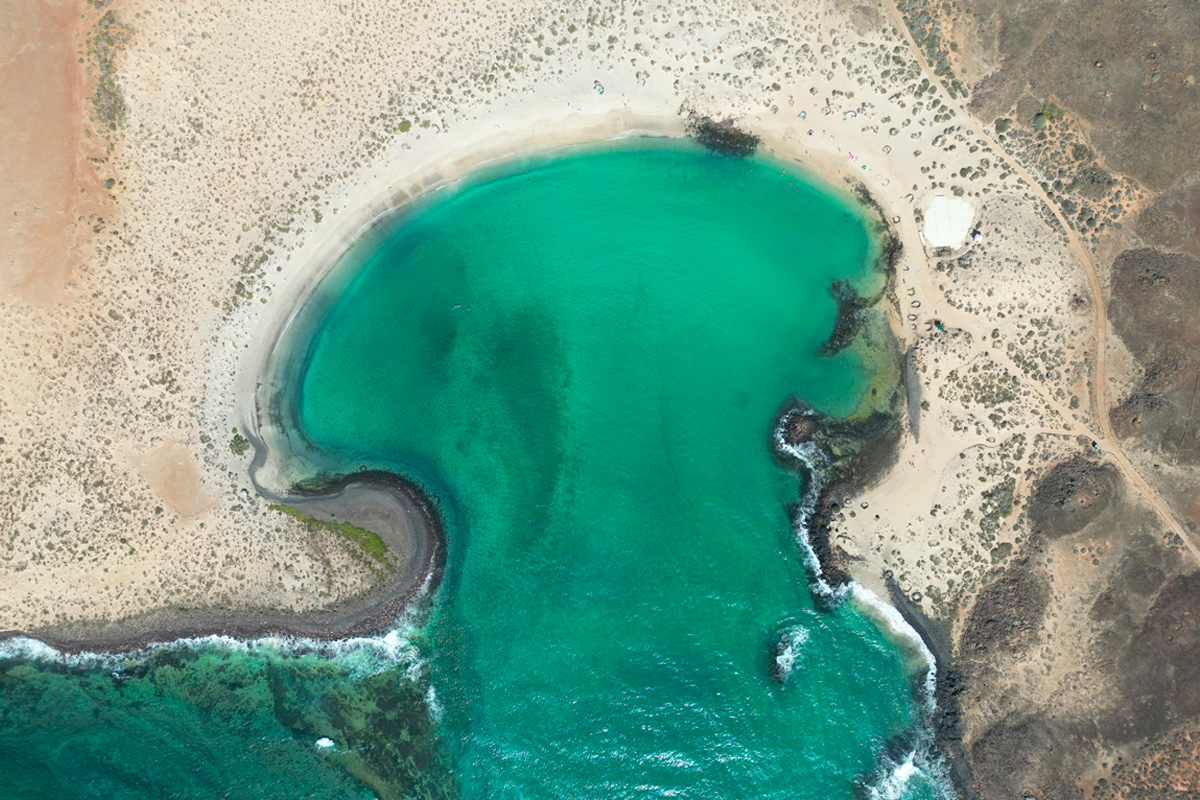
During the past month of November, the eighth campaign of archaeological excavations was carried out at the Roman purple dye workshop of Wolves 1, Located on La Calera beach, on the islet of Lobos. The work undertaken, as usual, is carried out within the framework of an inter-institutional research project under the shared direction of Isidoro Hernández Sánchez (Archaeological Museum of Fuerteventura, Fuerteventura Island Council), Mercedes del Arco Aguilar (Archaeological Museum of Tenerife, OAMC of the Tenerife Island Council) and Carmen del Arco Aguilar (Department of Geography and History, University of La Laguna).
The project has an interdisciplinary team that includes researchers from the fields of Paleontology, Plant Biology, Petrology and Geochemistry, Soil Science, and Analytical Chemistry at the University of La Laguna. This fieldwork is made possible by an agreement between the Island Councils of Fuerteventura and Tenerife, as well as the collaboration of the company BINTER, which covers the team's travel expenses and all the technical and archaeological material temporarily deposited for study at the Archaeological Museum of Tenerife. This year, the Directorate General of Cultural Heritage of the Government of the Canary Islands has also collaborated on the project.

C. De Arco.
As is known, the site is a purple dye workshop from the late Republican and high Imperial periods, specializing in the exploitation of marine mollusks of the Muricidae family, especially of Stramonita haemastoma and, to a lesser extent, of Hexaplex duplex, whose remains we identified in shell middens, associated with various tools, allowing us to study the technological process of extraction and obtaining the dye. This was an economic activity that generated significant profits, leading to intensive production for at least a century, with seasonal campaigns that likely originated in Gades
The excavation work has affected 38 square meters of the southern area of the site. There, the existence of a rockfall or landslide has been identified. little oven The volcanic rock in the area collapses levels of archaeological occupation, revealing diverse materials, all of Roman origin. “We also observed new shell middens of murex snails associated with lithic anvils and hammerstones, combustion structures, sometimes of great power, and sediments impregnated with purple dye, revealing that the cooking of the extracted animal product (the hypobranchial glands carrying the precursor substance of the purple dye) was carried out near the middens, with the subsequent extraction of the foam or supernatant from the cooking process, which was poured into the surrounding area,” explains Carmen del Arco, a researcher at the University of La Laguna.
In this area, which also serves as a garbage dump, remains of terrestrial fauna are abundant, and sheep and goats predominate, sometimes appearing in skeletal portions that show the

Skeletal portion of an ovicaprine. C. De Arco.
The animals were butchered, probably into food rations in the case of the spine or ribs. Fish remains are also very abundant, and we recorded other animalia maris, such as costal plates of turtles and teeth of sea lions.
The repertoire of artifacts found has also been very abundant, with ceramics of varied types (amphorae, common and tableware, thin-walled, black-glazed, oil lamps), metal tools (fishhooks and copper-based rods, iron and copper-based nails). Among these is a piece that, along with a similar one found in the previous campaign, we can attribute to clavi caligarii or sandal studs.
In parallel, they have carried out a ground-penetrating radar survey with the research team of Pablo Atoche from the University of Las Palmas de Gran Canaria and the direct involvement of two geographers from that university, Antonio Bueno and Claudio Moreno. This work, carried out on several areas in the immediate vicinity of the site, has allowed them to detect underburdened areas with various anomalies that indicate the probable extent of an ancient occupation, now covered by the sand dunes, and which suggest potential expansion of the archaeological site, "an aspect that we will verify in the upcoming campaigns with the corresponding soundings," he notes.

 Spanish
 English
 French