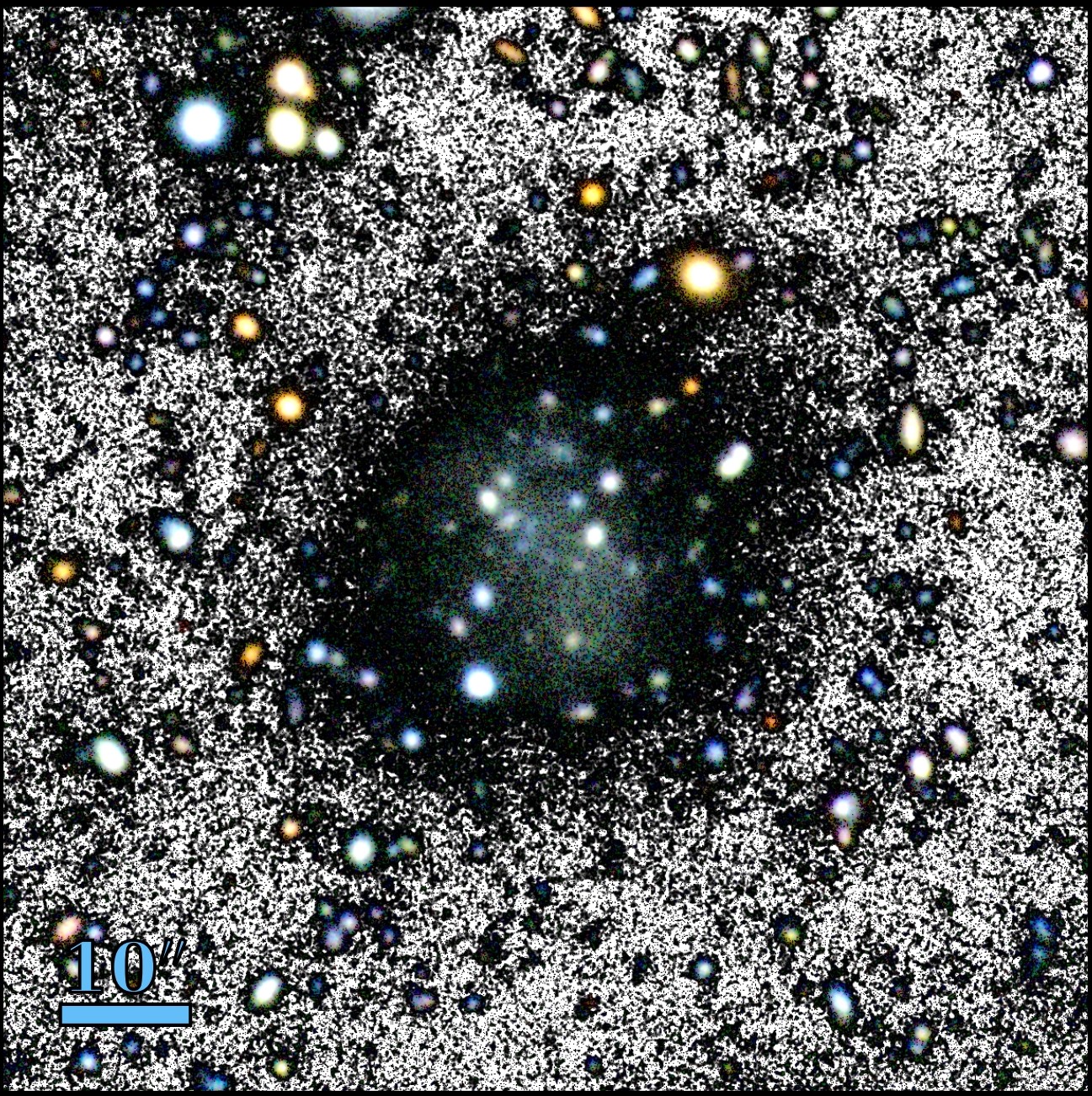
A group of astrophysicists led by Mireia Montes, a researcher at the Canary Islands Institute of Astrophysics (IAC), has discovered the largest and most diffuse galaxy recorded to date. The study, published in the journal Astronomy & Astrophysics, used data from the Gran Telescopio Canarias (GTC) and the Green Bank Telescope (GBT). The University of La Laguna is part of this international team.
The name was given by the five-year-old daughter of one of the researchers in the group and is due to the diffuse shape of the object. Its brightness is so faint that it has gone unnoticed in previous surveys of that part of the sky, as if it were a ghost. This is because the stars that compose it are widely distributed over a large volume, which made Nube almost imperceptible.
This new galaxy has a number of peculiarities that make it different from other previously known objects. The scientific team estimates that Nube is a dwarf galaxy 10 times fainter than others of its type, but at the same time, it is 3 times more extended than other objects with the same number of stars. To illustrate, it is described as an object that measures one-third the size of the Milky Way, but with a mass similar to the small Magellanic Cloud.
“With our current knowledge, we don’t know how it is possible for a galaxy with such extreme characteristics to exist,” explains Mireia Montes, lead author of the article and researcher at the IAC and the University of La Laguna.
For years, Ignacio Trujillo, the article's second author, has been analyzing, along with a team, the maps obtained by the SDSS (Sloan Digital Sky Survey) on a specific strip of the sky under the framework of the IAC Legacy project Stripe 82. In one of the reviews, they reported a faint spot that managed to attract enough attention to get things moving.
The next step was to use ultra-deep multicolor images from the Gran Telescopio Canarias to confirm that the patch appearing on the map was not some kind of error, but rather an extremely diffuse object. Due to its low brightness, it is difficult to determine the exact distance to the Cloud. The authors of the article estimated, based on an observation obtained with the Green Bank Telescope, that the galaxy could be about 300 million light-years away, although upcoming observations with the Very Large Array (VLA) and the William Herschel Telescope will attempt to confirm whether this distance is correct. “If the galaxy turns out to be closer, it would still be a very rare object that presents significant challenges for astrophysics,” comments Ignacio Trujillo.
Another challenge to the current dark matter model?
As a general rule, galaxies have a much higher density of stars in their inner regions, and this density decreases very rapidly as you move away from the center. However, Montes points out that in Nube, “the density of stars hardly varies throughout the entire body, which is why it is so faint and why we were unable to observe it until we obtained the ultra-deep images from the GTC.”.
Nube is baffling astronomers. The team points out that, at first glance, there is no interaction or indication that explains its strange properties. Cosmological simulations are unable to reproduce its “extreme characteristics,” even when considering different scenarios. “We have run out of options within the currently accepted cosmological model, which is that of cold dark matter,” the author emphasizes.
The cold dark matter model reproduces large-scale structures, but there are small-scale scenarios, such as Cloud, for which it is unable to provide an explanation. It has been demonstrated how different theoretical models cannot reproduce it, making it one of the most extreme cases known to date. “It is possible that with this galaxy, and similar ones we may find, we will obtain additional clues that open a new window to understanding the Universe,” Montes comments.
“One very intriguing possibility is that Nube’s unusual properties indicate that the particles that make up dark matter have a ridiculously small mass,” says Ignacio Trujillo. If this were the case, the galaxy’s unusual structure would be a manifestation of quantum physics, but on a galactic scale. “If this hypothesis were confirmed, it would be one of nature’s most beautiful displays unifying the world of the very small with the very large,” he concludes.
Article
M. Montes, I. Trujillo, et al. A. Karunakaran, R. Infante-Sainz, K. Spekkens, G. Golini, M. Beasley, M. Cebrián, N. Chamba, M. D'Onofrio, L. Kelvin, J. Román. “An almost dark galaxy with the mass of the Small Magellanic Cloud.” A&A, 2024. DOI: https://doi.org/10.1051/0004-6361/202347667
(Note and images provided).

 Spanish
 English
 French