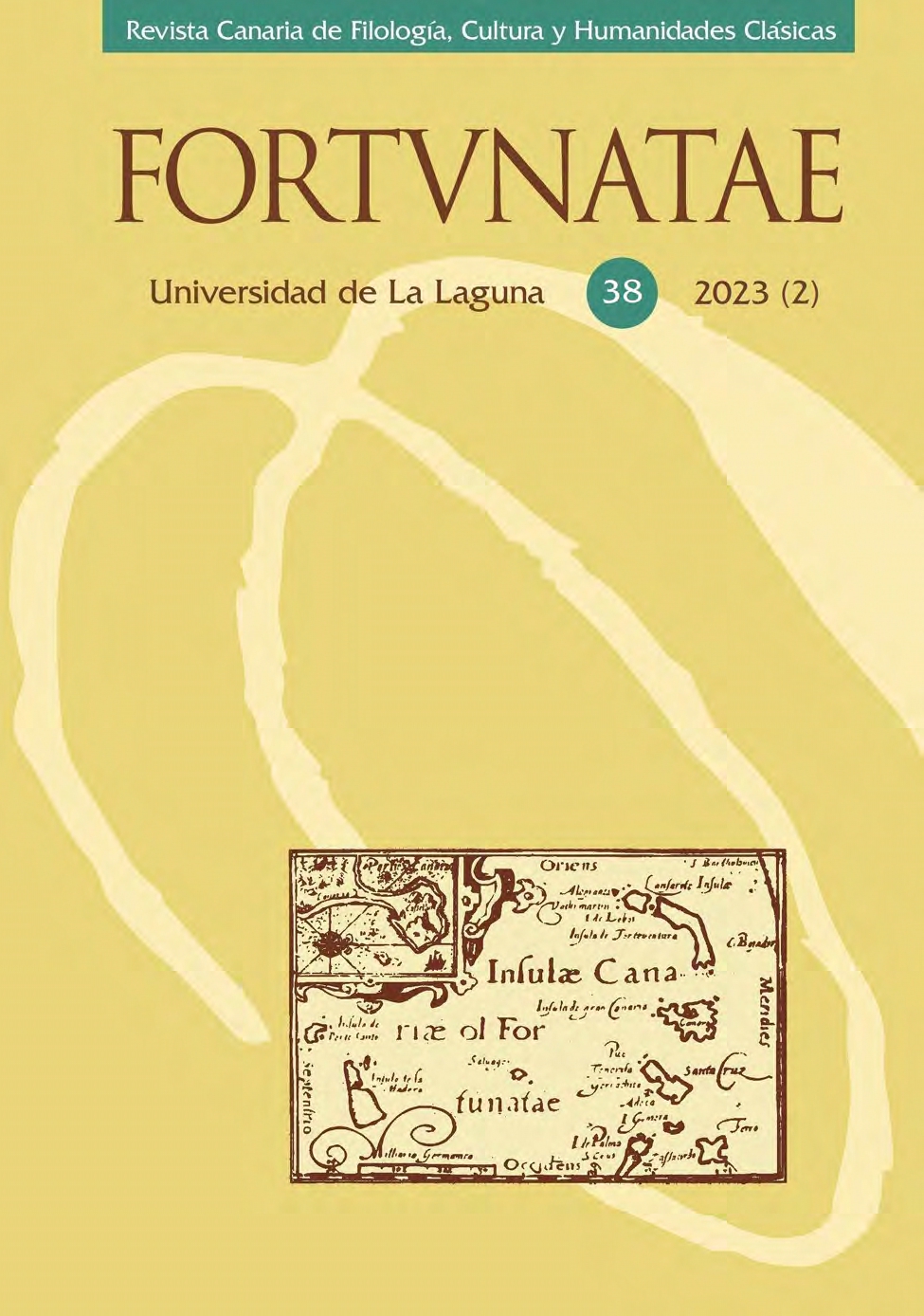
Fortunatae The Canary Islands Journal of Classical Philology, Culture and Humanities is an open-access electronic publication affiliated with the Department of Classical, French, Arabic and Romance Philology at the University of La Laguna. Following its biannual publication schedule, it recently released its 38th issue (2023, 2) last December, comprising 110 pages, five articles (four in Spanish and one in English), and three reviews.
This publication has been part of the LATINDEX 2.0 Catalogue since mid-2023, and is the first from the University of La Laguna to be accepted into this index, further extending the international character of the journal and its progress in quality standards.
«"The village of the therapists of Lake Mareotis as locus amoenus "Sacred and philosophical," by Diego Andrés Cardoso Bueno, opens the series of articles by presenting an analysis of the treatise Of contemplative life from Philo of Alexandria, where he describes a group of therapeutai y therapeutrides, ascetic Jews, who lead a communal and isolated life in an idyllic landscape near Lake Mareotis, close to Alexandria.
The description of this real place as locus amoenus Literature is the focus of the work. Marcos Medrano Duque presents in «Κασ(σ)-, Κασσι- and Καστι-in Greek Anthroponymy and its Indo-European Cognates», a study on the etymology of the proper name Κασσιέπεια and its variants Κασσιόπεια and Κασσιόπη attempting to prove that it is a bahuvrīhi compound made up of a nomen actionis *k̂n̥s-ti-, 'announcement' and *u̯éku- 'word, voice', also arguing that the first member of the compound is not only found on many occasions in Greek anthroponymy, but in at least four other historical dialects of Indo-European.
 «"The order of words as a poetic device in Tacitus (Annals IV)», by Carles Padilla-Carmona, delves into the alteration of word order as a significant feature and essential resource of the historian's style, which influences both the meaning and the signifier, affecting the expressive and aesthetic levels.
Marta Ramos Grané, starting from the arts of memory of scholastic origin, such as the Congestorium Romberch, in "Manipulating artificial memory: an example of mistake in recalling", argues how theories of perception can be applied to the mental formation of places and images, key elements of memory (per locos et imagines), and he does this by taking an example from the very Congestorium, In which the author acknowledges his error in the process of imagining places, so that, after a detailed description of the rules, Romberch himself defends the importance of experimentation and personal sensory experience to generate effective artificial memory systems.
Finally, "Evils, adversities and discomforts in Senecan's writing on providence," by Genaro Valencia Constantino, offers a reflection on the three terms (bad, adverse, uncomfortableThese are used to frame the philosophical arguments surrounding the supposed evils that befall humankind, in such a way that the divine emerges unscathed from accusations regarding the "evils" existing in the world. The aim is to follow the possible lexical variations indicated by the textual tradition, which, in some way, can serve to refine or better explain Seneca's philosophical ideas.
Regarding the reviews, Javier del Hoyo Calleja presents us with the well-documented book by Fernando García Romero, Owls to Athens. The survival today of the ancient Greek proverb. Ángel Martínez Fernández, for his part, comments, in a first review, with concision and clarity, on the publication of the contributions of the XIV International Symposium of the Spanish Society of Plutarchs held in La Laguna in 2022, and, in a second review, he analyzes step by step the release of the work on Greek epigraphy «IG X 2, 1 Suppl. 2: Inscriptiones Thessalonicae et Viciniae – Supplementum alterum: Addenda, Indices, Tabulae».
From Greek philosophy and asceticism to Seneca's Roman stoicism, from Tacitus's historiography to late medieval memory arts, including Indo-European studies, the journal Fortunatae It once again covers the most diverse fields of Classical Philology.

 Spanish
 English
 French