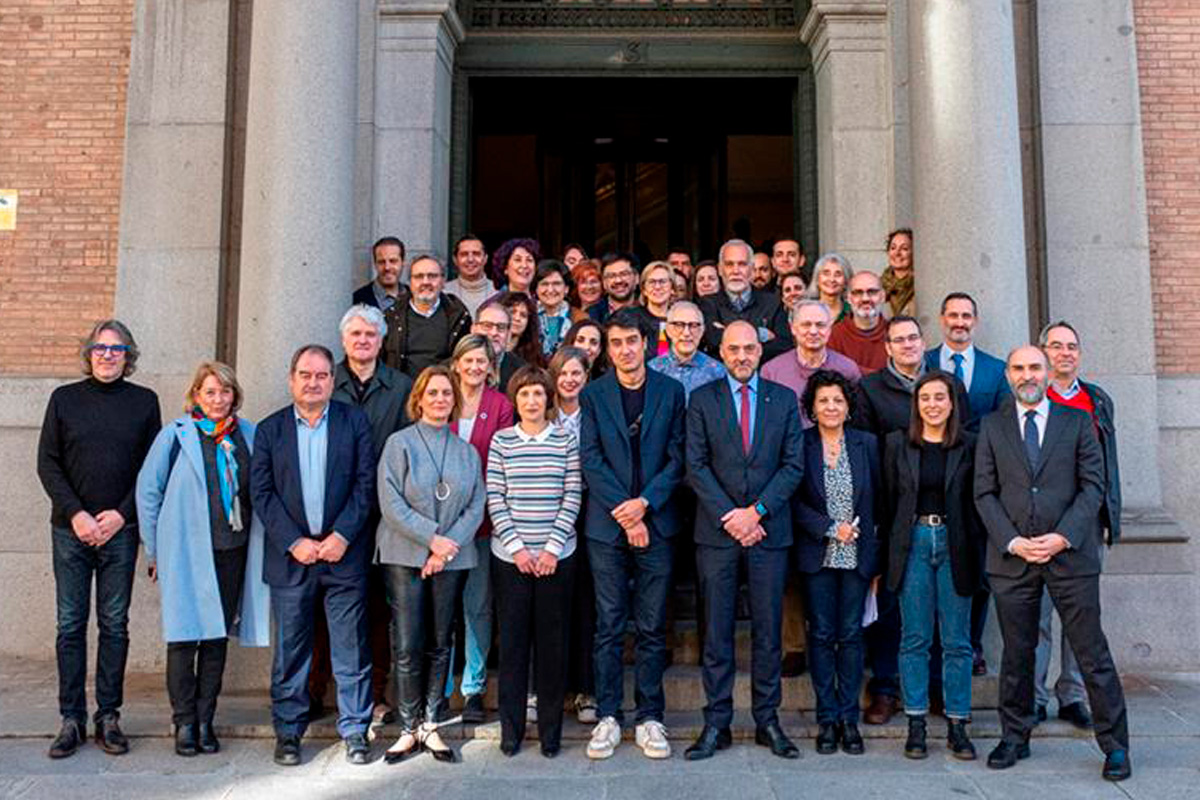
The National Geographic Institute (IGN) hosted the recent meeting of representatives of the ANEXXI Network for the development of the National Atlas of Spain and representatives of the National Geographic Information Center (ANEXXI). The ANEXXI Network is a network of scientific and academic organizations, promoted by the IGN and the CNIG, to ensure continuous scientific direction guided by criteria of excellence in the preparation of the National Geographic Anecdote (ANEXXI) and in the dissemination of the results obtained. The Spanish Association of Geography is the leading organization of this Network, and the IGN-CNIG formalized a scientific collaboration and technical innovation agreement with it for the preparation and publication of the 21st-century ANEXXI, and related works of common interest to both parties.
The honorary professor of the University of La Laguna Carmen Romero Ruiz She was appointed to the team in charge of updating the Atlas National Institute of Statistics of Spain, as coordinator of the section on Earth Structure and Landforms, which addresses aspects related to the Geophysics, Geology, and Geomorphology of the entire national territory. In the preparation of the Atlas Other professors from the Department of Geography and Spatial Planning of this academic center also participate as authors.
The Network currently comprises 36 universities, the Spanish National Research Council (CSIC), the Royal Academy of History, the National Library of Spain, the College of Geographers, and the Spanish Association of Geography (AGE). It contributes the work, knowledge, and experience of 137 researchers belonging to the Network, plus a significant number of scientific advisors from organizations not affiliated with it. In simplified terms, the National Geographic Institute (IGN), within its remit, is responsible for the general and technical direction and development of the National Geographic Survey (ANE); the National Geographic Institute (CNIG) is responsible for its publication and dissemination; and the Network is responsible for the scientific direction and collaboration on the ANE and for contributing to the dissemination of its results.
Representing the Network were its president - who holds this position as President of the AGE, as the leading organization of the Network - Professor Jesús González Pérez (University of the Balearic Islands), the Network's scientific director, Professor María Hernández Hernández (University of Alicante), the member of the Agreement Monitoring Committee representing the Network - who holds this position as secretary of the AGE - University Professor María García Hernández (Complutense University of Madrid), and 24 Scientific Coordinators, professors and tenured university professors, from various disciplines, responsible for each of the 22 Thematic Working Groups (GTT) of the Network, with the exception of the two eminently cartographic GTTs whose scientific coordinators and most of their members are IGN staff.
Representing the IGN were all the staff of the Cartographic Writing Service [of the ANE], the head of the Thematic Cartography and National Atlas Area, and the Deputy Director General of Cartography and Territorial Observation. Representing the CNIG were the head of the Service responsible for the Educational Atlas and the head of the Area responsible for communication and content dissemination, primarily on the web and social media.
At the reception, the deputy director, Javier González Matesanz, highlighted the indispensable role of the Network in the development of the National Energy Agency (ANE), as well as its most important areas of action. Subsequently, the Network's president and scientific director led the meeting to review how this new phase had been reached, with a more operational reconfiguration of the previous network, and its main organizational and functional characteristics.
Next, the scientific coordinators of the four topics updated during 2023 shared their experience in terms of organization and work procedures and showed the
Results achieved to date. The four topics presented, and the scientific coordinators who did so, were: • Demography, by Professor Ángel Pueyo Campos of the
University of Zaragoza (UNIZAR), • Human settlements, by Professor María José Piñeira Mantiñán of the University of Santiago de Compostela (USC), • Society, by Professor Oriol Nelo Colom of the Autonomous University of Barcelona (UAB), • Education, science, culture and sport, by Professor of
Orbange Ormaetxea Arenaza University of the University of the Basque Country (UPV/EHU).
At various times, a free participation period was opened, and this was more intense in the contribution of ideas for communication and dissemination actions of the results achieved so that the ANE would reach a wider audience: presentations, articles, reviews, short videos, infographics, news in specialized media (such as the communication departments of the member organizations of the Network and the Ministry of Transport and Sustainable Mobility), on websites and social networks and in mass media such as local and national press and television, presentations in Territorial Commissions of the Congress and the Senate, in institutes and before regional education officials using the CNIG's teaching resources, participating in Geography Olympiads, etc.

 Spanish
 English
 French