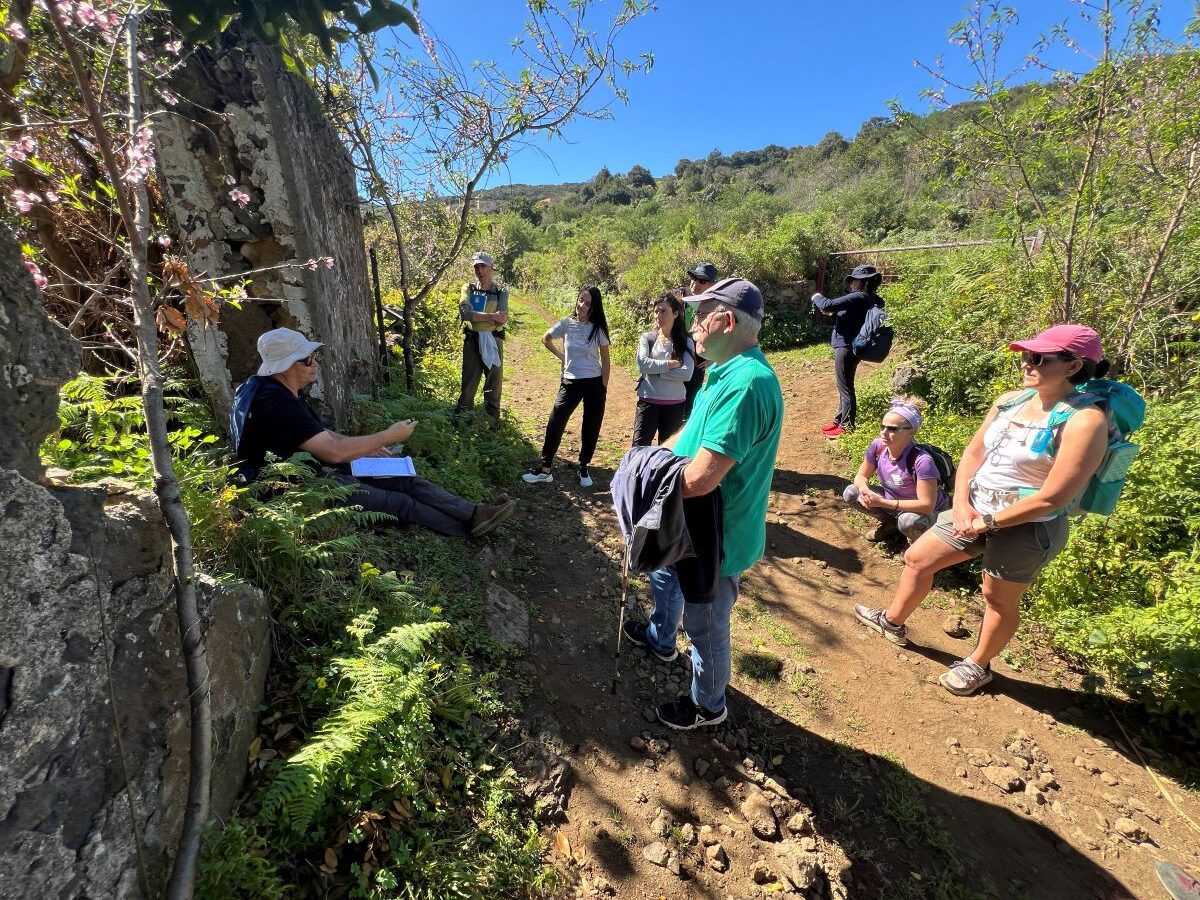
The University of La Palma's autumn-winter workshop on "Community Care of Paths for Local Development," promoted by the island's council and the University of La Laguna in Villa de Mazo, has helped to strengthen the 'Camino Viejo' project, which has been underway in this municipality for several months. This was demonstrated by the participants through their contributions during sessions held in the Town Hall's plenary hall and on the circular route they took along a section of the old mid-altitude royal road near El Pueblo, now part of the GR 130 long-distance trail.
The first session highlighted the importance of involving society in the rescue and conservation of collective heritage through activities that strengthen community relationships, particularly in local contexts where such processes have clear positive effects on local development strategies. These premises formed part of the presentations by Vicente Zapata Hernández and Felipe Monzón Peñate, professors of Human Geography and Architectural Graphic Expression, respectively, who focused on the need to emphasize shared social responsibility in the care of the heritage of roads and pathways.
During the workshop, other regionally and internationally relevant experiences were also shared that could serve as a reference for the La Palma initiative, such as the Transhumance Trails and Rural Roads project, which was designated a European Cultural Route by the Council of Europe in 2023 and in which the University of La Laguna participates through the La Laguna World Heritage Cultural Chair. The workshop also explored the opportunities that land stewardship offers for fostering partnerships focused on environmental conservation and biodiversity, both culturally and naturally.
Following the workshop, the next initiative will be an educational hiking activity, organized within the framework of the 'Camino Viejo' project jointly by the General Foundation of the University of La Laguna, the Villa de Mazo City Council and the PROA+ program of the Ministry of Education of the Government of the Canary Islands, with the aim of motivating and incorporating into the project the teachers of non-university education in the municipalities of southern La Palma.
Importance of roads
Roads represent a profound legacy of humanity throughout history and a valuable resource, both for their use and their significance and connection to countless dimensions of people's lives. The workshop highlighted their interaction with spheres such as communications, engineering, exchange, progress, history, culture, memory, health, and biodiversity, among others. It also addressed their abandonment or even oblivion due to the loss of some of their most important functions, as well as the identification of problems and the proliferation of waste resulting from their diminished value for broad sectors of society.
All of this was connected with the opportunities that can be articulated by projects such as the one currently being developed in Villa de Mazo, 'Camino Viejo', which promotes a collective work process for the community custody of paths, in order to influence the responsible care of the municipal territory and the preservation of its diverse natural and cultural heritage, as demanded by target 11.4 of the Sustainable Development Goals.
The workshop was well represented by the Steering Group established to develop this project, with support from the city council, the Island Council of La Palma and its Biosphere Reserve, as well as various organizations and individual citizens, whose role should be increasingly active and leading in community development processes of this type.
The tour through the northern sector of the municipality highlighted the large amount of resources that municipalities with the profile of Villa de Mazo possess, also in their natural aspect and in the environmental sphere: the volcanic complex around El Pueblo; the biodiversity; the traditional architecture; the agricultural and livestock practices; the customs, celebrations and local traditions; in addition to their endogenous productions.
The route was also useful for incorporating valuable elements into the ongoing project, identifying improvements and feasible initiatives in the short and medium term to strengthen Villa de Mazo's appeal for hiking and for the use of its diverse trails by both residents and visitors. Other ideas for future initiatives include the project's participation in street theater activities next August and the possible integration of trail infrastructure into the organization and promotion of all the identified resources. In addition, a group cleanup of a small section of the GR 130 long-distance trail was carried out.

 Spanish
 English
 French