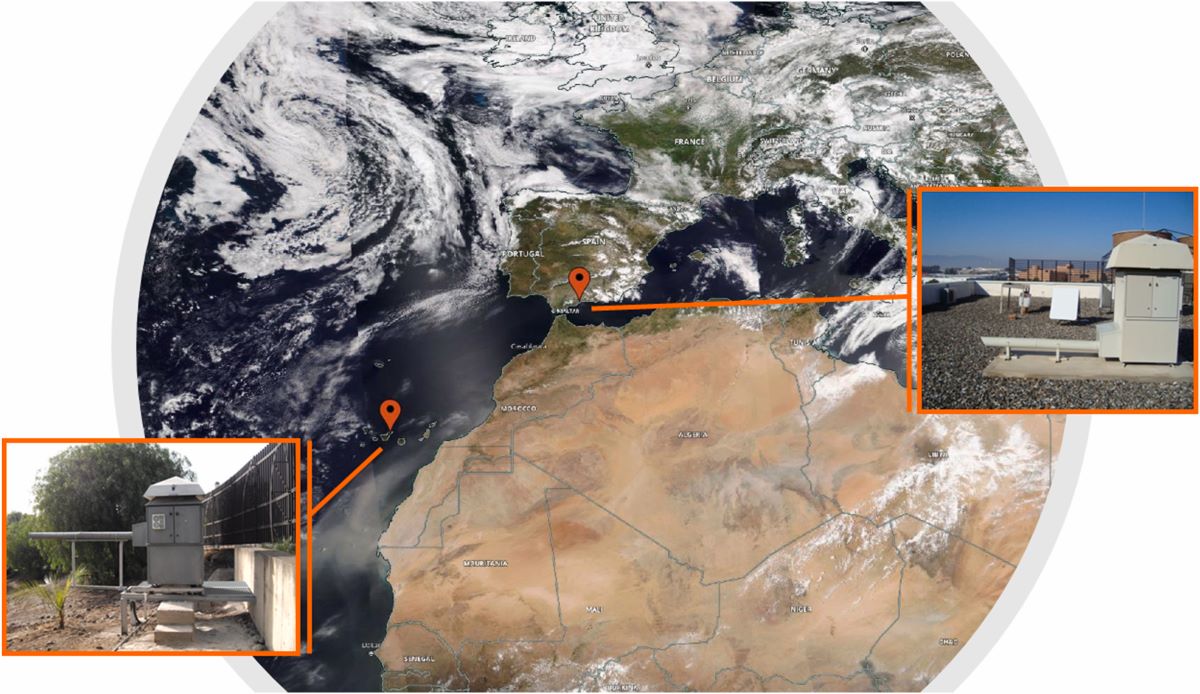
Chemosphere magazine has just published an open access article. an article With the results of a study prepared by researchers from the universities of La Laguna and Malaga on the particles transported from Africa to the Canary Islands and the south of the Iberian Peninsula during two episodes of intense haze in 2022. This type of research is becoming increasingly relevant at a time when warnings about suspended dust of Saharan origin are going to be more frequent and, therefore, it is of interest to know as much as possible about its composition.
Researchers Francisco Javier Expósito, Juan Pedro Díaz, Pedro A. Salazar-Carballo, Cristina González and María López-Pérez, affiliated with entities such as the Laboratory of Medical Physics and Environmental Radioactivity, participated in this work on behalf of the University of La Laguna (FIMERALL) and the Earth and Atmosphere Observation Group (DROP) and the Canary Islands Institute of Tropical Diseases and Public Health (IUETSPC)
The present study focuses on the two consecutive and markedly intense episodes of Saharan dust intrusion that significantly affected southern Spain (Malaga) and, to a lesser extent, the Canary Islands (Tenerife) in March 2022. These two episodes resulted from atypical weather conditions in the region and led to record levels of aerosols in the air in the city of Malaga.
The activity levels of several natural and artificial radionuclides (which are the unstable form of an element that emits radiation to transform into a more stable form) (7Be, 210Pb, 40K, 137Cs, 239Pu, 240Pu, 239+240Pu) and radioactive indicators (total alpha and total beta) were affected by these events.
These episodes caused, for example, 137Cs activity in aerosol samples at the Malaga monitoring station to reach the highest concentrations ever recorded since large-volume aerosol monitoring began there in 2009.
The results reported in this study offer additional insights into the dependence of particle properties on the source regions and the geographic location where they are collected. These findings can be valuable to the scientific community as they contribute to documenting and understanding the interaction between mineral aerosols and the environment.
Although the cases studied here lasted only a few days, the reported radiological impact suggests that this type of extreme Saharan dust event could have significant regional implications. Furthermore, the collected data suggests a continuous enrichment of 137Cs and plutonium isotopes in the soils of the affected areas, as a consequence of the resuspension, transport, and deposition of Saharan dust. In any case, the concentrations of radionuclides detected in the analyzed aerosol samples do not pose any radiological risk to the population.

 Spanish
 English
 French