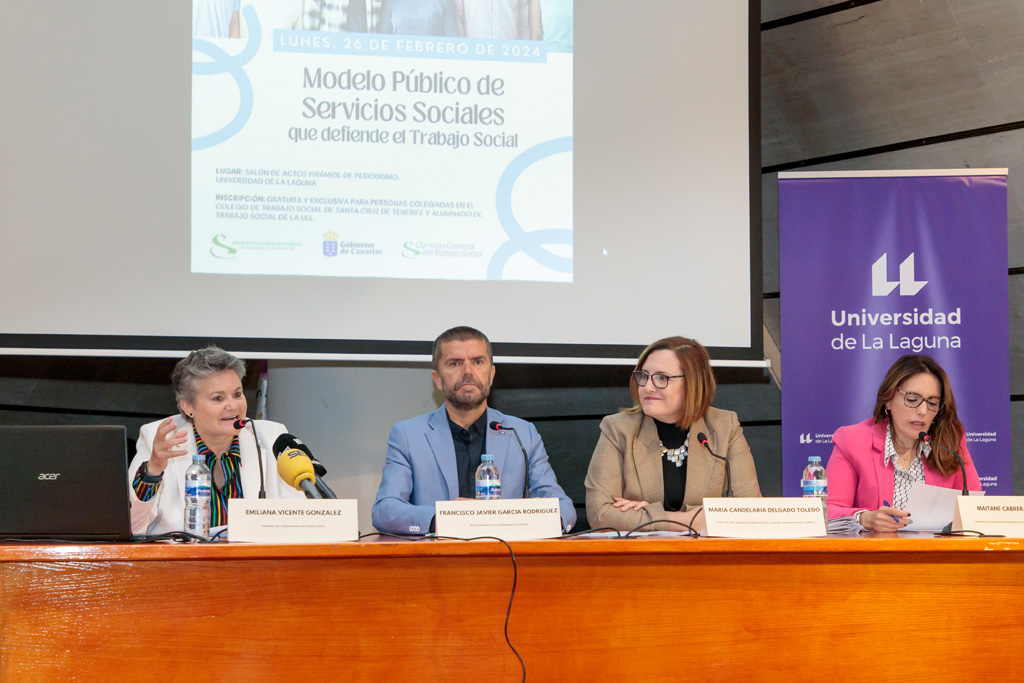
The Faculty of Social Sciences and Communication of the University of La Laguna hosted today, Monday, February 26, the conference “The public model of social services that Social Work advocates”The event, organized by the Official College of Social Work of Santa Cruz de Tenerife and the General Council of Social Work, featured presentations by various institutional representatives outlining legislative and organizational strategies aimed at advancing a social services model in the Canary Islands and Spain. These services are designed to be applied to diverse sectors and groups, while always maintaining their status as public services.
The opening ceremony was attended by the Rector of the University of La Laguna, Francisco García Rodríguez; the Minister of Social Welfare, Equality, Youth, Children, and Families of the Canary Islands Government, María Candelaria Delgado Toledo; the President of the General Council of Social Work, Emiliana Vicente González; and the President of the Official College of Social Work of Santa Cruz de Tenerife, Maitane Cabrera Primo. Before beginning the formal opening ceremony, those at the table paid tribute to the victims of the building fire in Valencia this past weekend, as well as to the social services staff who have worked tirelessly to assist the affected families.
The rector emphasized the importance of the conference addressing social services from a public perspective because “it is a crucial dimension.” In a society that, as he pointed out, faces the danger of fragmentation and polarization, he underscored the importance of social work in giving a voice to those without resources. He advocated for public higher education institutions to participate in this debate by providing spaces for work and discussion, as well as contributing to knowledge transfer. In this regard, he noted that the University of La Laguna has collaborated on various initiatives, such as the development of the Catalog of Services and Benefits of the Canary Islands Public Social Services System, the Canary Islands Social Services Plan, and the Canarias Convive project, which focuses on immigration management.
The president of the General Council of Social Work announced that the conference would feature the presentation of the Fourth Report on Social Services in Spain and the Social Work Profession, which reflects the current state of the profession. She noted that in the 35 years since the development of social work, “many things have happened that must be included” in this new document. Emilia Vicente pointed out that one of the challenges for this profession is “to equip it with a scientific methodology and more precise and uniform terminology to further its advancement.” She also advocated for expanding beyond mere social services to encompass other areas within the discipline, such as forensics and the prison system.
The president of the Official College of Santa Cruz de Tenerife pointed out that the progress that Canarian society demands requires values of coexistence and solidarity, and therefore celebrated that these conferences allowed for the presentation of a model of social services supported by the public system, something that was already discussed in the first Social Services Law of the Canary Islands, since 1987.
 Social policies of the Canary Islands government
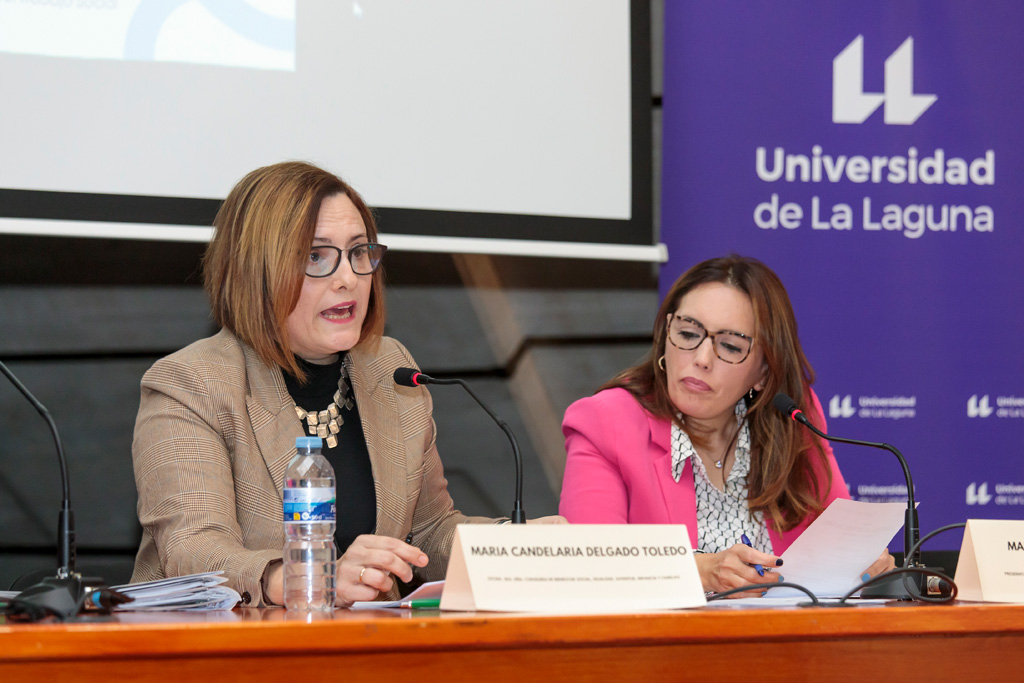
The Minister of Social Welfare, Equality, Youth, Children, and Families of the Canary Islands Government, in addition to participating in the opening panel representing one of the collaborating organizations, was the first speaker, outlining the general priorities of her department during this legislative term. María Candelaria Delgado Toledo, a practicing social worker, has entered politics and therefore has firsthand knowledge of the sector's needs.
She began by stating that the department's main objective is to improve the public social welfare system in the Canary Islands, prioritizing assistance to individuals and committing to a public system. "Only through hard work, effort, and professionalism can we build a more prosperous Canary Islands, and social services are one of the pillars of the welfare state." She then detailed the actions that have been implemented, or will be implemented in the future, in areas such as support for families at risk of poverty, the elderly, children, and immigrants.
As an immediate challenge, he cited the development of the Social Services Law, which was approved in 2019 with broad consensus from the regional parliament, but which has not yet been translated into more operational regulations, such as the catalog of services and benefits, a strategic plan that articulates its operation, and a map of services for its deployment in the territory.
Other objectives set for this legislative term include expanding the Canary Islands Citizen's Income program to provide resources to 13,000 families in need; reviewing dependency assessments, as a considerable number of people were awaiting this procedure and the number of applications has increased to approximately 160,000; strengthening home care services by improving coordination with local councils; launching the first Canary Islands Social and Healthcare Strategy, which will be in effect until 2027; creating the Digital Disability Card to facilitate the management of benefits to which people with declared disabilities are entitled; and also several measures concerning youth and children, such as establishing a chair with the University of La Laguna on Childhood and Adolescence; creating an Advisory Council for Equality and Discrimination; and, in immigration, working to provide dignified care for minors under Canary Islands guardianship and expediting negotiations with the central government for their shared distribution throughout the country.

 Spanish
 English
 French