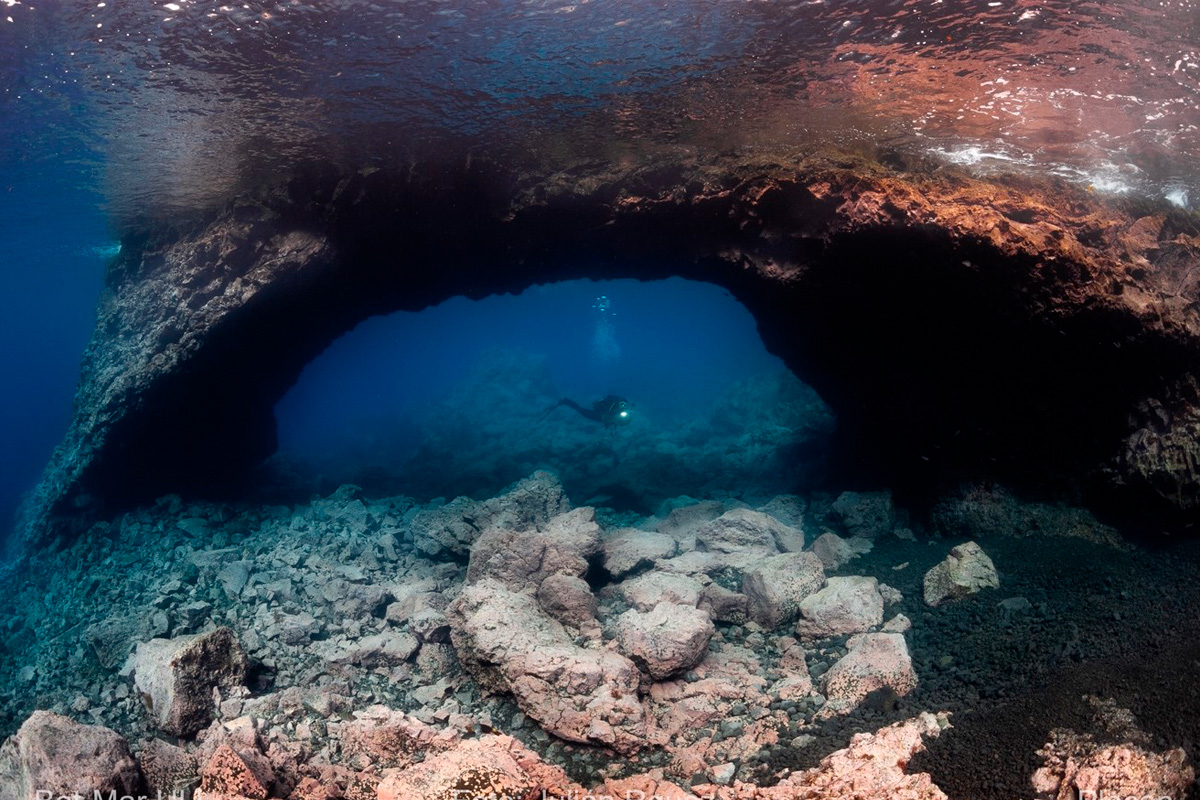
The Marine Biology research group at the University of La Laguna (BOTMAR ULL) has just published in the magazine Frontiers in Marine Science the first scientific publication This study recounts and describes the colonization process of the lava deltas of the Tajogaite volcano. These new marine habitats constitute an ideal natural laboratory for studying ecological processes that are difficult to replicate under controlled conditions, such as the primary succession of an ecosystem after the cessation of a volcanic eruption. Observations show that fish were the fastest to occupy this new ecosystem, followed by invertebrates and, more slowly, macroalgae.
The publication is signed by Carlos San Gil Hernández, Daniel Álvarez Canali, Javier Reyes, Julián Rodríguez and Marta Sansón Acedo, who is responsible for the BORMAL ULL group.
In these primary succession processes, all communities of organisms start from scratch, since they colonize a completely sterile substrate, devoid of any life form. In these early stages of evolution, unique demographic events occur, often resulting from limited competition and interaction between species. Consequently, it is possible to find communities and populations of organisms in these habitats that are uncommon or absent in mature ecosystems.
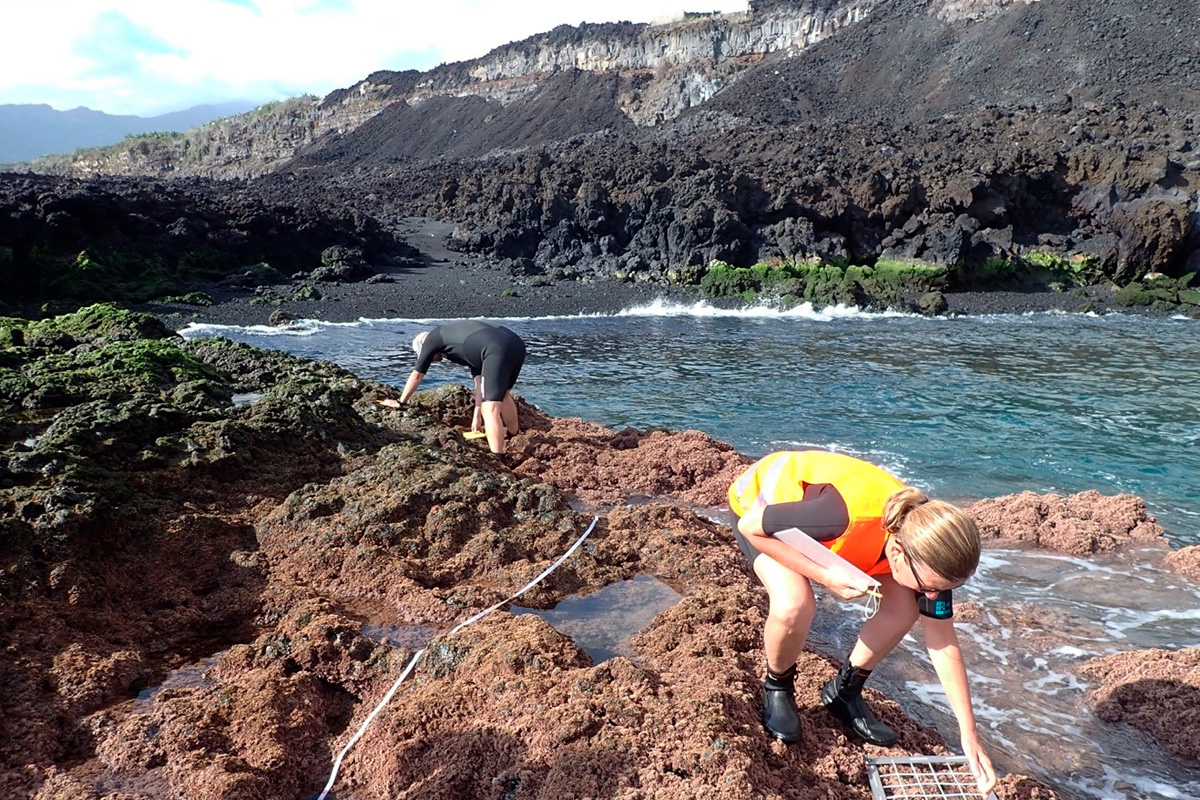
This study specifically analyzed the evolution of intertidal and subtidal communities 2, 4, 5, and 7 months after the eruption ended. Sampling included macroinvertebrates and algae in the intertidal zone, and fish, macroinvertebrates, and algae in the subtidal zone. To test and verify the trajectory of this new ecosystem, the San Juan Volcano lava delta (1949) was chosen as a reference control area.
 Ecosystem evolution
The colonization of the deltas has been rapid, to the point that 641% of the species present in the control area have already reached the new lava flows. Due to the increasing incorporation of species, the complexity of the communities has progressively increased, and all have followed the same trajectory: converging towards communities similar to those established in the control area, although the rate at which they have changed over time differs among the various groups.
After seven months, fish showed the fastest change, with only minor differences between the lava deltas and the control area. Following fish, the fastest-changing communities were those of invertebrates, while macroalgal communities were evolving the most slowly. Thus, the different communities of organisms are at different stages of succession, some more advanced and others still in their early stages.
Fish have been the fastest to arrive because adults from surrounding areas unaffected by the eruption entered to colonize the deltas. With invertebrates (almost entirely), such as algae, colonization has been via larvae or diaspores carried by currents, so the process has been slower.
Another characteristic of primary succession is that it involves significant changes in the specific composition of communities, where early colonizer species are replaced by later successional species. This has only occurred with algae, while in fish and invertebrates, the dominant species in deltas are the same as those in mature, undisturbed ecosystems.
BOTMAR ULL has been conducting research in the delta area since February 2022 and recently completed its latest periodic monitoring campaign. Since the eruption ended, the group has carried out more than 150 dives in the area to study the gradual colonization of these habitats.
However, their studies extend far beyond this recently published work, as they also conduct various experiments and sampling to understand species settlement patterns and the genetic structure of the populations establishing themselves there. They also use technical diving to collect data at greater depths in areas inaccessible to recreational diving. Recently, in their latest expeditions, they have also begun studying marine communities established at locations where carbon and pH anomalies have been recorded.
This project is carried out under the auspices and funding of the Ministry of Science, Innovation and Universities, through its Knowledge Generation Projects program; the Cabildo of La Palma, through a collaboration agreement with the University of La Laguna, “Campus Océano”; and the Oceanic Platform of the Canary Islands provides logistical support so that these investigations can be carried out through its DELTA project.

 Spanish
 English
 French