
Members of the Geoheritage and Geotourism in Volcanic Spaces Research Group of the University of La Laguna (GeoturvolThey have just published in the journal Geofísica Internacional of the Autonomous University of Mexico a scientific article on geotourism of the Tajogaite volcano. It reports on the work of identifying, selecting, characterizing and valuing geomorphosites of high geotourism interest representative of the natural and cultural heritage associated both with the landscape affected by the eruption and with the landscape generated after it, and which can be visited in situ or virtually, in accordance with the principle of accessible tourism promoted by the World Tourism Organization.
The spectacular volcanic eruption on La Palma in 2021 attracted thousands of visitors as it unfolded, and the variety of related volcanic and non-volcanic landforms and processes has drawn many tourists to the island. The geodiversity of landforms and processes generated directly during the eruption, along with the geographical heritage (both natural and cultural) that existed before the eruption but was affected by the volcanic material, constitute magnificent examples of geomorphosites with potential for geotourism.
 The publication is signed by Javier Doniz Paez, coordinator of Geoturvol at the University of La Laguna and researcher at Involcan; Rafael Becerra Ramírez, Rafael U. Gosálvez and Estela Escobar, from the Geovol group of the University of Castilla-La Mancha and scientific collaborators of Involcan; and Karoly Németh, from Massey University (New Zealand).
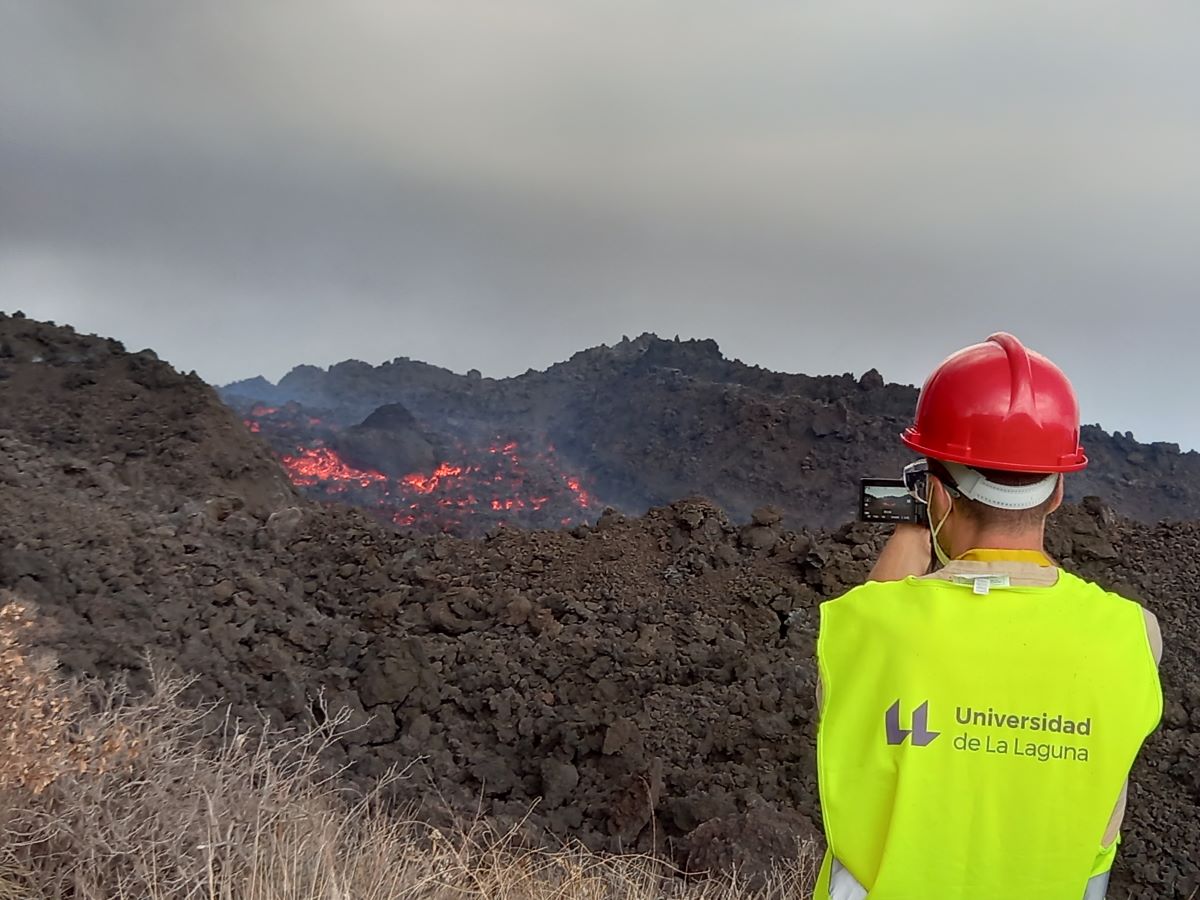
To develop the catalog of geomorphosites with geotourism interest, field campaigns were carried out during the eruption, in 2021, and after it, in 2022 and 2023, during which numerous photographs, drone recordings and, above all, tours of the different places that could be accessed were made.
Once selected, a semi-quantitative methodology for assessing geoheritage was applied to evaluate scientific, added, and use and management values. This allowed for defining the level of use for each of the selected geomorphosites in accordance with the conservation of their heritage values. One of the main difficulties during fieldwork was that several of the selected sites were inaccessible due to high temperatures and high concentrations of gases harmful to humans; therefore, recordings were made to apply this methodology.
Catalogue of geomorphosites
Sixteen geomorphosites directly and indirectly associated with the Tajogaite volcano have been studied. Of these, six sites were formed during the eruption (Tajogaite volcano cone, hornitos, eruptive fissures, pāhoehoe lavas, 'A'ā lavas, and lava delta) and ten correspond to the natural and rural heritage prior to the eruption (Montaña Rajada, Montaña Cogote, Montaña Todoque, Montaña La Laguna, Miradores de Tacande, Campitos, Tajuya, San Isidro, La Hoya, and La Bombilla).

Small ovens from the eruption.
In general, the six geomorphosites directly associated with the Tajogaite eruption and Montaña Rajada have scientific values that outweigh their added value, so their use for tourism should be more restricted than in the nine geomorphosites selected prior to the eruption, whose added value is greater than their scientific value. In fact, of the sixteen sites, seven are currently inaccessible, while the rest can be visited in person. This will define and determine whether the geoitinerary designed by the authorities and adventure tourism companies is real or virtual.
All the selected geomorphosites are representative of the volcanic heritage generated during the eruption, that which existed previously, and the result of the combination of both. Therefore, the research team believes these 16 sites encompass the full range of interest for volcanic tourism.
The research that led to the publication was funded by the VOLTURMAC project, whose lead institution was the Canary Islands Volcanological Institute (Involcan), and by the seventh objective of the La Palma Territorial Recovery Project commissioned to Involcan by the General State Administration, the Ministry of Science and Innovation and the Ministry of Ecological Transition and Demographic Challenge of the Government, and the Ministry of Ecological Transition, Fight Against Climate Change and Territorial Planning of the Government of the Canary Islands-GESPLAN (year 2022).

 Spanish
 English
 French