
A study led by the University of La Laguna has demonstrated the effectiveness of an intervention program for adolescents. The program successfully identified sexist attitudes and some of the factors that can trigger them, and also evaluated the intervention program itself. The study involved 723 high school students from four schools (three public and one private) in several phases over the project's duration, from March 2021 to January 2024.
The most significant findings reveal that there is a high consumption of pornography among adolescents (89% of the boys in the sample); that there is a tendency to negatively value the passive behavior of a woman who is a victim of gender violence; that the most sexist attitudes occur in male adolescents and in those who have been exposed to or consume pornography; and that educational intervention can be effective in the short and medium term to reduce this sexism.
The project has been financed by the CajaCanarias Foundation and the "la Caixa" social welfare program, and those responsible for it have been the teachers of the University of La Laguna. Marta Díaz Gómez, from the Nursing Department, and José Miguel Díaz Gómez, from the Department of Cognitive, Social and Organizational Psychology, together with Elena Vila Cortavitarte, midwife of the Canary Islands Health Service.
Despite the importance of the problem, few studies analyze the factors related to sexist attitudes in adolescents. And, while comprehensive sex education programs are known to be effective in combating gender inequality, few studies evaluate their effectiveness in the medium and long term. Therefore, this project had a dual objective: to identify some sociodemographic variables that predict sexism in adolescents and to analyze the effect of educational interventions to promote equality and prevent gender-based violence.
The sample students answered two questionnaires about sexist attitudes, stereotypes, and gender roles to assess sexist attitudes. Some of the items with the highest scores were: “A father’s main responsibility is to financially support his children,” which received a 22.51% agreement score; “When my partner is angry with me, I always feel guilty” (16.71%); “It is normal for men in love to be jealous” (15.31%); and “Only some types of work are appropriate for both men and women” (11.91%).
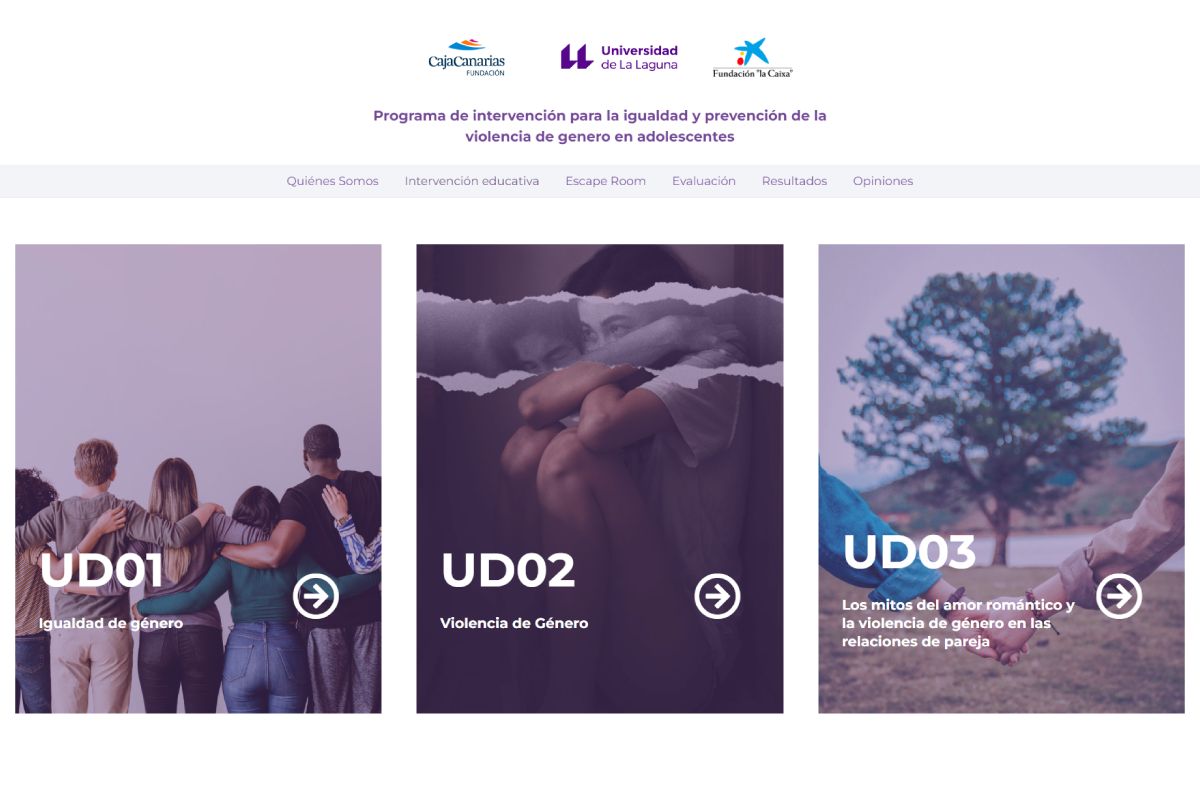
Project website.
Boys scored significantly higher than girls, reflecting greater sexism. Furthermore, students from other countries, mostly Latin America, scored higher than those from Spanish families; and students from public schools scored higher than those from private schools.
These responses reported on the explicit component of sexist attitudes, so the research team estimated that they could be influenced by “social desirability.” Therefore, they assessed implicit sexist attitudes using a narrative about which respondents were asked their opinion without being told they were being evaluated. The text described an interaction between two young people with a component of gender violence and some ambiguity: the girl invites the boy to her house and initially agrees to have sex. But when she expresses her desire not to continue, the boy forces a non-consensual encounter during which she adopts a passive attitude. More than 501% of the adolescents considered this passive behavior of the woman in an unwanted sexual encounter to be incorrect.
Another noteworthy finding is that 89% of the adolescents had consumed pornography, and it was found that exposure to this content had a significant effect on sexist attitudes, with higher scores on both questionnaires among consumers, who also stated that pornography had influenced their relationships.
Intervention
The 561 first-year high school participants were randomly assigned to either an experimental group that received an intervention for the prevention of gender violence, or a control group that received a talk on contraception and sexually transmitted infections.
The intervention took place over several sessions, totaling 15 hours, and included lectures followed by discussions, group exercises, and videos to reinforce key concepts about equality and gender violence. It also included reading a comic about the manifestations of an unequal relationship, and a escape room whose purpose was to help uncover the obstacles that women have encountered throughout history in their fight against inequality.
Changes were assessed at six and twelve months after the intervention, revealing a decrease in sexist attitudes in the experimental group, with a significant drop in scores on both scales. There was also a significant improvement in the assessment of the passive behavior of the female protagonist in the story, who was forced into an unwanted sexual relationship. These effects persisted until the end of the follow-up period. Therefore, the team believes this sex education program is a valuable tool for reducing sexist attitudes in adolescents and achieving a stable, medium-term change in their behavior.
All the material and methodology used is available on the website https://previogen.com/ and thus provide tools to address equality education and the prevention of gender-based violence among adolescents in the classroom. The results of this research have led to a doctoral thesis that will be presented this year., an article in the International Journal of Environmental Research and Public Health and several communications at conferences.

 Spanish
 English
 French