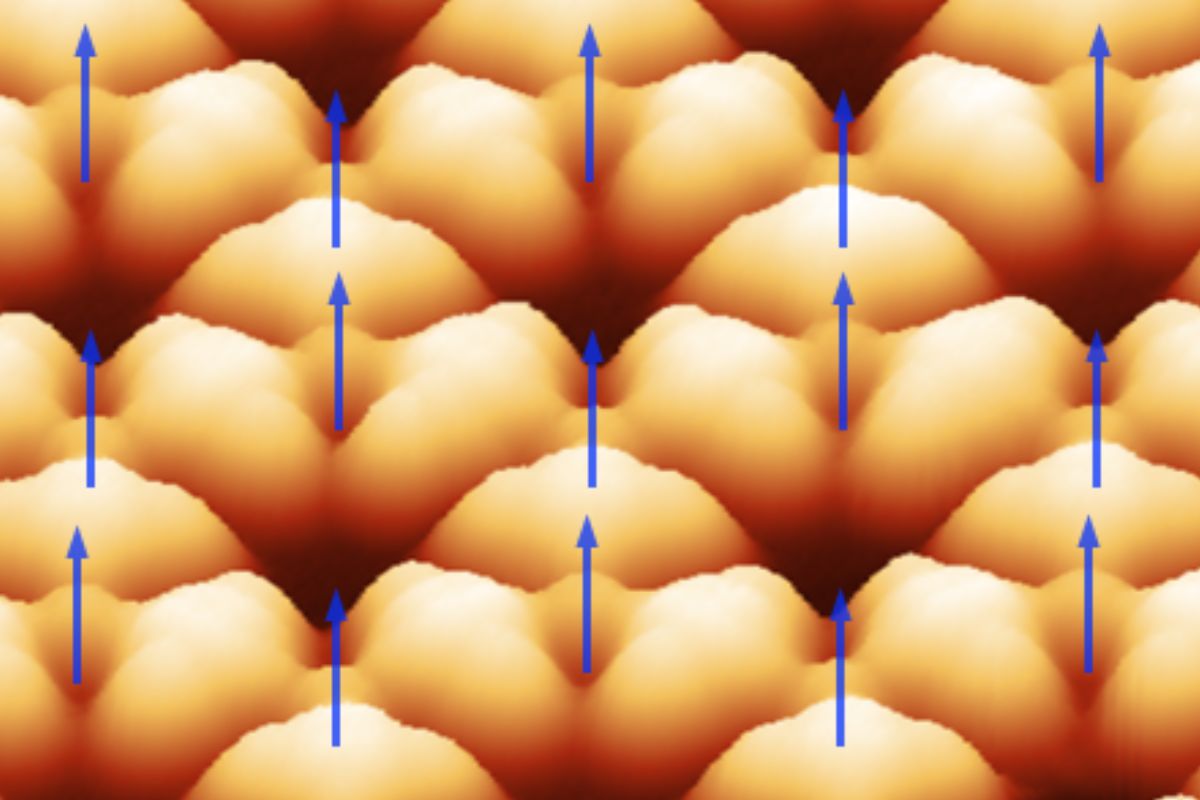
Representation of the orientation of magnetic moments in the organometallic lattice that gives rise to a two-dimensional layer with a thickness of a single atom.
An international research team has, for the first time, observed two-dimensional ferromagnetism in an organometallic structure. This structure achieves greater magnetic stability than any other similar two-dimensional system studied to date, making it the thinnest magnet ever observed and with the lowest concentration of magnetic metals.
This theoretical and experimental research team has been led by scientists from the Institute of Nanoscience and Materials of Aragon (INMA) in Zaragoza and the Center for Materials Physics (CFM) in Donostia-San Sebastián, together with researchers from the BOREAS line at the ALBA synchrotron, members of the ICMM in Madrid, the Technical University of Zurich, CONICET of Argentina and the University of La Laguna, more specifically Professor Fernando Delgado, from the Department of Physics. The work has been recently published in Nature Communications.
Ferromagnetic materials are what are commonly known as magnets. At a microscopic level, their main property is that the magnetic moments of the atoms of the material, the basic constituents of matter, align with each other, resulting in a total magnetic moment observable macroscopically.
Physicists describe this property using a quantity called magnetization. Thus, a material with greater magnetization will be a stronger or harder magnet. Hard magnets play a fundamental role in society, from the electronics industry for information storage and sensors applicable to a wide variety of fields (biomedicine, automotive, military, robotics), to the construction of hydraulic turbines for electricity generation and wind turbines, as well as electric motors. They are, therefore, of great importance for the decarbonization of the economy.
The hardness of these magnets is determined by two fundamental quantities: On the one hand, the so-called Curie temperature TC, Above this point, the magnet ceases to behave as such. On the other hand, there is the so-called coercive field B.c, which corresponds to the magnetic field that would need to be applied to the material to cancel its magnetization, giving an idea of the material's resistance to being demagnetized.

ULL researcher Fernando Delgado. (Provided).
Given this extensive field of applications, it is of great interest to be able to generate magnets that are as thin and hard as possible, thus reducing the cost in terms of material (or carbon dioxide generated in its processing), where the ultimate limit would be determined by the atomic scale.
One of the most interesting proposals comes in the form of so-called two-dimensional organometallic coordination networks (2D-MOCNs). Among other advantages, 2D-MOCNs are technically simple to fabricate using self-assembly protocols at near-room temperature, which significantly reduces manufacturing costs. Furthermore, these 2D-MOCNs can be generated from different magnetic metal atoms deposited on non-magnetic substrates, resulting in easily scalable periodic structures. However, despite these promising properties, until now no 2D-MOCN had been synthesized that explicitly exhibited ferromagnetism in two dimensions.
The results are particularly striking, as a small amount of iron atoms (~5% from a monolayer) leads to out-of-plane magnetization with a coercive field of about 2 Tesla, equivalent to about ten million times the Earth's magnetic field, and a Curie temperature of about 35 K (-238 °C). These values are close to the record values obtained to date based on layers of two-dimensional materials that interact through van der Waals forces, which are much more difficult to synthesize and have much higher concentrations of magnetic elements.
These findings culminate more than two decades of research into ferromagnetism in 2D-MOCN materials, representing a significant advance in surface science and magnetism. With this crucial step, the research team hopes to foster the study of new magnetic 2D-MOCN materials that can yield stable two-dimensional magnets at much higher temperatures and with low densities of magnetic metals, which can be difficult to obtain or expensive, such as cobalt, an increasingly important technological (and geopolitically problematic) metal.

 Spanish
 English
 French