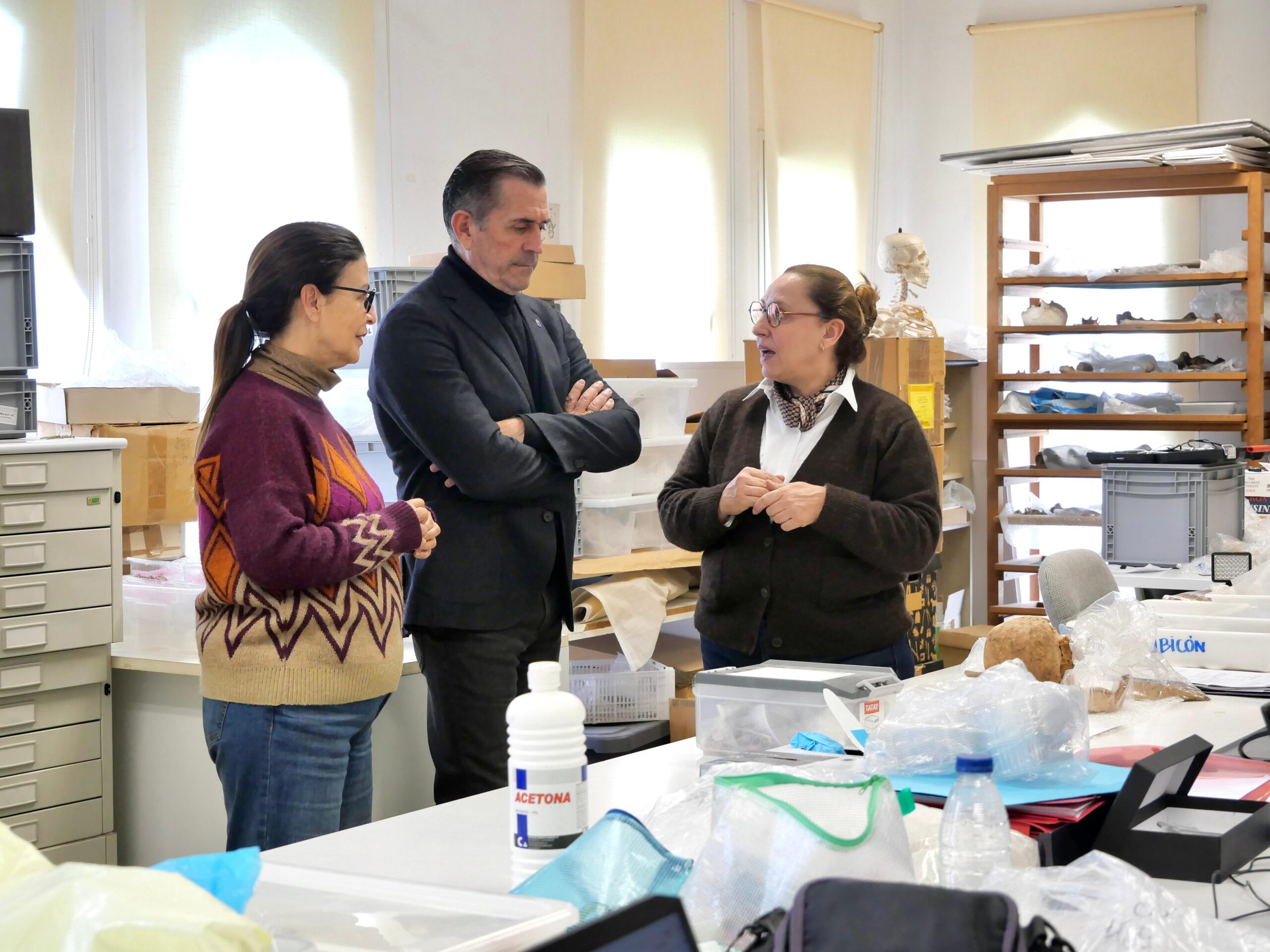
The latest archaeological excavation campaign at San Marcial de Rubicón in Lanzarote has unearthed a wealth of bone, animal, metal, and ceramic artifacts, among others, providing evidence of early contact between the indigenous and European cultures. Following the fieldwork, the research continues under a collaborative agreement between the Government of the Canary Islands, the Yaiza City Council, the University of La Laguna, and the University of Las Palmas de Gran Canaria, with the materials being analyzed in the Prehistory and Archaeology Laboratory at the University of La Laguna.
The co-directors of the Rubicon Project, Doctors María del Cristo González and Esther Chávez, along with the company Baraka Arqueólogos and specialists in various fields, carry out the laboratory work, which mainly consists of cataloging the artifacts recovered from this first European settlement in the Canary Islands. Furthermore, the project has a strong educational focus, and students also participate voluntarily in the research.
 The Director General of Culture and Cultural Heritage, Miguel Ángel Clavijo, visited the facilities of the University of La Laguna to learn about the preliminary results of the laboratory work, "which is generally not seen, but from here we extract all the historical information that these archaeological sites provide us," Clavijo assured.
During the meeting with the research staff, the director general stressed the importance of the Canary Islands universities in the study and knowledge of the history of the islands as “absolutely fundamental” institutions to provide “a great deal of information about the first cities of the archipelago”, in this case.
It's worth remembering that this site has a high scientific and heritage value, as it marks the beginning of the exploration and conquest of the Canary archipelago in the 15th century. This is clearly reflected in the ceramics imported from Europe, which "appear in the same contexts, sharing space with indigenous ceramics, but not only indigenous ceramics from Lanzarote," González explains.
Initial results
Initial findings indicate that, in addition to the ceramic remains from Lanzarote, as is typical, there are also artifacts from Fuerteventura and Gran Canaria, something unprecedented at this archaeological site. However, according to González, “this was to be expected because these findings are the material evidence of what that written source tells us.” Le Canarien”, where the expeditions to other islands by the Norman-Castilian company, led by Jean de Bethencourt and Gadifer de la Salle, are recorded.
As already mentioned during the fieldwork, the research team located a necropolis with a dozen burials, among which the skeletal remains of three babies and one stand out. infant. Some of them were in a worse state of preservation, so they were consolidated and moved as a group, following the instructions of the restorer Patricia Prieto, "so that they could be exhumed in a controlled place such as the laboratory and thus guarantee their preservation," explains the researcher from the University of La Laguna.
It is important to emphasize that the discovery of these infant remains raises the possibility that this is the first mixed-race population in the Canary Islands. For this reason, all the bones are undergoing DNA analysis to determine their origin and radiocarbon dating to establish their age, González explains.
The archaeological research project at the San Marcial del Rubicón site will have continuity and greater stability thanks to the extension of the collaboration agreement between the Ministry of Universities, Science and Innovation and Culture, the Yaiza City Council and the two public universities of the Canary Islands, which has gone from two to four years in duration (2024-2027) with an increase in the budget and resources.

 Spanish
 English
 French