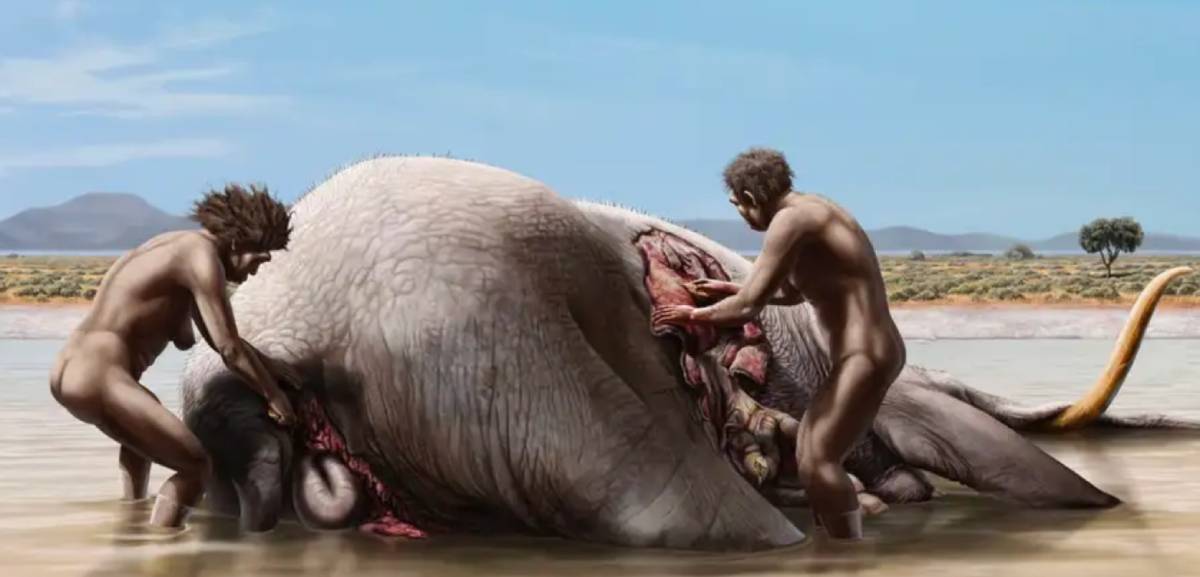
The presence of cut marks on elephant bone remains Mammuthus meridionalis Evidence from the Fuente Nueva 3 site in Orce (Granada) confirms that humans ate this animal 1.2 million years ago, according to research involving the University of Granada (UGR), the Complutense University of Madrid (UCM), the University of Jaén, and the University of La Laguna through its AMBI Lab, among others.
These cut marks on this female elephant are the oldest known for this type of animal, both in the Iberian Peninsula and in Europe to date.
In 2013, the discovery of the remains of an elephant in semi-anatomical connection associated with lithic industry remains and coprolites was published. Pachycrocuta brevirostris, ...an extinct type of hyena from the Pleistocene. The novelty of this article, published in the journal Quaternary Science Reviews, Taphonomic studies – fossil formation – and the application of artificial intelligence (AI) demonstrate that humans fed on this large animal.
“When there are no cut marks on a fossil remains found at an archaeological site, there is no direct evidence to suggest that the animal was used by humans; it only allows for speculation about the possibility… It’s like a crime: if there’s no body or weapon, you can only speculate, but with the weapon and the body, you have direct proof. The cut marks on the elephant bones are the proof that confirms that humans ate the animal,” says José Yravedra, professor in the Department of Prehistory, Ancient History and Archaeology and director of the Archaeometrics and Archaeological Analysis Unit at the CAI of Earth Sciences and Archaeometrics of the UCM.
Another key finding highlighted in the article is that the elephant also bears tooth marks. To determine which carnivore left the tooth marks on the bones, a three-dimensional analysis of taphonomic alteration documentation (in this case, tooth marks) was used, combined with artificial intelligence techniques that help classify with a high degree of probability which carnivore made the marks.
Felines yes, hyenas no, according to AI
The analysis links the marks to saber-toothed tigers and confirms that they also marked bones when they ate, suggesting that they "rushed" through their food, according to the researchers.
To the researchers' surprise, no tooth marks were found on the elephant. Pachycrocuta. “Traditionally it was said that hyenas acted on this individual, but in reality nothing has been seen to reflect this,” Yravedra acknowledges.
Finally, based on the anatomical position of the cut and the tooth marks, the researchers propose that both hominins and saber-toothed tigers had early access to the animal.
The mammoth died of natural causes.
The elephant found at Fuente Nueva 3 between 2001 and 2003 is the nearly complete carcass of a female mammoth that died of natural causes at 50-60 years of age. This mammoth is almost entirely represented, missing only its limbs and head, the whereabouts of which are currently unknown. Highly relevant information can be obtained from the micromorphology of sediments associated with this animal, as revealed by researchers from the Universities of Jaén and La Laguna. These studies consist of analyzing blocks of sediment, which are cut into 30-micron-thick slices and then examined under a microscope, revealing characteristics imperceptible to the naked eye.
“Micromorphology has shown that the female proboscidean died when the area around Fuente Nueva 3—1.2 million years ago—was submerged. This also explains the excellent state of preservation of the skeleton,” says Juan Manuel Jiménez Arenas, a researcher at the University of Granada. This indicates that humans and large felines must have taken advantage of the elephant before it was completely submerged.
“These results help the scientific community to open a window to the past, and continue unraveling the mysteries of the lives of past human populations,” Yravedra concludes.
(Press release and image provided by the University of Granada)

 Spanish
 English
 French