
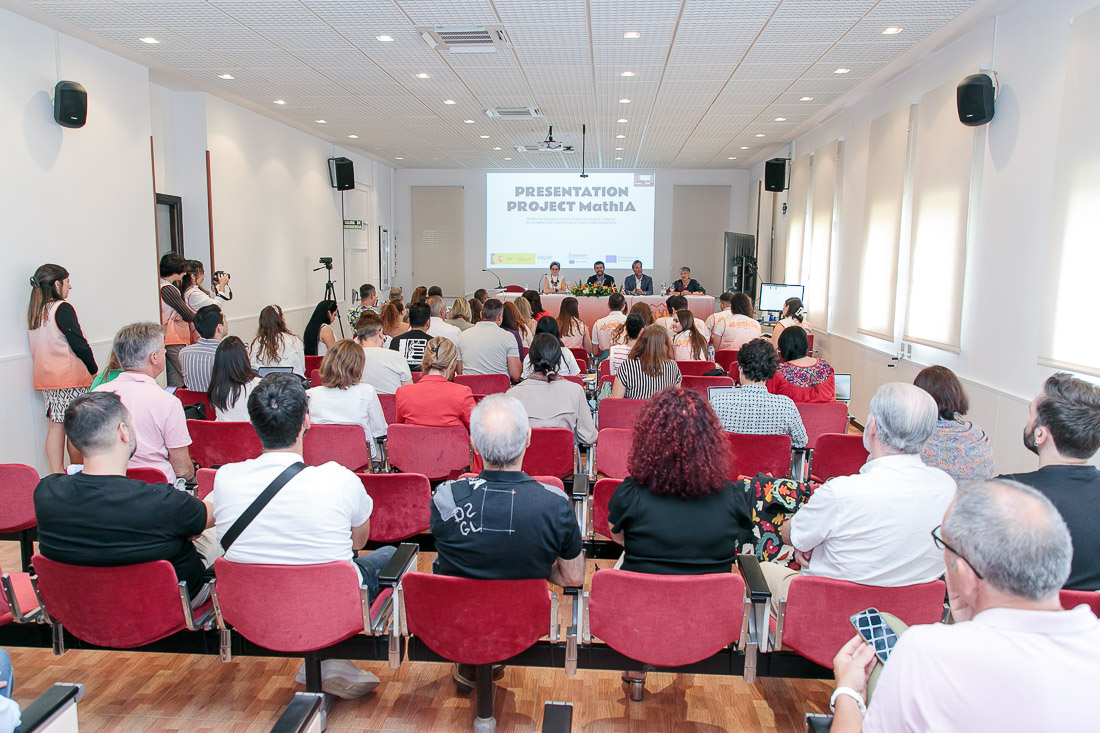
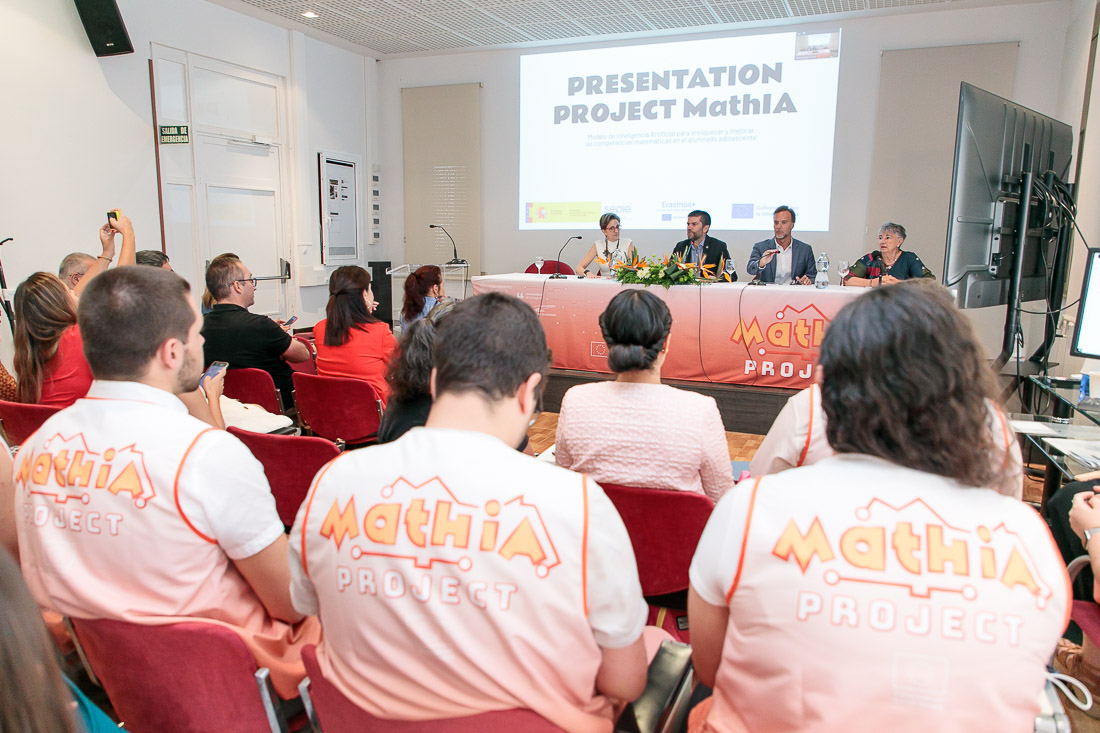
MathIA is the acronym for the research project “Artificial Intelligence Model to Enrich and Improve Mathematical Skills in Adolescent Students,” led by the University of Murcia and with the participation of the University of La Laguna. It was presented today, Thursday, April 18, at an event attended by the rector of the academic institution, Francisco García. In his opinion, this project demonstrates that, despite AI being perceived as a threat, it can also be a tool for implementing beneficial projects for the community, such as this one.
In addition to García, participants included the Deputy Minister of Universities and Research of the Canary Islands Government, Ciro Gutiérrez Ascanio; the Director of the MathIA Program at the University of Murcia, Ana Fuensanta Hernández; and the Professor of Methodology of Behavioral Sciences and project coordinator at the University of La Laguna, África Borges del Rosal. This presentation took place within the framework of the VI International Conference on the Overview of Intervention in High Intellectual Abilities, which have been developing since yesterday and will culminate tomorrow, Friday, April 19.
The rector praised the project's objective, as it addresses academic performance in mathematics, a subject that is particularly challenging for a large portion of the student body. Furthermore, MathIA aims to address potential inequalities stemming from this complexity, such as the underrepresentation of women in technical fields, and will also tackle the specific difficulties faced by groups like gifted students.
He also emphasized that this is a project that can be of great use to the teaching staff, and therefore has very high potential for transfer to society, benefiting from an interdisciplinary team. García also highlighted that the project has secured good funding in a highly competitive international call for proposals such as Erasmus+, which validates its merit.
The regional deputy minister praised this project "as an educational psychologist and as a father," noting that it will improve teaching because his own personal experience with his teenage daughter has shown him the difficulties that mathematics can entail as a subject in secondary education. He therefore valued that an AI tool in this regard could be very useful not only for teachers, but also for families.
Gutiérrez reflected that this project proposes an ethical and appropriate use of AI, which will allow for individualized instruction in this subject. In his opinion, having young people with strong mathematical skills will benefit society as a whole and represent a further step towards achieving the economic model shift that is so widely discussed these days. He also emphasized that this project is a testament to the strength of the Canary Islands' public universities and their capacity to participate in international projects.
África Borges explained the University of La Laguna's participation in the consortium of eight institutions from Spain, Portugal, and Italy developing MathIA. The Tenerife-based center is contributing a team of four researchers in mathematics, four in physics and engineering, three in social sciences, and three in behavioral sciences. Although the project has only just begun, the team has already completed its first planned task: developing basic training on AI technologies for secondary school teachers, which will begin implementation in September.
For her part, the project's general coordinator, Ana Fuensanta Hernández, detailed the specifics of this three-year project, funded with €400,000 by European institutions. Its objective is to develop an AI model that will help improve adolescents' performance in mathematical skills. This will also foster values such as equality and attention to diversity, raising awareness about giftedness, learning difficulties, and special educational needs.
Additionally, a resource bank will be created to assist teachers in lesson planning and promote learning in STEM areas, as well as reduce anxiety levels before exams. This will be achieved through five work packages covering design and development, AI model creation, impact on mathematical skills and STEM areas, and the promotion of equality, diversity, giftedness, and support for learning difficulties. Up to three websites will be developed: one about the project, another for teacher training, and a third with the database that will feed the AI.
High Abilities Days
Prior to the presentation of this project, a session of presentations was held as part of the VI International Conference on Intervention in High Intellectual Abilities, focusing on research from the University of La Laguna itself. Elena Rodríguez-Naveiras provided an overview of the institution's Comprehensive Program for High Abilities, and focused on the sub-program "Discovering Ourselves," which targets different age groups starting from age 4.
 This subprogram addresses socio-emotional and cognitive content. The former is explored experientially through play-based activities that foster self-awareness, interpersonal relationships, decision-making, and frustration tolerance. As for cognitive content, it covers subjects such as handwriting, science experiments, and activities that improve attention and concentration, primarily through challenges.
Another subprogram is “Meetings for Families,” which offers an experiential model with teamwork and discussion, aiming to provide parents of gifted students with educational strategies and tools, addressing the diverse issues that may arise in daily life. The first level focuses on enhancing their parenting skills, and the second level centers on self-care and managing the emotional and stress challenges they may face with their children.
Another presentation, by researcher Barbara Amaral from the Federal University of Mato Grosso (Brazil), focused on a personality study of gifted individuals, who may exhibit traits such as curiosity, perfectionism, creativity, sensitivity, critical thinking, impatience, sensitivity to injustice, and independence. She studied 231 individuals between the ages of 16 and 72, analyzing the expression of the Big Five personality traits: openness, conscientiousness, extraversion, agreeableness, and neuroticism, and what variations might exist in these traits according to gender, vulnerability, and occupation, among other factors.
Adriana Villalba presented the calligraphy intervention for students with high abilities, since on many occasions cognitive development occurs earlier than motor development and, therefore, this group of people may present inaccuracies in their written expression.
Factors such as margins, alignment, spacing, shape, stroke, size, slant, and thickness are evaluated on both plain and lined paper. These concepts are introduced in 15-minute sessions to improve these factors. The researcher explained that the act of writing can be tedious for these children, which is why strategies are being sought to stimulate them.
Finally, Alejandro Galera presented a paper evaluating one of the activities in the ATENEA program for gifted students at the University of La Laguna, designed to improve socialization. The participating students—11 men and 8 women with an average age of 20 and from all academic disciplines—rated these meetings positively because they allowed them to meet people with similar characteristics and interests, make new friends, and strengthen their sense of social integration.

 Spanish
 English
 French