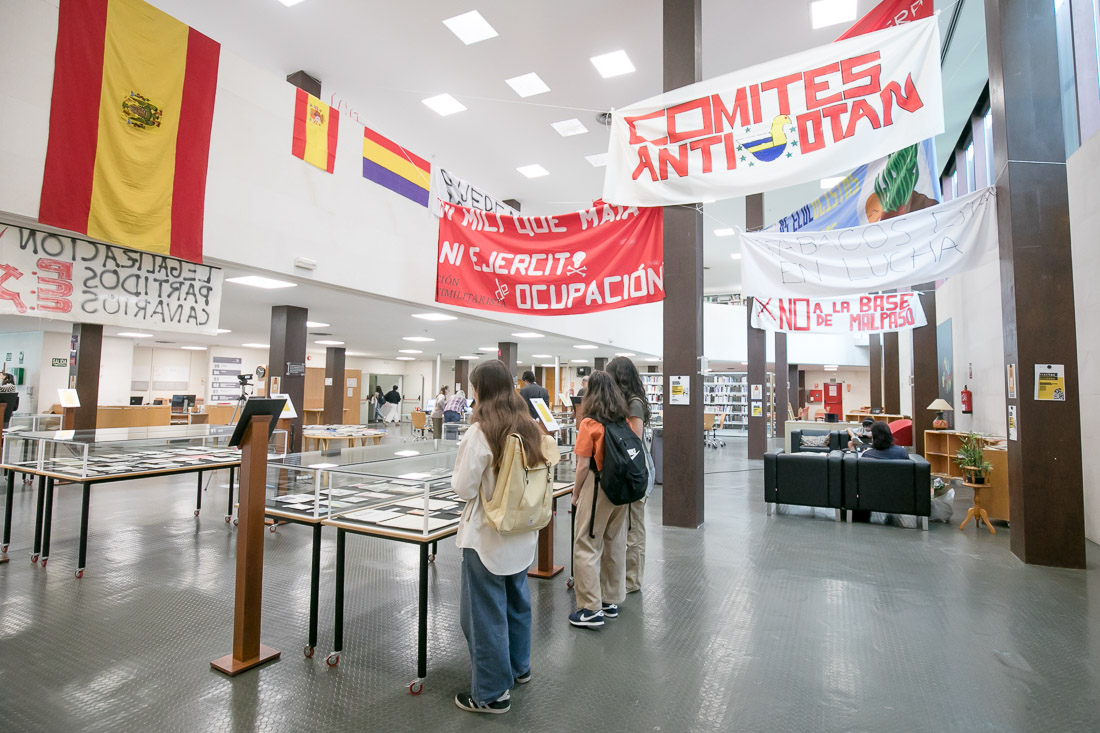
Since receiving its first documentary donation from Professor José Luis Escohotado in 1991, the University of La Laguna Library Service has been building a significant archive of diverse documents on the democratic transition in the Canary Islands, a collection that has grown thanks to contributions from individuals and organizations. This important documentary heritage on such a crucial period in recent history is the focus of the traditional exhibition that the academic institution organizes as the main event of its Book Day celebrations, which opened today, April 23, in the General and Humanities Library on the Guajara Campus.
The rector of the academic institution, Francisco García, emphasized the importance of this documentary collection because it serves not only to commemorate the period in question, but also to keep alive the unique energy and social fervor of that era. In his view, it would be beneficial to recapture that “intensity and critical, assertive attitude” at this time, when citizens face challenges such as the environmental crisis, the escalating conflict, and discontent with the Canary Islands' development model, which led to protests last weekend.
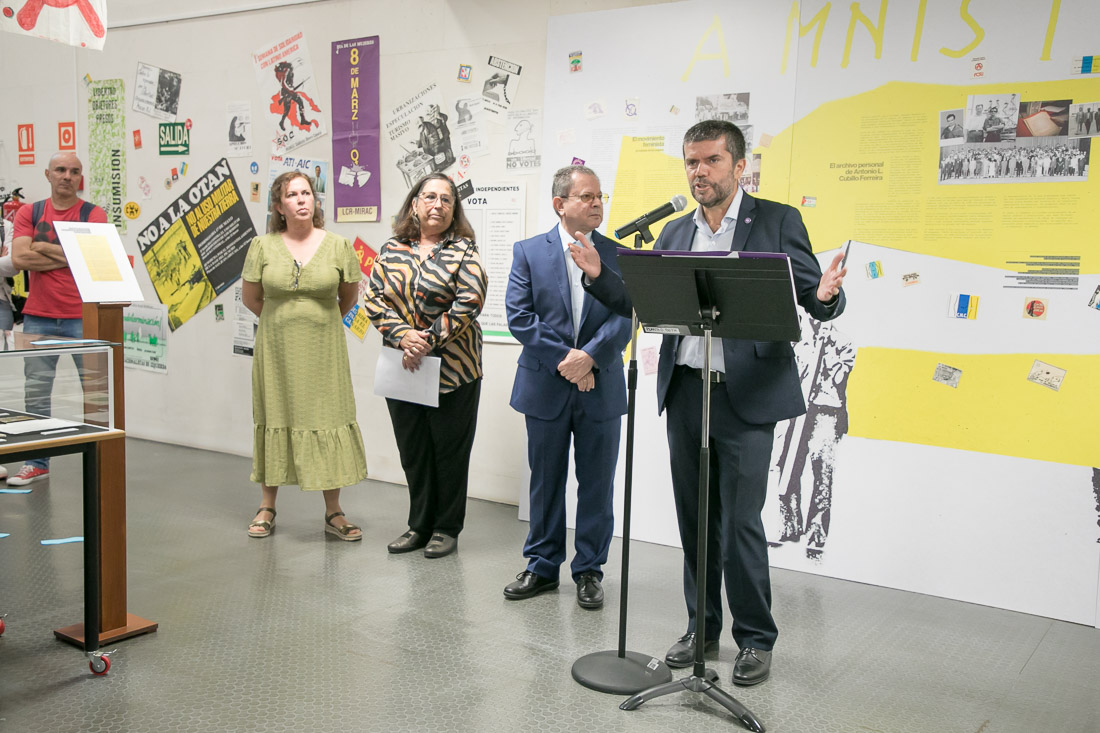
Paqui Rivero, Marta Jiménez, Gonzalo Rey and Francisco García during the inauguration.
Professor Marta Jiménez Jaén, from the Department of Sociology and Anthropology, who was part of the exhibition's academic coordination team along with Vicente Jesús Díaz Burillo and Domingo Garí-Montllor Hayek, presented the exhibition's contents. The exhibition chronicles a period in which the Spanish population emerged from its social lethargy in the late 1960s, giving way in the following decade to a major cultural and activist explosion in the final years of the dictatorship. Like the university rector, she emphasized the continued relevance of that movement, which even then denounced problems that remain unresolved today, such as pressure on the land, gender-based violence, job insecurity, access to housing, and environmental damage.
For her part, Paqui Rivero Cabeza, a technician from the Library Service and technical coordinator of the exhibition along with Fernando Rodríguez Junco, highlighted the immense amount of work involved in receiving, cataloging, and digitizing this constantly growing archive, a task made possible thanks to the agreement signed with the Canary Islands Government's Department of Education, Universities, Culture, and Sports. She also noted that much more material than could be physically displayed in the library's library space is accessible through the exhibition's website.
The inauguration began with a performance by the Philology Theatre Group, in which its members mimicked one of the many street demonstrations of the 70s, and remembered some of the victims murdered by Francoist repression at that time: Antonio González Ramos, Bartolomé García Lorenzo, Belén Sánchez Ojeda and Javier Fernández Quedasa, the latter shot down by the police in the lobby of the Central Building of the University of La Laguna.
The sample
The exhibition “Making History: The Archive of the Democratic Transition in the Canary Islands at the ULL Library” will be open until June 28, from 8:30 a.m. to 8:30 p.m., Monday to Friday. It features documents from the period encompassing the late Franco regime, the Transition, and the consolidation of democracy, a time of great political, social, labor, and cultural activity in the Canary Islands. The proliferation of organizations and the growing intensity of political and social action generated a vast amount of written, graphic, and audiovisual documentation, which forms the basis and enriches the project of the Archive of the Democratic Transition in the Canary Islands.
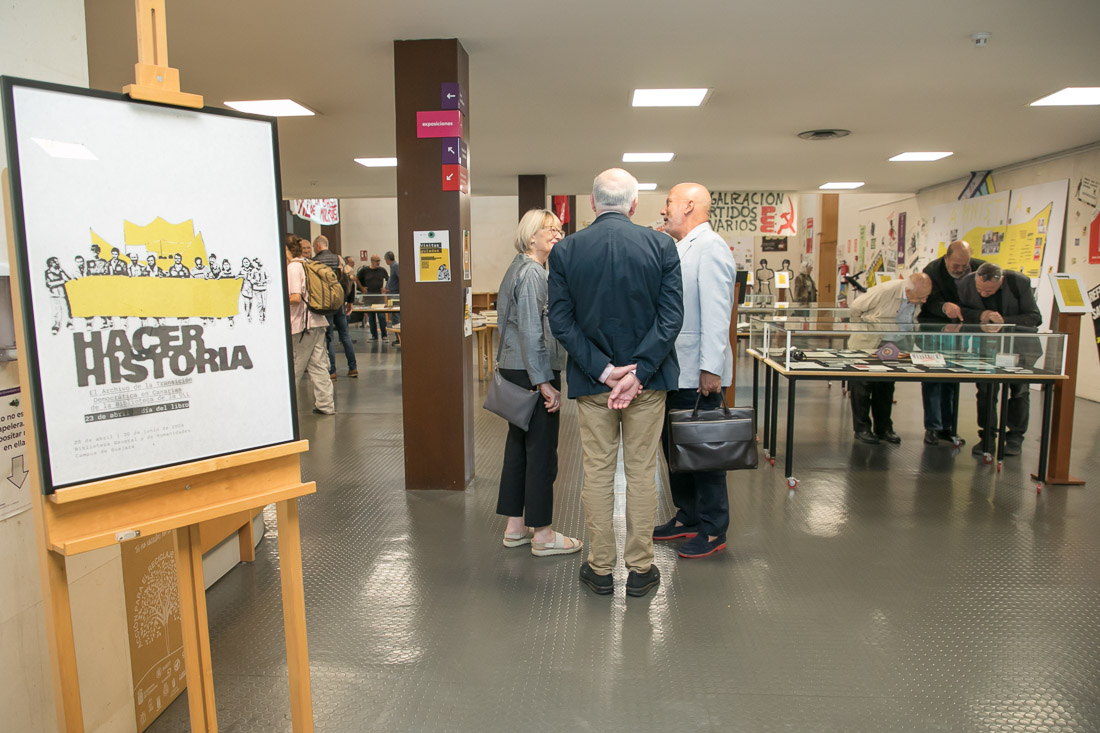 This exhibition aims to contribute to historical understanding by showcasing primary sources generated by civil society and marginalized groups—sources that may not yet be widely known. Structured in ten sections, the exhibition focuses on briefly describing the period in the Canary Islands, how the Archive was built through donations from individuals and organizations, and its commitment to continuous growth through new donations that encompass the full political, social, and cultural spectrum of the era.
It is complemented by objects related to the production of this documentation, the modes of communication of the period and some characteristic elements of the protest atmosphere of the time, provided by individuals, institutions such as the Museum of History and Anthropology of Tenerife or the University of La Laguna itself through its Industrial Heritage collection, as well as the Santo Ángel Association.
In addition, a selection of modern bibliography on this period of the recent history of the Canary Islands will accompany the exhibition, which will have its own website and a catalogue published by the Publications Service of our university, which will be presented at the opening ceremony.
Individuals or groups interested can request a guided tour of the exhibition by filling out the form. this form.
Donations and round table
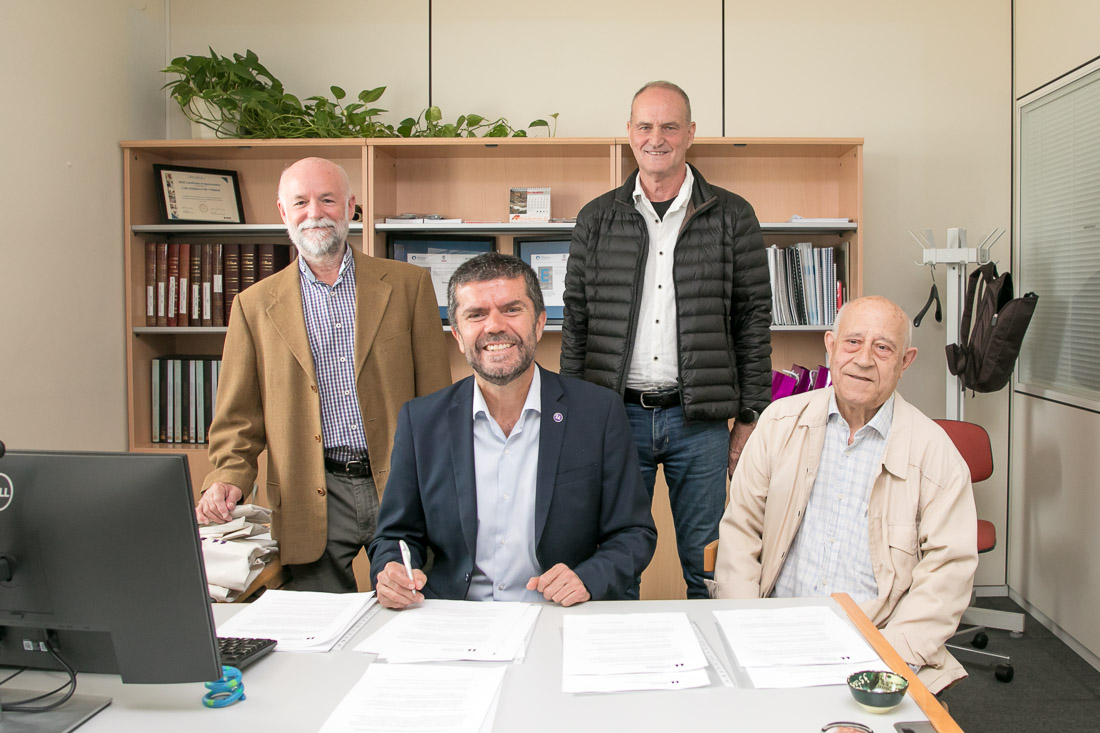
The rector with the three donors: Luis Ortigosa, Sergio Millares and, seated, José Luis Escohotado.
Another common feature of Book Day celebrations is the signing, by the rector, of the official records acknowledging material and monetary donations to the university library. The first of these was the now-traditional donation from the Alumni ULL association, amounting to 1,200 euros, which will be used by the Canary Islands Collection to acquire new volumes and carry out conservation work. This record was signed by the president of the donating organization, Luis Ortigosa.
In addition, two new donations have been received that will be added to the archive on the Transition in the Canary Islands that has been the focus of the day: on the one hand, one focused on the work of the poet Agustín Millares Sall, which was signed by one of the writer's sons, the historian Sergio Millares; and on the other hand, a new contribution from José Luis Escohotado Ibor, thus closing the circle that started this collection.
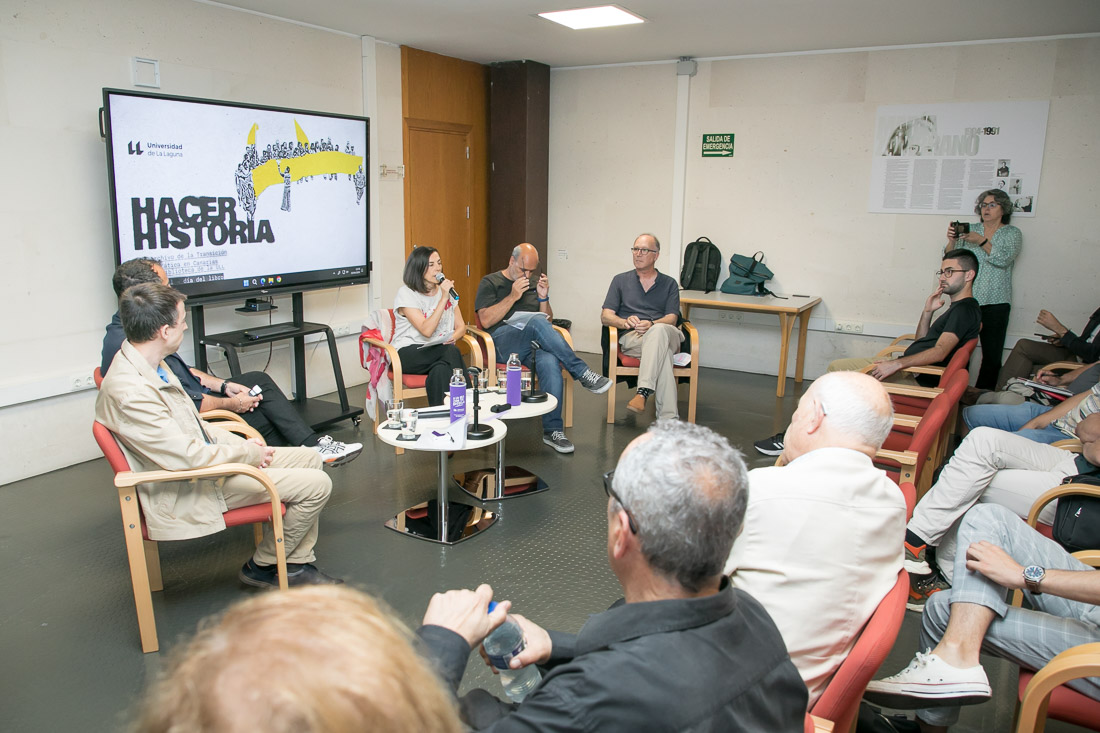
Round table discussion on archives and democratic memory.
As a complement to the opening of the exhibition, there was a round table discussion entitled “Archives and Democratic Memory: Difficulties and Challenges,” featuring Emilio Rosillo Clement, director of the Archive of Democracy at the University of Alicante; Juan Manuel Brito Díaz, professor of History at the University of Las Palmas de Gran Canaria and member of the Archive of Social Movements of Gran Canaria and the Center for Studies and Dissemination of the Atlantic (CEDA); Domingo Garí-Montllor Hayek, professor of Contemporary History at the University of La Laguna; and Alberto Báez García, researcher and professor of Political Science at the University of La Laguna, moderated by Inma Blasco Herranz, professor of Contemporary History at the University of La Laguna.

 Spanish
 English
 French