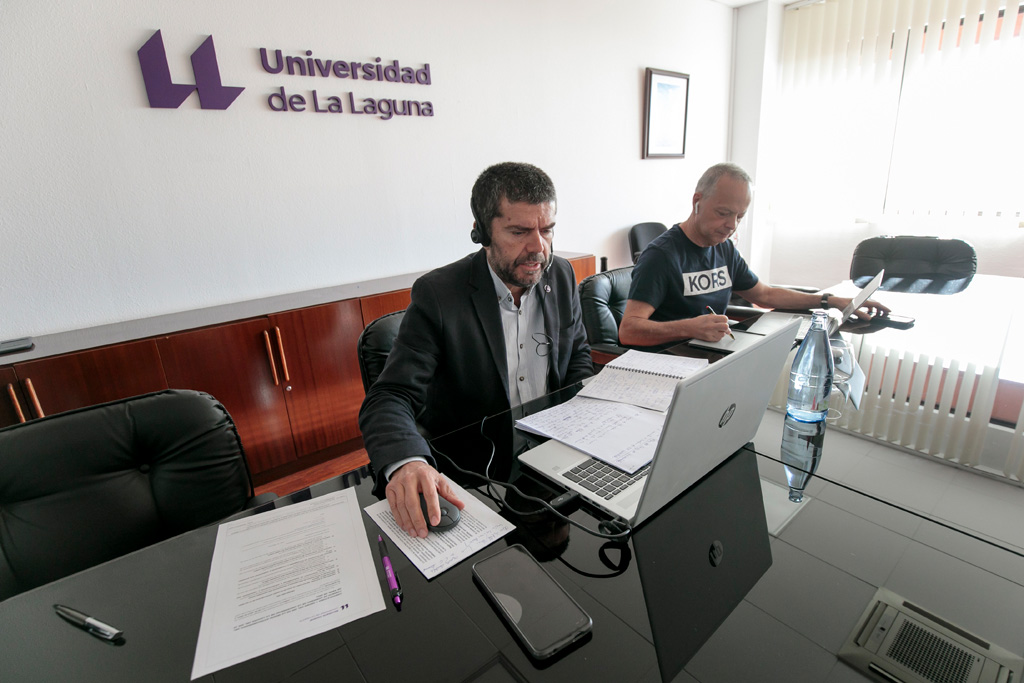
The Governing Council of the University of La Laguna has given its approval to the establishment of a new Knowledge Transfer Office (KTO) With this, it will be able to better develop one of the basic functions of any higher education academic institution, which is none other than to facilitate that the discoveries and technological developments originating within it can reach the productive fabric and society in general through contracts, agreements, patents and other possible ways.
As explained by the Vice-Rector for Research and Transfers, Antonio Aparicio Juan, this office is both a necessity to improve the service provided to society by the center, and a regulatory obligation, since the Science Law, the Organic Law of the University System, the statutes of the University of La Laguna itself and Royal Decree 984/2022 highlight the need to establish these Knowledge Transfer Offices, which are an evolution of the previous Research Results Transfer Offices (OTRI).
The vice-rector explained that, while the Royal Decree does not mandate the creation of Technology Transfer Offices (OTCs), it recommends it and establishes that a registry of all such entities in Spain will be created. It also adds that there will be specific funding lines for them. The University of La Laguna has a budget available through FDCAN funds that will allow this body to operate at least until 2029. In fact, nine people have already been hired until that date to launch the office; these individuals were previously directly assigned to the vice-rector's office.
Another item on the agenda, presented by the Vice-Rector for Students, Rosario Hernández, concerned the updating of public prices for the university's halls of residence and student accommodation. These prices will be adjusted next year in accordance with the 2023 Consumer Price Index (CPI) increase, which is around 3.51%, thus not increasing the cost in real terms. The measure, approved by 29 votes in favor, 2 against, and 2 abstentions, was agreed upon with student representatives on the inter-hall committee.
For her part, the Vice-Rector for Sustainability and Infrastructure, Candela Díaz, presented to the governing body a new set of guidelines for parking spaces on the various campuses and facilities of the University of La Laguna. This regulation stems from the need to rationalize the use of these parking areas given their high demand. The document establishes basic regulations that will be further developed in subsequent instructions from the Vice-Rector's office, addressing the specific circumstances of each campus. It stipulates that the use of these parking areas is reserved for members of the university community during the hours designated for academic and work activities, with justified exceptions such as students residing in university residences, who, in any case, must have special authorization.
The regulations stipulate penalties for non-compliance and govern the use of electric vehicle charging stations on the Central Campus, including the possibility of establishing limited usage periods, if necessary, to ensure turnover. The University of La Laguna reserves the right to verify that parked individuals have the required authorization. Implementation of these regulations will also entail modifications to the parking areas to better optimize available spaces and the possibility of using license plate recognition access barriers.
The Vice-Rector for Teaching and Research Staff, Alfonso Ruiz, presented two sets of regulations concerning competitive examinations for entry into teaching positions, both tenured and contracted, to adapt them to the new regulations stemming from the Organic Law on Universities (LOSU). As the Vice-Rector explained, there was a certain urgency to have these new regulations in place, given that the period covered by Transitional Resolution 11 of the law, which allows the continued use of the previous legislation, has already expired. Therefore, the pending new recruitment processes are awaiting this regulatory update. These regulations have been extensively debated within the university community and are the result of an agreement with the employee representatives.
The two sets of regulations detail the procedures for accessing the different teaching positions, with particular attention to the permanent contracted professor (PPL) position created by the LOSU (Organic Law of University Services), which replaces the previous position of tenured lecturer. They also outline the competitive processes for each position and how the members of the selection panels and committees involved in these processes will be appointed. These new regulations simplify the evaluation and application procedures, streamlining the work for both the committees and the candidates applying for these positions.
On the other hand, the director of the Doctoral School and Postgraduate Studies, Gustavo Marrero, presented the regulations governing doctoral studies, which, among other changes, extend the timeframe for completing a full-time dissertation from three to four years, and for part-time dissertations from six to seven, in both cases with a possible additional year of extension. Finally, the center's manager, Teresa Covisa, presented to the Council a modification to the University of La Laguna's closing schedule for August of this year, which will now be between the 8th and the 23rd of that month.

 Spanish
 English
 French