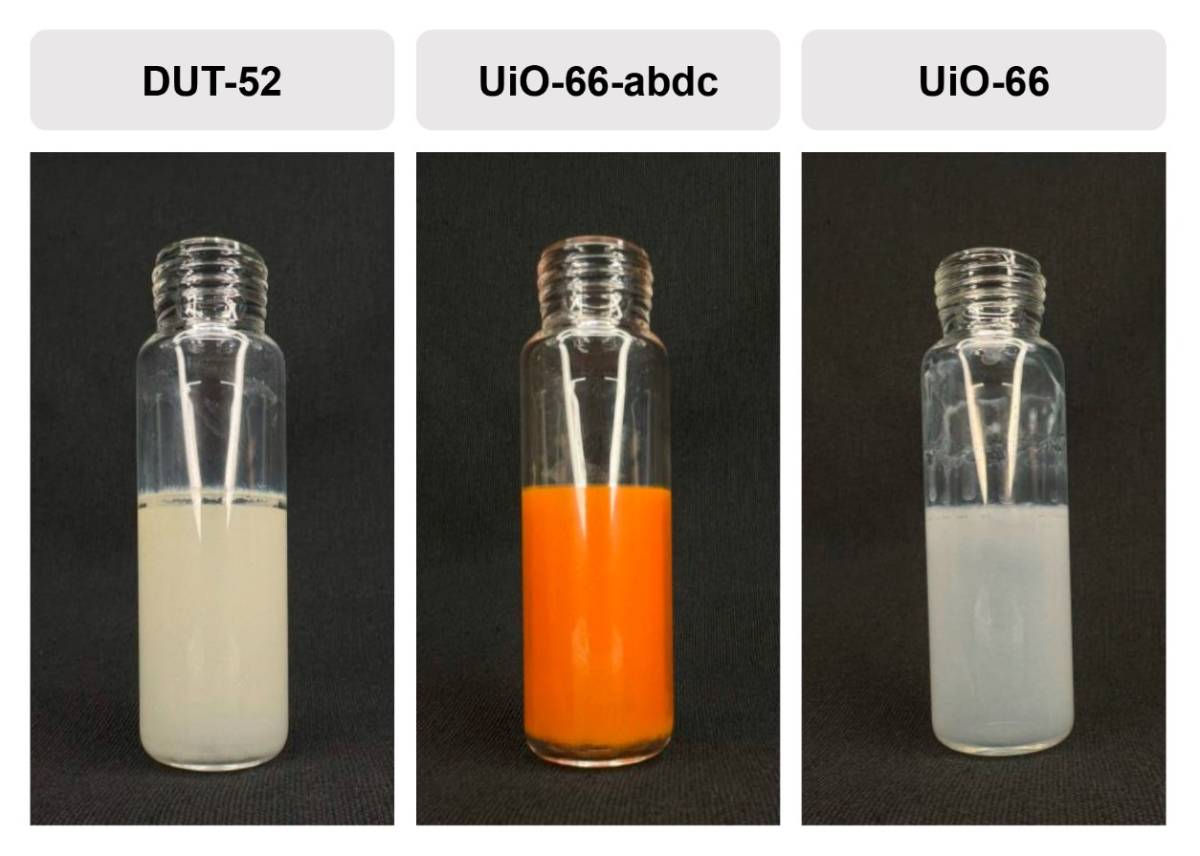
Researchers from the Materials for Chemical Analysis Group (MAT4LL) from the University of La Laguna have published an article in the high-impact journal Advanced Functional Materials, in which they showcase the development of a new micro-analysis device to ensure highly effective and simple methods.
The device is a glass vial where the formation of a thin internal layer of crystalline growth of metal-organic frameworks (or MOFs) has been reproducibly achieved. These frameworks are characterized by having a porous structure and a high surface area, ideal for trapping molecules present in the environment, such as emerging contaminants in environmental aqueous samples, as in the case of this publication.
Thus, when the water sample is added to the vial, its contaminants are retained by the MOF anchored to its surface, simply by shaking the vial. In this way, when the vial is emptied, the discarded water no longer contains these contaminants, and those trapped in the vial can be easily subjected to further analysis by adding a few microliters of solvent. This greatly simplifies the analytical methods, as it is only necessary to shake the container with the sample to be analyzed and then discard it.
This study is part of the MAT4LL group's ongoing research into incorporating metal-organic frameworks into miniaturized strategies for environmental, agri-food, and bioanalytical analysis, aiming to achieve more sustainable, simple, and efficient methods. Specifically, this development was the subject of the National R&D Plan Proof of Concept Project “A simple platform for sample pretreatment in analytical applications” (InVial), reference PDC2021-120816-I00.
Among the results of the project, it is worth highlighting the obtaining of a patent for the aforementioned device (ES2944724) with international extension (PCT/ES2022/070767) and that is in the negotiation phase with a company for its license.
This work represents the culmination of the doctoral thesis of Ivan Taima Mancera, focused on metal-organic networks and miniaturization in Analytical Chemistry, supervised by his thesis directors Verónica Pino Estévez y Jorge Pasán García, as well as with the collaboration of the researcher Ramón y Cajal and also a member of the group María José Trujillo Rodríguez.
Also imminent is the publication of another work in which the MAT4LL research team intends to expand the use of these vials to other applications of interest, such as the analysis of non-invasive biological samples such as blood or urine, by modifying the size of the vials for this purpose.

 Spanish
 English
 French