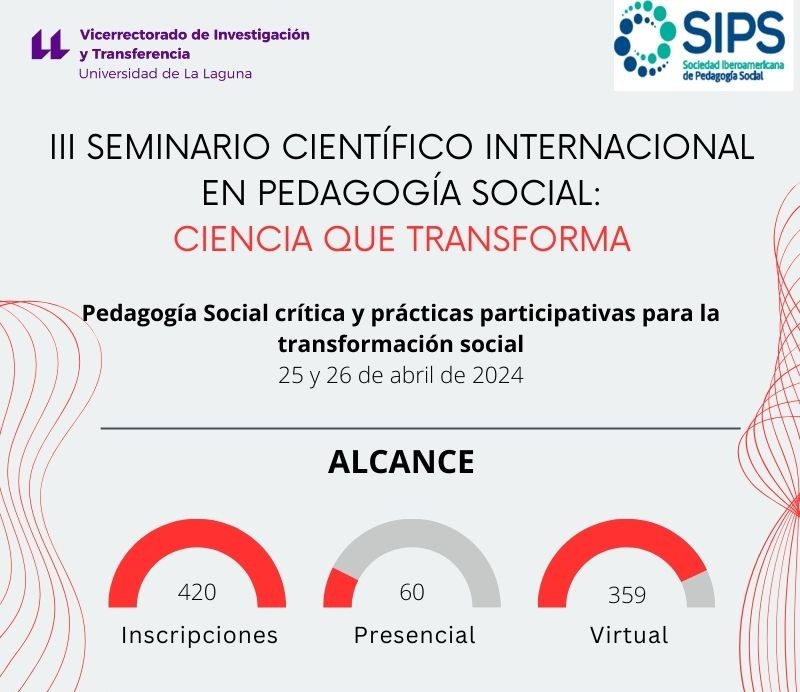
The University of La Laguna and the Ibero-American Society of Social Pedagogy (SIPS) have organized the III International Scientific Seminar: Science that transforms, Under the slogan 'Critical social pedagogy and participatory practices for social transformation', this event was held at the end of last month in person at the Candelaria Youth Center, although it was also broadcast online via the Canal de ULL YouTube channel.
The first edition was held online from the Pablo de Olavide University (Seville), the second also virtually from the University of Málaga, and this third edition has been organized by the University of La Laguna in a hybrid format to broaden its reach and connect with more regions. In 2025, the University of Oviedo will be responsible for organizing it.
“We are very grateful because this is the first time the Ibero-American Society of Social Pedagogy has organized a scientific event with the University of La Laguna, and it is also the first time an international scientific event on Social Pedagogy has been held in the Canary Islands,” she says. Itahisa Pérez Pérez, She is a professor at the Faculty of Education and heads the local organization. The previous known event was the National Congress of Committed Youth, held in 2022 and also organized by her.
This seminar began with a plenary session that emphasized the need to recognize the political nature of methodology, particularly as presented by popular, feminist, and decolonial pedagogies. The panel discussion on educational leisure highlighted leisure as a tool for social transformation, which can be fostered through Participatory Action Research or Service-Learning projects, strengthening university ties with society and promoting participation and amplifying the voices of communities.
The second panel, on social, cultural, and educational policies, explored how these policies and participatory practices not only enrich our theoretical understanding but also drive social and community change. The third and final panel, on experiences in inclusive socio-educational spaces, provided a forum for sharing experiences on the role of Social Pedagogy and Social Education in improving people's living conditions and how the participation of all those involved in this socio-educational support process is vital when developing effective socio-educational actions, programs, evaluations, and strategies.
The call for submissions has had a wide impact, with 82 papers received from Mexico, Brazil, Colombia, Chile, Cuba, Portugal, and Spain, involving 152 professionals. These submissions presented inclusive participatory experiences in educational leisure and key areas of social welfare (housing, education, employment), as well as in community and children's participation. Furthermore, they highlighted the potential of social pedagogy in critically addressing violence and social inequalities and in building more inclusive societies.
Undoubtedly, this congress has made visible and dignified the socio-educational research and experiences of Social Pedagogy that are developed in Ibero-America, through the research groups, says Pérez, who points out that it has also promoted alliances between professionals, institutions and professional associations in Social Pedagogy and Social Education.
Both sessions can be viewed at these links: first day y second day.

 Spanish
 English
 French