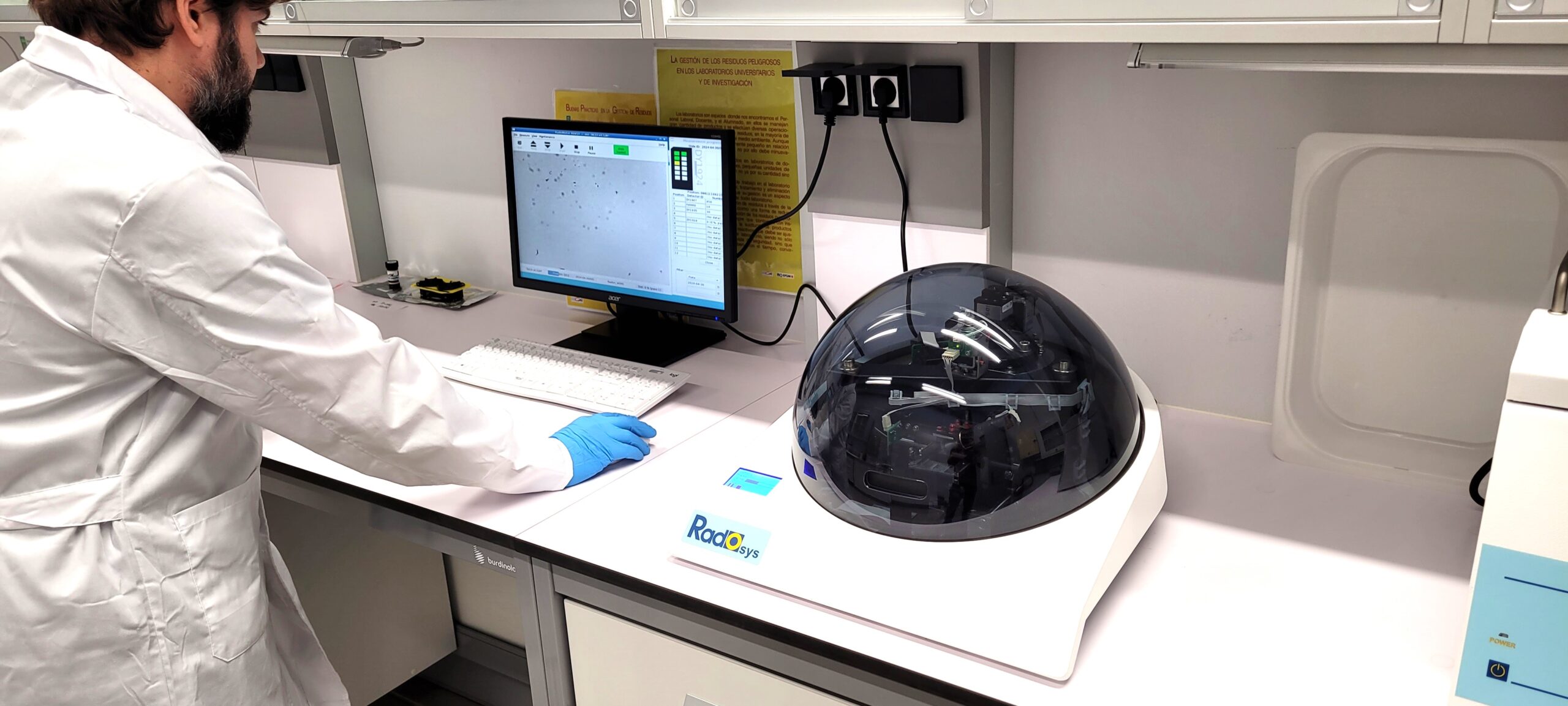
He Laboratory of Medical Physics and Environmental Radioactivity (Fimerall), The research support service of the University of La Laguna, attached to the General Research Support Service, has taken a crucial step in the protection of public health by acquiring a trace detector to quantify the levels of exposure to radon gas.
The acquisition of the trace detector (Radosys, model RadoMeter 2000) has been made possible thanks to FDCAN funding and will allow this university laboratory to carry out precise measurements of radon in the environment of indoor spaces, thus helping to identify and mitigate the risks associated with its presence in homes and workplaces.
The next challenge is to obtain accreditation for their technical qualifications to perform these types of tests, in accordance with the UNE-EN ISO/IEC 17025 standard, and become one of the first laboratories in Spain to achieve this recognition. This instrumentation places Fimerall at the forefront of the detection and control of this radioactive gas, which can pose a significant risk to human health.
Radon is a ubiquitous gas that comes from the Uranium-238 (U-238) radioactive decay series, one of the uranium isotopes found in the Earth's crust. This radioactive gas is formed from the decay of uranium and can seep into homes through cracks in foundations, fissures in walls, porous soils, and underground plumbing systems. In areas with significant geological activity, such as volcanic terrain, radon levels can be especially high due to the increased concentration of radioactive minerals in the soil and rocks.
Inadequate ventilation also contributes to the accumulation of radon indoors. Furthermore, modern buildings, designed to be more energy-efficient, tend to be more airtight, which can trap radon inside and increase its concentration.
Fimerall's acquisition of the radon tracer will allow for precise measurements of radon in the environment, helping to identify and mitigate the risks associated with its presence in homes and workplaces. With this initiative, the university laboratory reaffirms its commitment to safety and public health, providing society with effective tools for radon prevention and control. "It is a crucial step in the fight against lung cancer related to exposure to this radioactive gas, and it sets new standards of excellence in indoor radon detection in Spain," say its researchers.

 Spanish
 English
 French