
The Chair of Agritourism and Wine Tourism of the Canary Islands Institute of Agrifood Quality, University of La Laguna Yesterday, Thursday, May 9th, the organization held a commemorative event for its fifth anniversary, attended by the rector of the academic institution, Francisco García, the president of the Canary Islands Government, Fernando Clavijo, and the Minister of Agriculture, Livestock, Fisheries, and Food Sovereignty, Narvay Quintero. During this five-year period, the organization has carried out activities throughout the archipelago and other territories of Macaronesia, including 1,000 training sessions and 6,000 awareness-raising and opinion-forming initiatives.
The rector spoke highly of the institutional and corporate chair model for its potential to link academia with the productive sectors toward a common goal. Currently, there are 23 such entities, and two more have recently been established, in partnership with the Government of the Canary Islands and the University of Las Palmas de Gran Canaria, focusing on Commerce and Tourism and Data. Specifically regarding the chair in Gastronomy and Wine Tourism, he praised its regional scope and its focus on creating synergies between two key sectors. “The Canary Islands will continue to be a leader in tourism, but we must be able to generate our own value linked to who we are, to our territory, and that is what this chair aims to achieve.”.
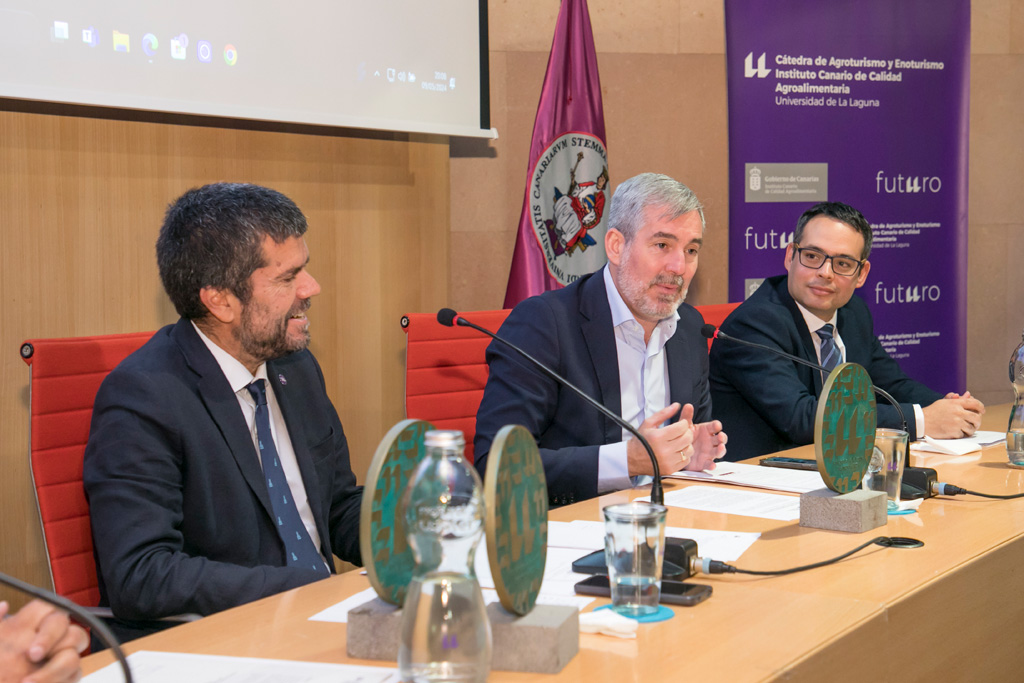 The President of the Canary Islands Government, Clavijo, described the chair as “a successful project” and highlighted the academic institution's commitment to regional development. “The University of La Laguna has always shown a willingness to try new things, to support us, and to advise us,” he said, before explaining that the purpose of the chair is, among other things, to ensure that tourism supports the primary sector and fosters a complementary relationship between the two. “We want our visitors to not only stay in hotels but also have a gastronomic experience.”.
The Minister of Agriculture, Livestock, Fisheries, and Food Sovereignty recalled that in 2015 he received a mandate from President Clavijo to try to establish synergies between tourism, the Canary Islands' main industry, and other sectors, such as the primary sector. This led to the creation of the Growing Together project, which has fostered thousands of activities and culminated in the establishment of the chair in 2019, channeled through the Canary Islands Institute of Agri-Food Quality. "I always give the example that it's impossible to leave Lanzarote without visiting La Geria. The Canary Islands cannot be understood without the primary sector, which feeds us but also fights against climate change and desertification.".
Also present at the event was the current chair director, Professor Jesús de las Heras of the Department of Chemical Engineering and Pharmaceutical Technology, who reviewed the chair's activities over the past five years. He noted that the project extends much further back in time, having evolved from a Cultural Center for Wine Tourism and Gastronomic Tourism founded in 2011 by the now-retired Professor José Antonio Lastres and wine and gastronomy tourism consultant Gabriel Santos, the chair's current deputy director. Looking ahead, he outlined three major challenges: internationalization, specialization, and consolidation within the Canary Islands.
 Sensory analysis
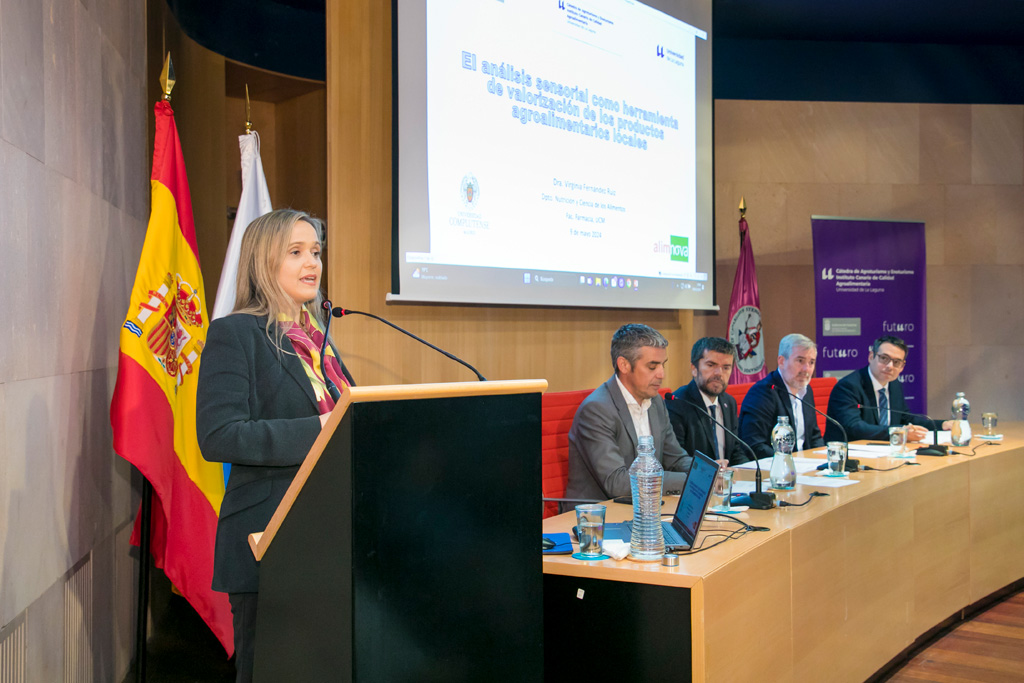
Virginia Fernández Ruiz, from the Faculty of Pharmacy at the Complutense University of Madrid, also spoke at the ceremony, delivering a short lecture entitled “Sensory Analysis as a Tool for Adding Value to Local Agri-food Products.” In it, she explained what sensory analysis entails: a scientific research method that uses human subjects as measuring instruments. While this presents its own challenges, with proper training it allows for the collection of measurable and rigorous data.
He explained that this type of analysis uses, on the one hand, reports from trained tasters, who can provide technical expertise and whom he called "judges," and on the other hand, the opinions of untrained users, who can offer a more realistic view of market interests. Combining both perspectives makes it possible to identify different consumer profiles and design products tailored to each segment.
The speaker presented various types of questionnaires used to evaluate both the acceptance of the product analyzed - in this case, wine - from the point of view of the pleasure it provokes, as well as a more diffuse a priori element: well-being, understood as something more than the sensory experience and which has five dimensions: physical, social, emotional, intellectual and spiritual.
The expert believes these tools can be perfectly used to analyze locally sourced food products and, in doing so, enhance their value in the local market. This would contribute not only to the economy but also to environmental sustainability by promoting the consumption of regional products, which have a smaller carbon footprint.

 Spanish
 English
 French