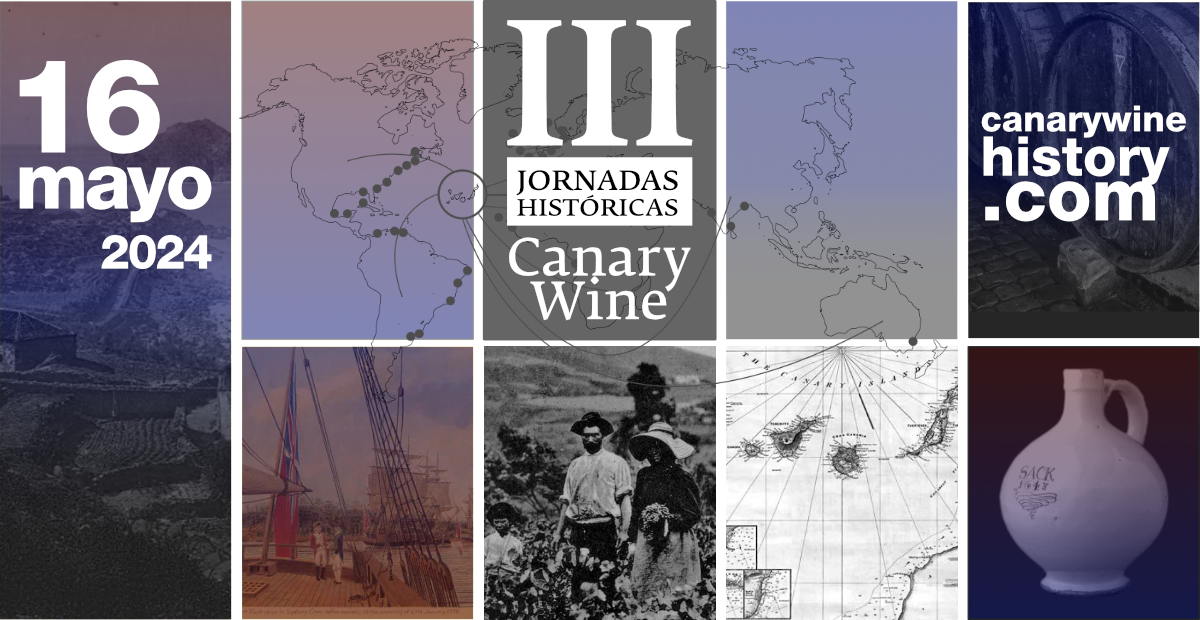
The Chair of Agritourism and Wine Tourism of the Canary Islands of the Canary Institute of Agri-Food Quality and the University of La Laguna, along with the Protected Designation of Origin Canary Islands – Canary Wine, On May 16, 2024, they organized the III Canary Wine Historical Conference, which delved into the knowledge of the economic, social, political and cultural situation of the wine of the region, approaching the history of local wines in particular, and of the world in general.
The president of the Protected Designation of Origin Islas Canarias, Juan Jesús Méndez, pointed out that “the term Canary Wine is a collective brand owned by the Association of Winegrowers and Winemakers of the Canary Islands (AVIBO) and the objective of the PDO is to recover the international recognition of the historical importance of Canary wines, which have more than 500 years of winemaking history.”.
Next, Marta María Domínguez, Director of the Secretariat of Institutional and Business Chairs at the University of La Laguna, Janira Gutiérrez Peraza, President of the Canary Islands Institute of Agricultural Research, and Jesús Enrique de las Heras Roger, Director of the Canary Islands Chair of Agritourism and Wine Tourism of the ICCA and the ULL, spoke, expressing their gratitude for the opportunity to discuss the history of wine in the Canary Islands, highlighting the region's unique viticultural and winemaking traditions, which date back to the 15th century after the conquest of the islands, as well as the importance of understanding and preserving this heritage, which has profoundly influenced Canarian society and culture.
The inaugural conference, “Technology, tradition, continuity and change: the wine press in viticulture from the Classical World to the Middle Ages” was given by José Antonio González Marrero, professor of Latin Philology at the University of La Laguna, who addressed the technology, tradition and continuity in winemaking from the classical world to the Middle Ages, focusing on the role of wine presses in the production process throughout history.
Next, Carlos Cologan Soriano and Josué Ramos analyzed the historical significance of the wine press, highlighting its importance as an example of the technological and social changes of that era. They addressed the challenge of finding accurate information about the origins of Canarian wine amidst marketing efforts and a lack of accessible historical resources. Both experts expressed the need for a greater public historical discourse and the publication of more books on the subject to make the information accessible to a wider audience.
Next, Javier Luis Álvarez, scientific coordinator of the III Canary Wine Historical Conference, gave way to the different presentations, after which an interesting debate took place on the proposals presented and the cultural, historical and social significance of wine beyond its agricultural and chemical aspects.
The first communication presented was “From Columella to Alonso de Herrera: construction of a Western culture of vineyards and wine”, by Rudy Chaulet (Institut des Sciences et Techniques de l'Antiquité (ISTA) – Université de Franche-Comté, Besançon, France STARS EU Alliance).
The second, “What’s yours is mine: imitation as a strategy: wine and spirit label designs with (future) European designations of origin made in Chile, 1877-1930”, was presented by Carolina Cofré Silva (San Sebastián University, Santiago de Chile).
The third and final communication “Women of Wine: key to the development of wine tourism” was authored by Sabrina Salerno as part of her final thesis for the Master's Degree in Destination Management and Experiential Tourism from 24Ore Business School and UniMarconi.
Closing of the III Conference
José Felipe González Monje-Domínguez, representing the Canary Islands PDO – Canary Wine, and Gabriel Santos García, representing the Chair of Agritourism and Wine Tourism of the Canary Islands Institute of Agri-Food Quality and the University of La Laguna, were responsible for closing the conference. Both emphasized the importance of sharing the history of Canary Island wines as a showcase of unique traditions, exquisite varieties, and exceptional producers.

 Spanish
 English
 French