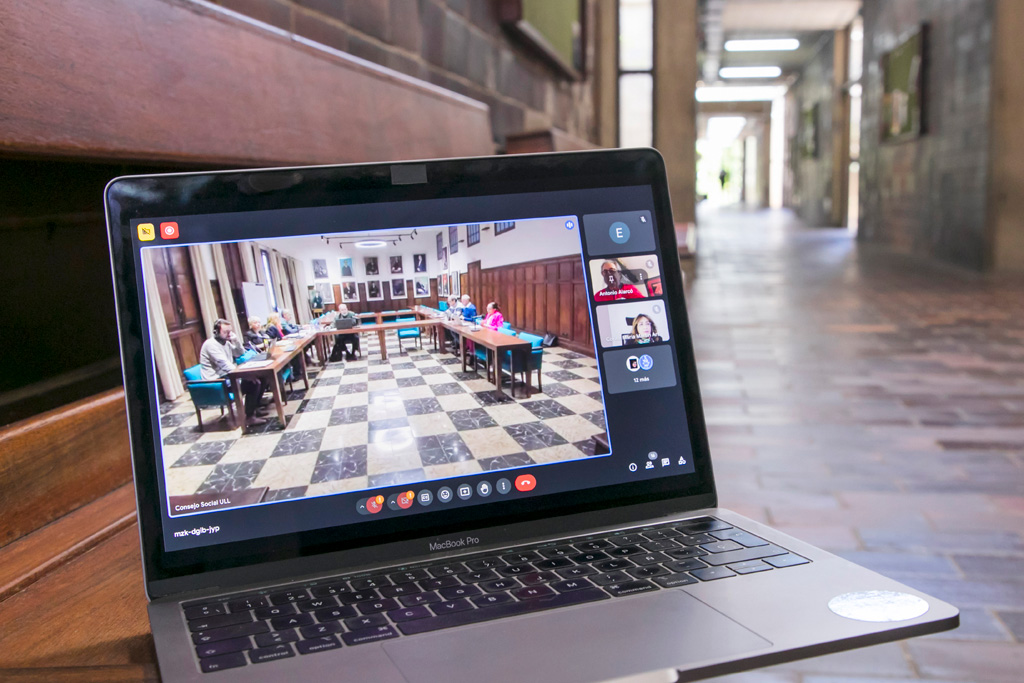
The Social Council of the University of La Laguna held a plenary session today, May 23, in which it approved the offering of five postgraduate degrees, four of which are newly created and a fifth being reinstated after years of hiatus. All five will begin in the 2024/25 academic year. Most will be taught virtually and are organized in a modular format, which, according to Rector Francisco García, is highly beneficial for competing internationally. The programs are tailored to professionals and incorporate a type of teaching geared towards the micro-credential system, which will soon be implemented in all universities.
The qualifications were presented by the Vice-Rector for Teaching, José Manuel García Fraga. The first is the Certificate of Specific Training in Property Administration and Real Estate Management, offered in collaboration with the Territorial Association of Property Administrators of Santa Cruz de Tenerife and endorsed by the General Council of Property Administrators of Spain. This program addresses the lack of a specific qualification in this field, which, according to its proponents, limits training opportunities for qualified professionals in a sector that is strategic for the Canary Islands' economy, as well as the growing demand for professionals in this area. It comprises 180 credits, spread over three academic years, and offers 60 places in an online format.
Another approved postgraduate qualification is the Expert in Characteristics and Needs of Students with High Intellectual Abilities, also offered online, and designed to train education professionals to provide specialized support to this student group. Thirty places are available, with 15 credits, and the course will be taught online from January to May 2025.
The Expert in Affective Neuroscience and Clinical Psychology, also offered online, is designed to foster innovation in therapeutic practice for affective and anxiety disorders. It provides training based on basic and applied research, primarily focused on the study of affective behavior and its alterations, as well as its regulation through psychological intervention and neuromodulation techniques. The program has 20 places, 29 credits, and will run from November 2024 to July 2025.
The postgraduate certificate in Management of Social and Solidarity Economy Entities fosters the acquisition of skills to navigate the current changing landscape in a sector of growing importance. The training provides the foundation for entrepreneurship and the organization, direction, and management of businesses related to this field. It will again be offered online, with 20 credits and 30 places available.
Finally, the Continuing Education Master's Program in Family Therapy, offered in a blended learning format, is designed to train professionals in the applied practice of psychotherapy. It has 25 places available, comprises 60 credits, and will run from October 2024 to June 2025.
For her part, the manager of the academic institution, Teresa Covisa, presented to the Social Council the file for supplementary credit to carry out the calls for positions in 2024, which was also approved.
Covisa also informed the governing body of the financial statements for the 2023 fiscal year, whose budget totaled 166 million euros, with an overall execution rate of 90.61%. The manager explained that 162 million euros had been projected, but an additional 6 million euros had to be incorporated throughout the year from grants and competitive funding secured by the university's researchers. She stated that this was very positive and demonstrated the strength of research at the university.
Furthermore, Julio Brito, the managing director of the General Foundation of the University of La Laguna, presented the financial statements for the past year, which were approved by the governing body. Brito noted that this entity, conceived as an in-house resource of the university, initially budgeted 11.5 million euros and ultimately spent over 18 million euros. He pointed out that the Foundation's activities are divided into training, innovation and knowledge transfer, scientific outreach, employability programs, and projects commissioned by the university itself.
Finally, the rector indicated that a meeting will be held next week to begin strengthening the program contract for the Canary Islands' public universities. Francisco García maintained that the institution is making progress in modernizing the academic center, hiring more faculty, improving the management of its procedures, and exploring new options for its degree programs. As he did yesterday before the Governing Council, the rector affirmed that this university is underfunded, a situation compounded by the new challenges of implementing the Organic Law on Universities (LOSU), and therefore requested the support of the governing body in these upcoming negotiations, a request that was endorsed by the president of the Social Council, Francisco Almeida.

 Spanish
 English
 French