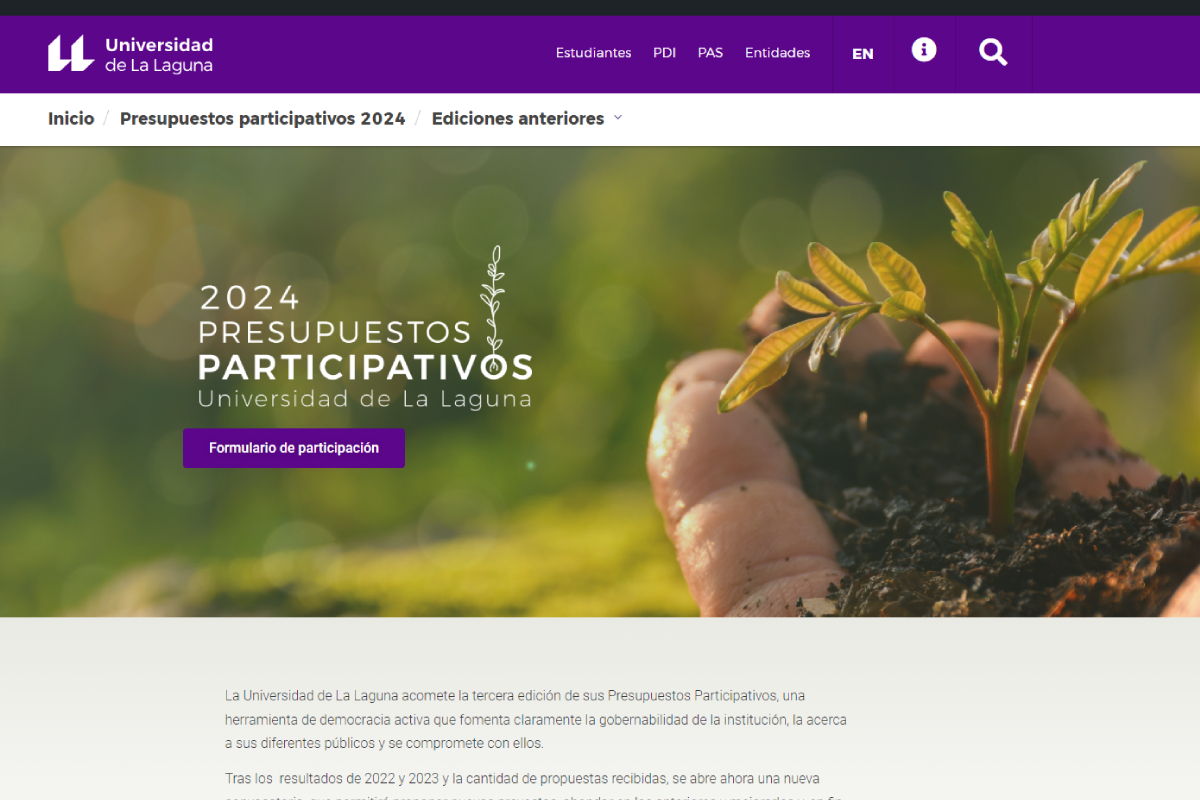
The University of La Laguna's administration has once again opened its call for Participatory Budgeting proposals, through which all groups within the university community can submit proposals that, after a public vote, will receive funding for implementation next year. The deadline for submitting proposals through the initiative website It will be open until next Sunday, June 9th.
The process will consist of two phases: until June 9, all interested parties may submit a single proposal with two main conditions: that it be submitted from their institutional email account (domain @ull.edu.es) and that its maximum cost does not exceed 45,000 euros. The second phase will consist of the selection of the proposals received by the university community, whose members will be able to access the voting process through a message they will receive in their institutional email account, allowing them to choose up to a maximum of five projects.
The terms and conditions of the call for applications They specify the requirements that the proposals must meet, which, among other things, imply that they are of general interest to the entire university community, are within the competence of the academic institution, do not involve the hiring of personnel, do not constitute scholarships or subsidies, do not affect contracts in force or actions already budgeted or in execution, and that they have technical, legal and budgetary viability and can be carried out within the foreseen period, or be susceptible to programming.
This third call for proposals has sought to address some shortcomings of the previous two, identified during the implementation of the approved measures. Thus, the maximum budget allocation for each project has been increased to €45,000, as in previous years it was €15,000 and was sometimes insufficient to carry out the approved initiatives.
The criteria for allocating the €345,000 available for this project fund have also changed. The new guidelines specify that 60% will be used to fund proposals from each of the three university groups, with 20% going to each group. The remaining 40% will be allocated to the proposals that receive the most votes, regardless of which group submitted them.
The guidelines also allow for the evaluation committee to allocate more than the initially planned €45,000 if justified by the quality, relevance, and timeliness of the proposals. This committee, which will ensure the viability of the submitted proposals, is composed of the Vice-Rector for Students, who will serve as chair; the Vice-Rector for Sustainability and Infrastructure; the Coordinating Director of the Infrastructure, Maintenance, Procurement, and Occupational Risk Prevention Area, who will serve as secretary; the Deputy Manager for Strategic Planning; and one representative from each of the three groups, appointed by the Rector.

 Spanish
 English
 French