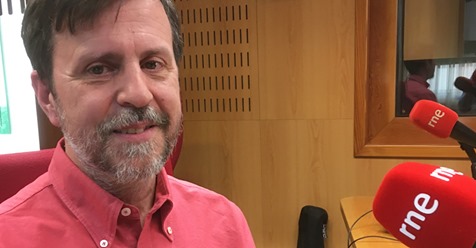
Professor Souto, during an intervention in the science outreach program "Doble Hélice 3.0" of RNE with support from the ULL.
The professor at the University of La Laguna Ricardo Souto Suárez has been distinguished by the Spanish Materials Society with the national award for best scientific career in materials science and engineering. This researcher will inaugurate the plenary conference of this society, which will take place on June 25 in Malaga, where he will give the plenary lecture 'Development and application of electrochemical microscopies for the characterization, monitoring and active control of corrosive processes'.
Souto is a professor of Physical Chemistry at the University of La Laguna and leads the research group in Electrochemistry and Corrosion. His lines of work focus on the development and application of micro-electrochemical techniques such as scanning electron microscopy (SECM) and the scanning vibrating electrode technique (SVET) for the study of corrosion and protection mechanisms of different metals, the characterization of the bioactivity of prosthetic biomaterials and the decontamination of water and effluents using electrochemical methodologies.
The University of La Laguna's scientific portal showcases the prolific scientific output of the award-winning researcher, with over 200 articles published in recent years. It is no coincidence that in 2022 he shared the university's Research Prize, awarded jointly at the Institutional Day ceremony. This prize recognizes a high-quality scientific career with social impact and international recognition, and was received alongside ecologist José María Fernández-Palacios.
Souto's research is fully internationalized, and in addition to collaborating with various Spanish universities, he also works with research centers in Mexico, Japan, Finland, the United States, the United Kingdom, and Italy, among others. He has supervised a dozen doctoral theses and served on numerous examination committees.
It also participates in a European consortium to improve marine energy generation techniques in the Canary Islands, with the aim of minimizing pollution caused by environmental degradation. “The exciting possibilities for developing novel processes that drastically reduce environmental impact through collaborative research between industry and academic institutions represent a major challenge within this project.”.

 Spanish
 English
 French