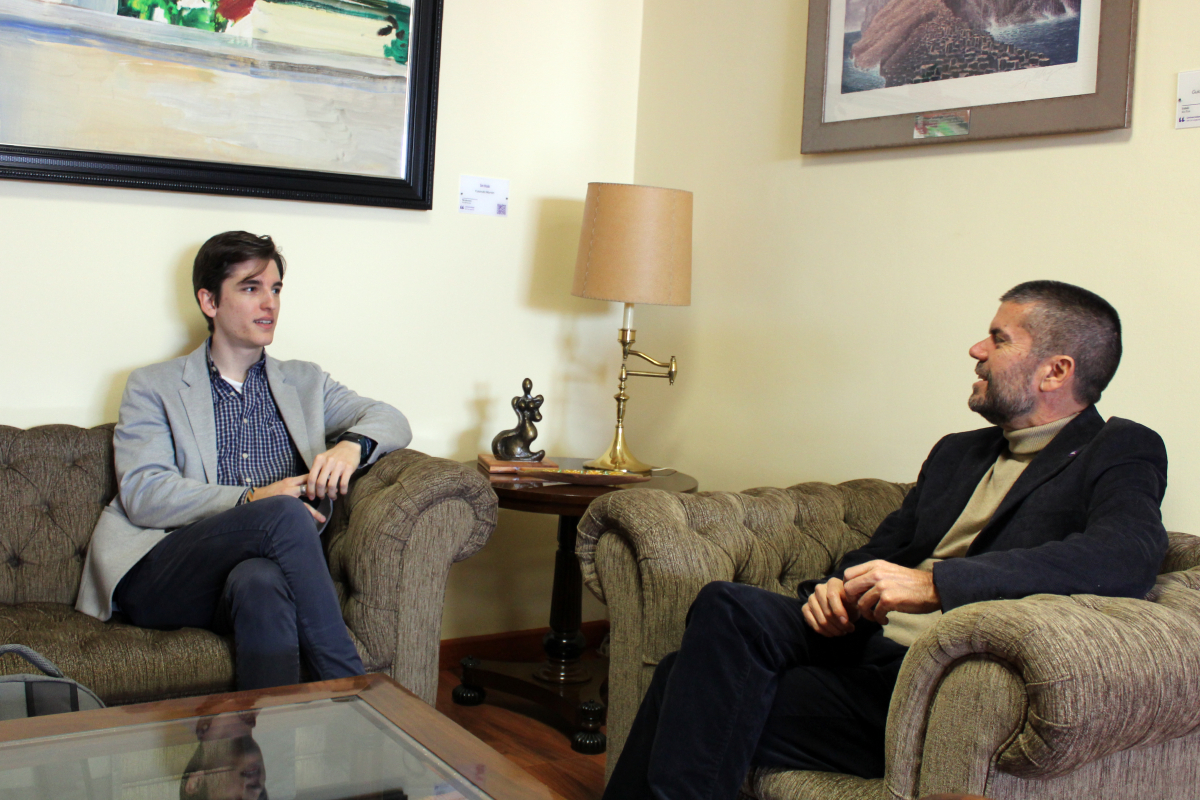
The Global Entrepreneurship Monitor Observatory (GEMSpain has just published its annual report corresponding to the 2023/24 academic year, which analyzes entrepreneurial activity throughout the country in detail and provides examples of best practices. One of the selected projects was Crideo, a company providing digital manufacturing solutions that has been launched by Óscar García Puche, a Physics graduate from the University of La Laguna and who in 2023 was one of the ten award winners in the INJUVE National Young Entrepreneurs Competition.
The GEM Spain report interviewed García Puche, who explained that the idea of starting his company arose during his university years, when he collaborated on the project Formula Student from the University of La Laguna, consisting of the manufacture of a single-seater electric vehicle to compete in a national race. “It was evident from the outset the need for a local, fast, and efficient manufacturing industry to solve the production challenges we face in the archipelago. That was the spark that ignited my passion for digital manufacturing, helping companies and clients to solve their production challenges as quickly and efficiently as possible.”.
The young entrepreneur also mentions that his company is very aware of the social and environmental impacts of its venture: regarding the former, he believes his work contributes to digital transformation and collaborates with organizations for people with special needs and those involved in adapted sports. On the environmental front, he points out that, being a local production, its carbon footprint is small, and it also uses raw materials from organic or recycled sources. Furthermore, the very nature of his business allows it to manufacture only the number of items needed.
Entrepreneurship in the Canary Islands
The GEM Spain 2023/2024 report is one of the most powerful tools for understanding the progress of different regional entrepreneurial ecosystems. The research team responsible for preparing the section on the Canary Islands is composed of researchers from the two public universities.
Among the key findings of this report, it is worth noting that, considering potential entrepreneurship (the intention to launch an entrepreneurial project in the coming years), the Canary Islands, along with the Valencian Community, Catalonia, Andalusia, and the Balearic Islands, surpasses the Spanish average in terms of generating expectations for starting a business in the next three years. While this suggests a favorable environment for future entrepreneurship in the region, the rate of early-stage (nascent or new) entrepreneurship is relatively low, highlighting the need to design policies and programs that facilitate the implementation of these initial intentions.
On the other hand, fear of failure, one of the limiting factors when developing entrepreneurial projects, has very little impact in the Canary Islands, similar to communities like Madrid, the Basque Country, or the Valencian Community. Furthermore, the perception of opportunities for entrepreneurship in the Canary Islands is high, similar to Madrid, the Basque Country, the Valencian Community, and the Balearic Islands, where more than 30% of the adult population perceives opportunities to start a business.
In summary, the Canary Islands presents itself as a promising environment for the development of entrepreneurial projects. The perception of opportunities and the reduced influence of fear of failure are positive aspects that can be leveraged to strengthen entrepreneurial activity in the region.

 Spanish
 English
 French