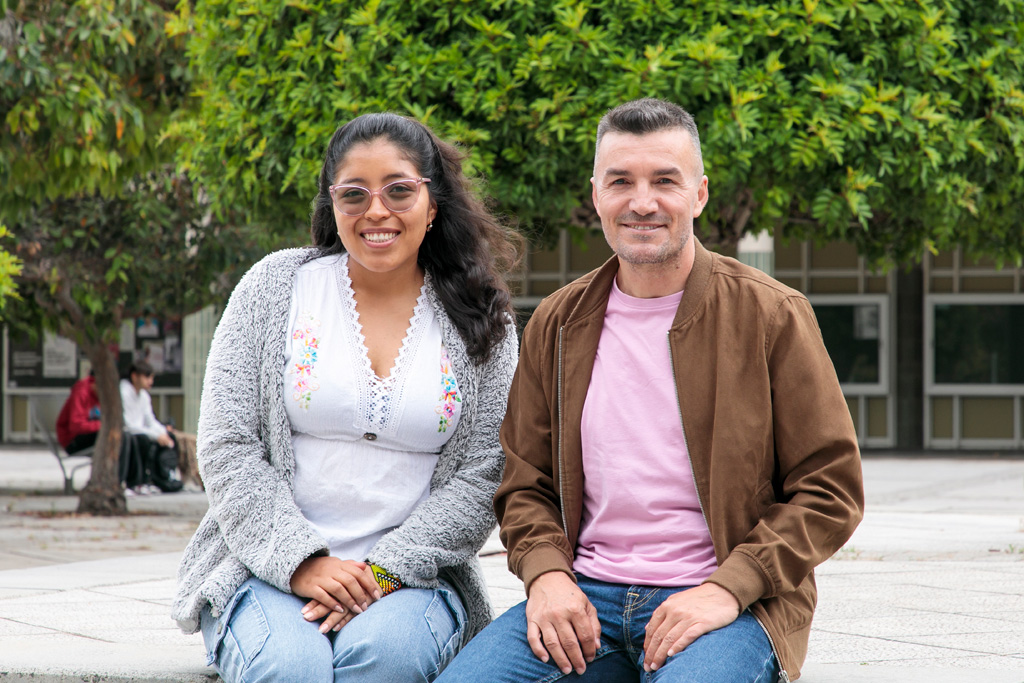
The professors of the universities of La Laguna Francisco Javier Doniz Paez y Minho (Braga, Portugal) José B. Rodrigues Brilha, a world-renowned expert in geoconservation and geological heritage, co-directs the first comparative study on the geomorphosites of the volcanoes of Ecuador and the Canary Islands - specifically those located in Tenerife - whose objective is to demonstrate that island volcanism is much richer and more geodiverse than continental volcanism.
For this reason, Lisbeth Alexandra Oña Morales, the geologist in charge of the project overseen by both universities, has been in Tenerife for several months to characterize the selected geomorphosites on the island in order to compare them with those taken in the first phase at volcanoes in Ecuador. This analysis will determine which geodynamic context has the most potential for the development of geotourism or geological tourism.
“We start from the idea that island volcanism is much richer and more diverse than continental volcanism, something we try to demonstrate with this study, based on the experience of our research group, which has been working on these topics for many years,” says Dóniz regarding the extensive track record of Geoheritage and Geotourism in Volcanic Spaces, GeoTURvol, which has previously performed this comparative analysis of geomorphosites in the Poás volcanoes in Costa Rica and Paricutín in Mexico, as well as in the Teide-Pico Viejo volcanoes in Spain.
The relevance of the current research lies in the fact that the study encompasses several Ecuadorian volcanoes, headed by Tungurahua, located in the eastern mountain range of Ecuador, where 28 geomorphosites have been identified, as well as those described in Tenerife, among which the volcanoes of Teide, Pico Viejo, cliff of Los Gigantes, rambla de Los Caballos, Punta del Hidalgo, Masca, Malpaís de Güímar or the Chinyero volcano have already been analyzed, among others that still need to be characterized and valued as geomorphosites of high geotourism interest that are part of the project.
According to the researcher, the choice of the island of Tenerife stems from the need to have a selection of active volcanoes with characteristics similar to those of Tungurahua, a volcano whose last eruption took place in February 2016. “We needed similarities for comparison, and upon verification, it has been seen that here, island volcanism is more geodiverse than that of Ecuador, where there is also glaciation, while in the Canary Islands there is a greater richness in forms and processes.”.
The selection and categorization of a geomorphosite, a place of scientific, socioeconomic, aesthetic and cultural importance, must meet three essential characteristics: that it is considered representative, that it is properly preserved and that it is accessible, since "if it cannot be accessed it is unlikely to be able to orient it towards tourism, the same as if it is deteriorated or has lost certain values," says the expert from the University of La Laguna.
 Ecuadorian candidacy for geopark
Another objective of this research project, funded by the EU through the program Pangea (Erasmus Mundus modality) is the promotion of the circular economy in Ecuador through the recognition of a geopark in the Tungurahua region. “This vision is very important for developing countries like mine, where inequalities are very high, especially in central Ecuador, where the greatest amount of social inequality is concentrated. If we work along these lines, it is possible that ventures based on the existing volcanism could emerge, such as the implementation of geo-route design,” says the researcher from the University of Minho.
The fact that these Ecuadorian volcanoes have achieved geopark status, a designation supported by UNESCO, represents a mark of distinction that would boost tourism development in that region of the country, and specifically geotourism, a model of sustainable and environmentally friendly tourism. “In the Canary Islands, we have extensive experience with geotourism and the geopark designation, as we have two (El Hierro and Lanzarote) of the four volcanic geoparks in Spain,” notes the researcher from the University of La Laguna.
Once the research currently underway in Tenerife is completed, as part of the fieldwork initiated on four volcanoes in Ecuador in early 2024, the next step is the presentation of the conclusions at the First Ibero-American Meeting on Geomorphological Heritage, a world congress organized by the University of Santiago de Compostela that will be held next September.
In addition to presenting the results at this international gathering of experts, the universities of La Laguna and Minho will also be responsible for coordinating and supervising an article on the project's results, which will be published in high-impact scientific journals, in order to "achieve greater international visibility, since this is the first time a comparative study like this has been launched," both researchers indicate.

 Spanish
 English
 French