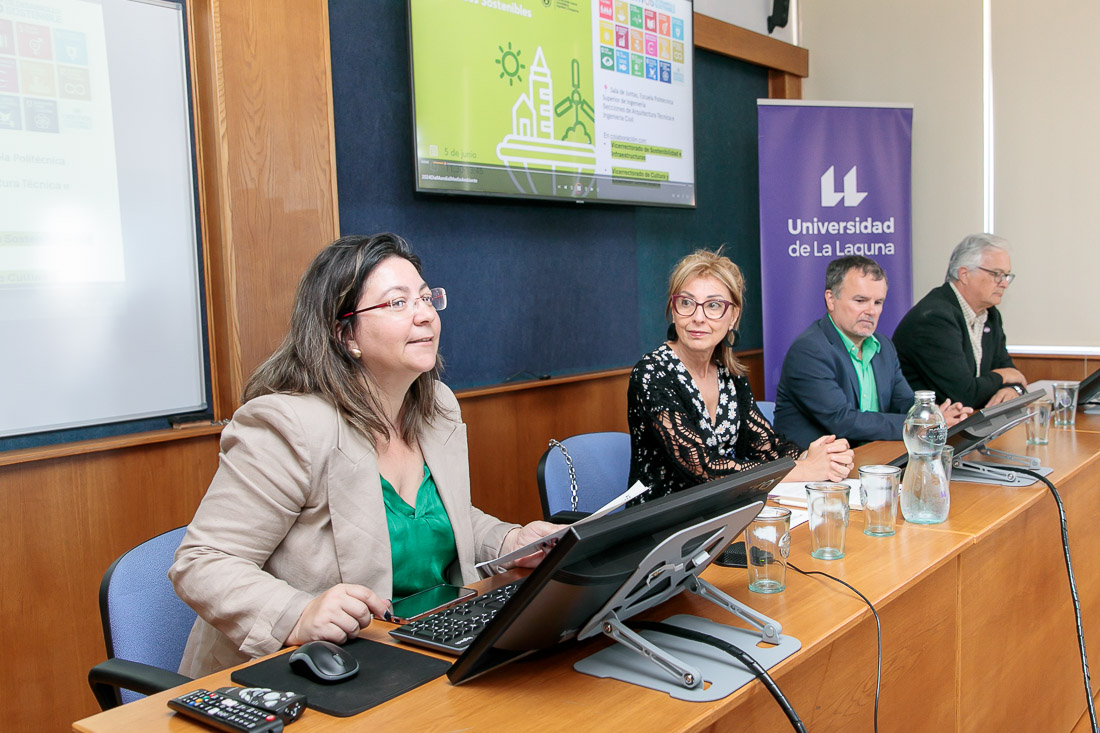
The Chair of Environment and Sustainable Development Cabildo de Tenerife – University of La Laguna, In collaboration with the Vice-Rectorate for Sustainability and Infrastructure and the Vice-Rectorate for Culture and University Extension, the University commemorated World Environment Day yesterday, June 5, with a debate on actions applicable in Tenerife in key areas such as water, energy, fires, waste and sustainable communities.
The presentation was given by the Vice-Rector for Sustainability and Infrastructure, Candela Díaz, who emphasized the importance of inter-institutional collaboration for improved sustainability. The Island Director of Natural Environment for the Tenerife Island Council, Pedro Millán, stressed the need to raise public awareness about fire prevention and the importance of collaboration in protecting natural areas. Felipe Monzón, Director of the Higher Polytechnic School of Engineering, was also present at the presentation and welcomed the attendees.
The event took place within a global context defined by the urgent need to address the environmental and climate challenges threatening the planet. The debate was structured around five key areas: water, energy, forest fires, waste management, and the promotion of sustainable communities. Each area was addressed by researchers from the academic institution, who presented a wide range of detailed analyses, practical experiences, and innovative proposals to drive concrete action in each field.
The first talk, given by Noelia Cruz from the group Geological Engineering, Innovation and Water (INGENIA), The discussion focused on the necessary actions in the water sector. The Canary Islands, as an outermost region, face unique challenges due to their geographical isolation, making water management a fundamental priority. Cruz highlighted the importance of current planning and the impacts of the climate crisis on water availability and quality on the islands. Furthermore, she emphasized the need for concrete actions and adaptation measures to guarantee water security in the future.
Benjamin Gonzalez, from the group of Electrical Engineering and Bioengineering (INGELEC), He elaborated on energy-related actions. In a context where almost 801,000 tons of Tenerife's energy supply comes from fossil fuels, it is urgent to move towards a sustainable energy transition. González emphasized the need to diversify the energy mix and promote the use of renewable sources to reduce greenhouse gas emissions and mitigate the impacts of climate change.
Pedro Dorta, from Group for Studies in Territorial Planning and Risks (GEORIESGOS), Dorta offered a detailed overview of climate change and forest fires in the Canary Islands. With alarming data on forest loss and the increase in fires in the region, Dorta emphasized the importance of prevention and integrated land management to reduce risks and promote resilience against forest fires.
Carlos Jiménez, from the group of Research and Innovation in Design, She addressed waste management as a key challenge for sustainability. She highlighted the need to implement prevention policies and promote community composting as effective strategies to reduce waste generation and foster a circular economy on the island. In this regard, she presented Campustage, an initiative of the University of La Laguna with the aim of managing organic matter on campuses.
Finally, María Toledo, an architect and doctoral candidate at the University of La Laguna, explored the relationship between public health and sustainability in built spaces. She highlighted the importance of designing healthy urban environments and promoting sustainable practices in building construction and management to improve citizens' quality of life and mitigate environmental impacts.

 Spanish
 English
 French