
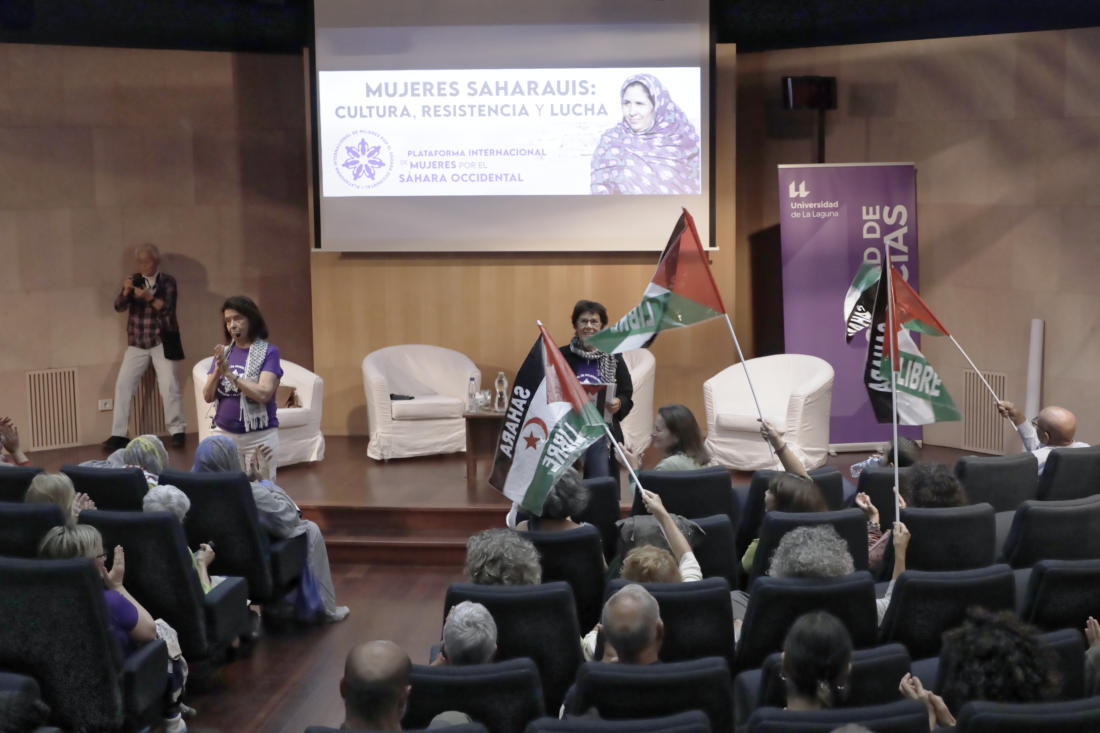
Making visible the situation of repression in which Sahrawi women live who “fight silently” for a free Sahara was one of the messages launched at the event held yesterday [Thursday, June 13] at the University of La Laguna by the newly created International Platform of Women for Western Sahara (PIMSO), a network that involves associations, NGOs and various women's groups committed to the struggle of the Sahrawi population in the occupied territories and refugee camps.
The meeting, which took place in the Blas Cabrera Auditorium of the Physics and Mathematics Building of the Faculty of Sciences, was attended by the renowned activist Sultana Khaya, protagonist of the documentary Unsubmissive Women: Women in the Struggle in Western Sahara, The documentary recounts the brutality of the methods and violence suffered by Sahrawi women in the territories occupied by Morocco. It includes first-person accounts that delve into forced disappearances, rape, torture, discrimination, and censorship imposed for decades in the African territory.
Sultana Khaya, the protagonist of the subsequent discussion, along with the minister of the Sahrawi Arab Democratic Republic (SADR), Fatma El Mehdi, described the struggle of Sahrawi women as "very hard" and carried out under "absolute repression," a situation in which it is very difficult to organize in order to continue exercising the peaceful opposition that remains standing thanks to the "men and women" who fight for a free Sahara.
 “We are victims of the media blackout. Nobody talks about the Sahrawi people. It is very difficult to create resistance and peaceful struggles that no media outlet reports on, since they only speak out when there are conflicts,” Khaya pointed out, narrating the “sad reality” of the struggle for the occupied territories, a “very complicated” situation for the fighters and activists for the Sahrawi cause who continue to experience the harshness of torture and censorship.
The activist denounced the “total repression” exerted on the Sahrawi people from within the school itself, as well as the “constant surveillance” through the placement of cameras in public areas, which prevents them from carrying out or organizing any kind of activist activity or movement. “There is a public espionage network in place that controls our lives and follows our every move,” stated the founder and president of the Sahrawi League for the Defense of Human Rights and Against the Plunder of Natural Resources.
In her speech, Khaya also alluded to the conditions of her more than 500 days of captivity in her own home, where “toxic products” were poured, affecting her physical and cognitive abilities. She denounced the difficulties imposed by the Moroccan regime on her ability to leave the country and carry out her work as an activist. “The Sahrawi people are being silently massacred because Morocco has the same modus operandi that Israel, believe it or not.”.
In line with the activism carried out by Sultana Khayak, the SADR minister, Fatma El Mehdi, alluded to the “silence of the various Spanish governments” regarding the murders, torture and disappearances denounced by the families of those affected, and how, every time a new war or international conflict arises, “the Sahrawi cause, marginalized and forgotten, becomes a secondary issue again.”.
Fatma El Mehdi emphasized the need for support and collaboration mechanisms, such as the new International Platform of Women for Western Sahara (PIMSO), which “will undoubtedly play a very important role in continuing to bring to light the testimonies of many women in this situation,” and highlighted the role of New Technologies and Social Networks, “thanks to which visibility and dissemination” of the situation faced by the Sahrawi people is achieved through the activities of the SADR.
In her speech, the minister also alluded to the fact that, thanks to the SADR, the Sahrawi people have a political representation that goes "far beyond" that of many countries.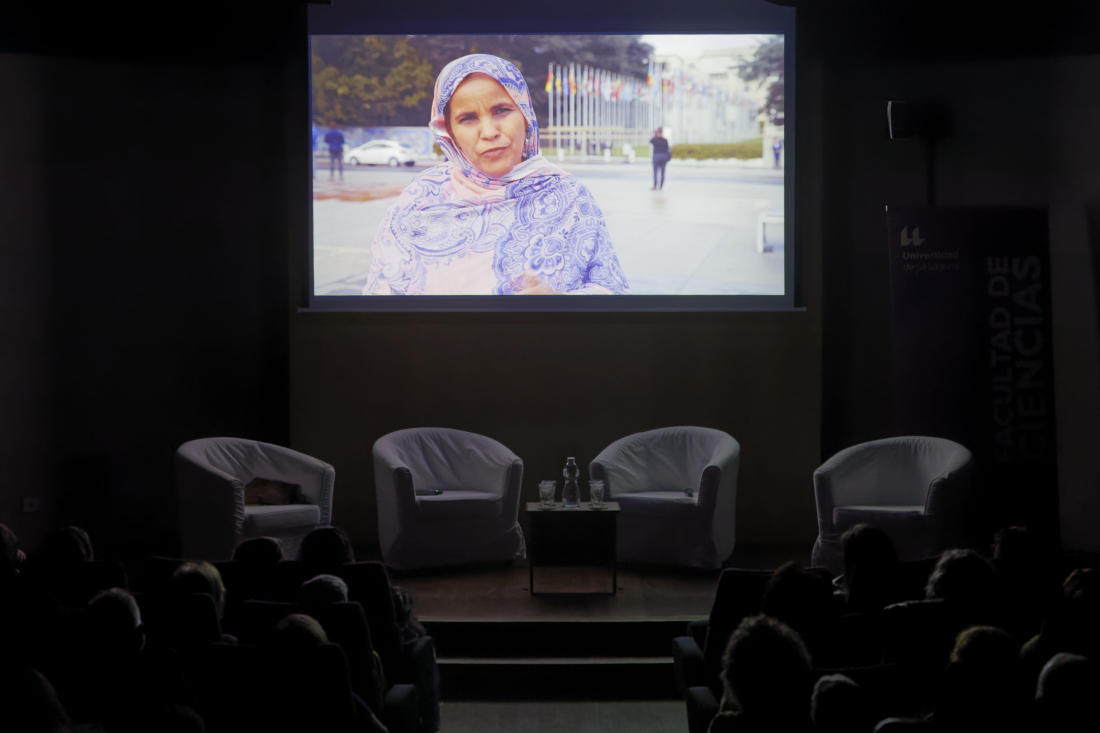 democratic: parliamentary representation of over 401% of the population, as well as a presence of 481% of local governments in the Pan-African Parliament (PAP). “We are building our state, trying to make our people and our culture known throughout the world. And despite the wear and tear of 50 years of struggle, we will continue until we have a free Sahara,” El Mehdi stated.
The event held yesterday, organized and coordinated by the representatives of PIMSO, Carmen Roger Padilla, and Concepción Reyes Fernández, of the Canary Islands Association of Friendship with the Sahrawi People (ACAPS), The Vice-Rector for Internationalization and Cooperation of the University of La Laguna, a collaborating institution of the meeting, attended, as well as various members and representatives of the Association for the Freedom of the Sahrawi People, ALPS, and the Sahara Canarias La Concordia Association.

 Spanish
 English
 French