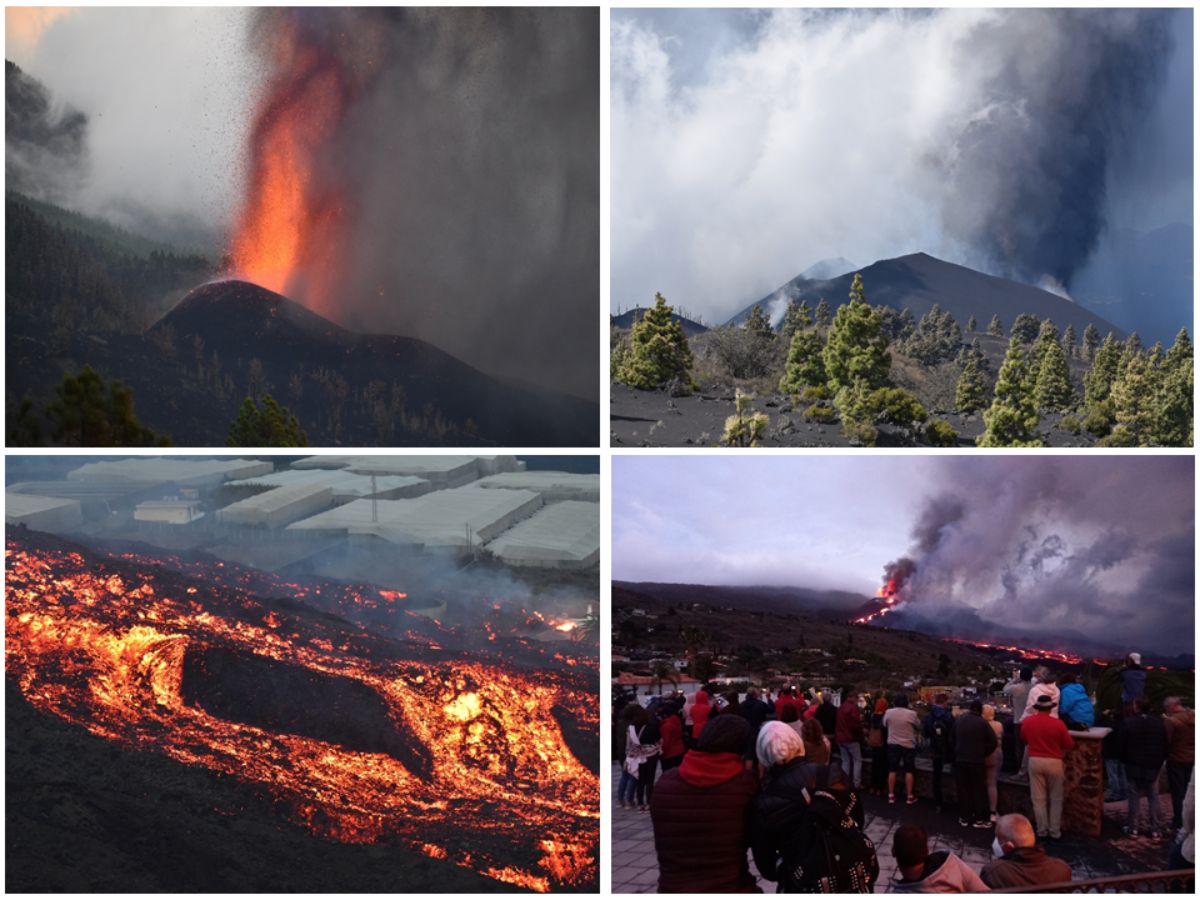
A research project involving the University of La Laguna has analyzed the geotourism potential on the island of La Palma related to volcanic eruptions, with a particular focus on the most recent eruption of Tajogaite, also analyzing landscapes prior to the 2021 event. This work has identified the geotourism products on the island before the eruption, assessed the importance of the volcano for this activity through a survey of people who witnessed the eruption firsthand, and also analyzed the geotourism products developed after the event.
You have participated in the project as members of the research group of Geoheritage and Geotourism in Volcanic Areas from the University of La Laguna, together with researchers from Canary Islands Volcanological Institute (Involcan) and of the Geovol Group from the University of Castilla-La Mancha. The results have just been published in the article '‘Geotourism on an active volcanic island (La Palma, Canary Islands, Spain)’'from the journal Miscellanea Geographica-Regional Studies on Development of the University of Warsaw (Poland). Specifically, the signatories were Javier Dóniz-Páez, Nemesio M. Pérez, Rafael Becerra-Ramírez and William Hernández-Ramos.
The results show that, before the eruption, La Palma's tourism products (hiking, archaeology, stargazing and volcano tourism) were closely linked to the island's volcanic landscape and heritage, and that the historic volcanoes of San Antonio (1676-77) and Teneguía (1971), with its "San Antonio Volcano" Visitor Centre; San Juan (1949), with the interpretation centre of the Volcanic Cavities-Caños de Fuego; and the rest of the historic and recent volcanoes of the Volcano Route played an essential role in it.
Through an on-site and online survey of 752 people who witnessed the 2021 eruption, they were asked, in addition to aspects related to their socioeconomic profile, how they arrived on the island, with whom, where they were staying, how long they were going to stay in La Palma, what were the main motivations for going to the island and what aspects of the eruption (the effects/damage, ashfall, noise, fire, smell or others) were the ones that caught their attention the most.
This multiple-choice questionnaire received 1,026 responses regarding the motivations for visiting La Palma, and of these, 64.31% stated that it was to witness the eruption. For the second question, 1,607 responses were received, and the most striking aspects of the eruption were the noise (26%), the ashfall (22.5%), the effects and damage to the town and its property (18.9%), the fire (17.5%), the smell (10.6%), and finally, other (4.5%) unspecified reasons.
These data highlight the interest the eruption generated as a tourist attraction and the role of the noise produced during its nearly three-month duration. However, this latter point is not surprising, since in historical eruptions of the Canary Islands, the noise produced has always been recorded in documentary accounts as one of the most striking aspects for the local population, with widely varying interpretations in its description.
Once the eruption ended, geotourism has come to play a key role in the various island recovery plans through the evaluation of places of geotourism interest and the design of geo-routes from these places, both in natural and urban spaces.
This scientific work has been made possible thanks to the funding of the VOLTURMAC-Strengthening of Volcano Tourism in Macaronesia projects (MAC2/4.6c/298), co-financed by the European Commission through the INTERREG VA Spain-Portugal MAC Cooperation Program (Madeira-Azores-Canary Islands) 2014-2020 and 'Territorial Recovery La Palma' financed by the Ministry of Ecological Transition, Fight Against Climate Change and Territorial Planning of the Government of the Canary Islands.

 Spanish
 English
 French