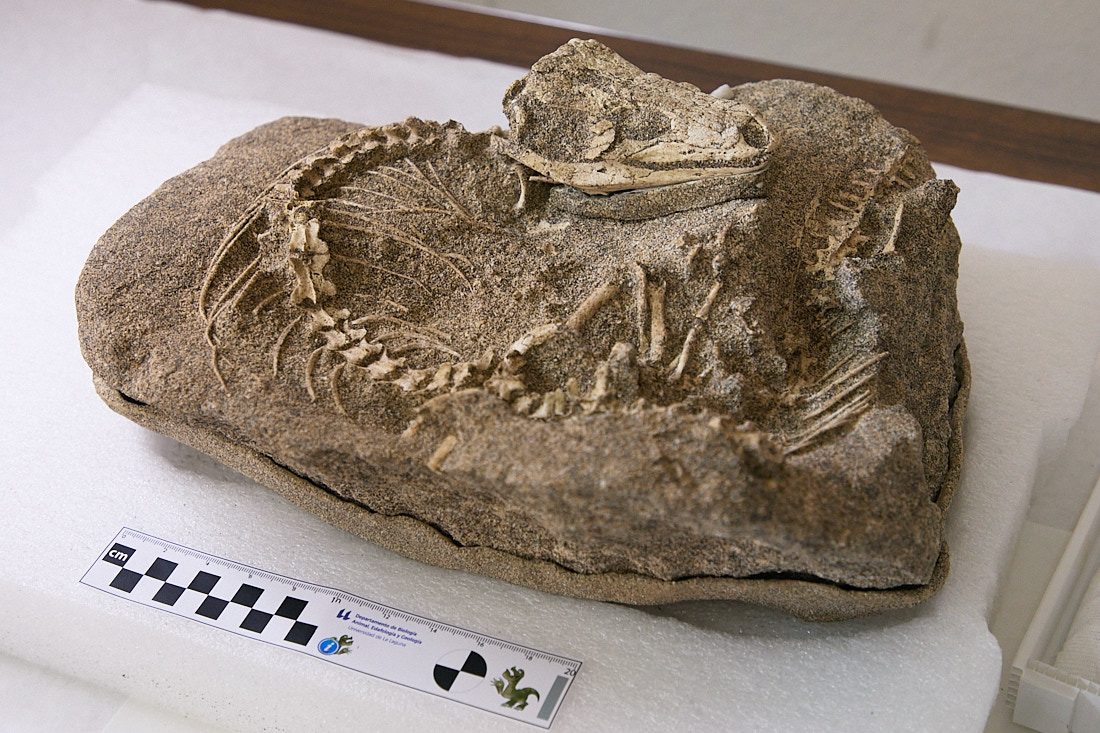
The research team of the paleontologist from the University of La Laguna Carolina Castillo Ruiz has discovered in Tenerife an articulated lizard of the species Gallotia which is dated to 700,000 years ago. The specimen has been scanned and cleaned and is currently in the Biology Section of the academic center, awaiting further study and its presentation at the next national congress of this discipline.
The discovery, which occurred years ago, was entirely accidental. Botanist Arnoldo Santos Guerra was searching for snail shells when he found a block weighing over 20 kilos with a bone that caught his attention. He immediately contacted the paleontologist, who was developing the funded projects at the time. Gallotia 3D and Anaga Paleopark.
The specimen retains its complete morphology, and its skeletal structure is clearly visible. Researchers have also observed the presence of another similar lizard, perhaps younger or smaller, but in a worse state of preservation. Initial hypotheses suggest that the two were together in a dune formation, and that death may have been accidental or sudden, as the skeletal structure is almost intact.
This lizard bears a strong resemblance to the Gallotia The fossil from El Hierro has been identified, although the exact species still needs to be determined and its morphology compared. Computed tomography scans have already been performed on the head, which was separated from the body, to obtain a 3D model for comparison with extant species. The researcher, accompanied by several members of her team, explained to the rector, Francisco García, that the excellent condition of the piece allows them to determine its exact proportions without having to use the regression line method so often employed in other cases.
Castillo Ruiz points out that it would now be necessary to study each bone individually and analyze the subtle clues to determine its paleobiology. Everything suggests it could be a giant lizard. Gallotia goliath, a species that went extinct before the presence of humans, but this needs to be verified with certainty, he adds.
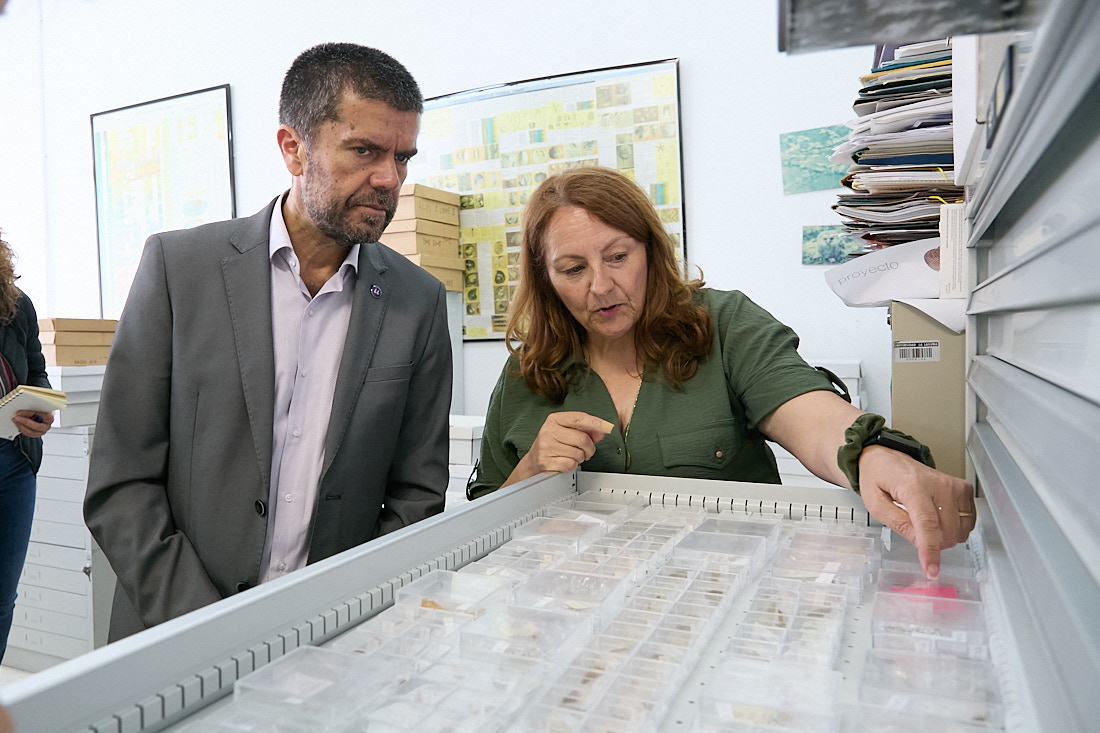
Carolina Castillo shows the rector some of the collections housed in the Paleontology area.
Rich paleontological heritage
His laboratory is a true center for the conservation of paleontological heritage, with many thousands of specimens from collections of fossils of plants, vertebrates, invertebrates and trace fossils, both terrestrial and marine, associated with the research and teaching work of the Paleontology area of the University of La Laguna.
Thus, remains of lizards from El Hierro dating back 4,000 to 15,000 years can be observed, including jaws with teeth, leg bones, and other elements that have been properly cataloged. In fact, a total of 26 caves on that island were investigated, of which only one has been cataloged.
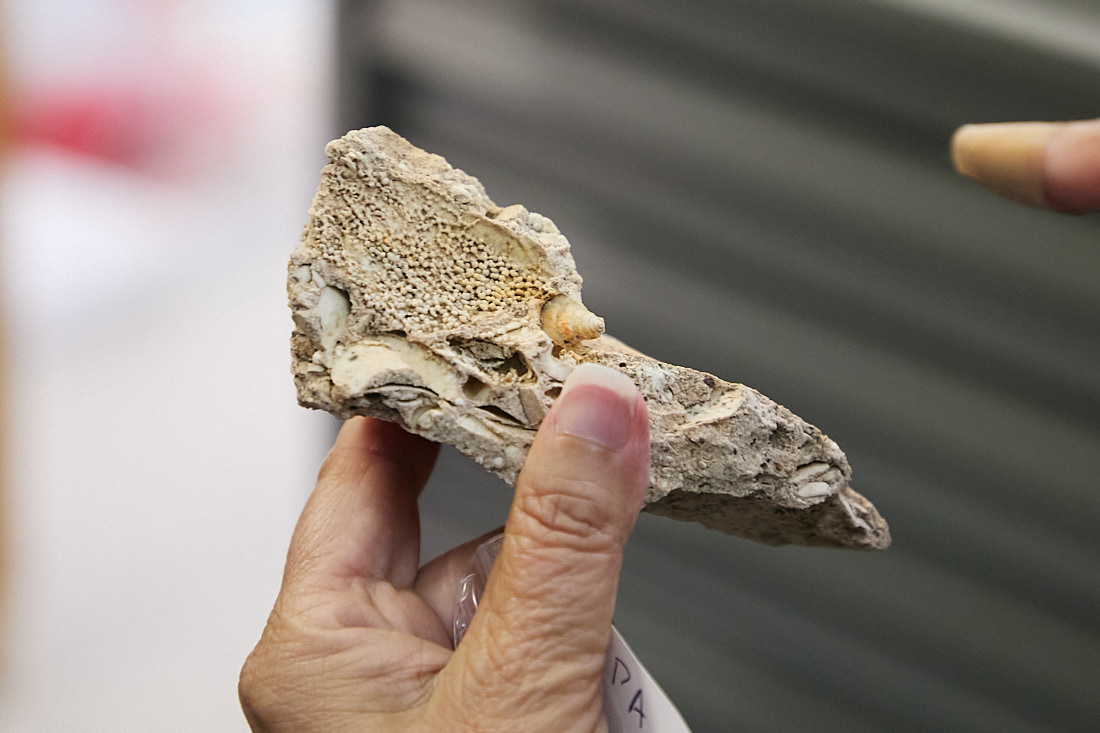
Image of endolithic marine sponges with shell remains.
Addressing the need for technical support staff and researchers will allow scientific knowledge in this area to advance.
The same is true for many pieces from the marine environment, which preserve fossil traces of enormous scientific interest such as Santichnus mayoralii. However, much of this material is being used for the completion of various final degree projects and doctoral theses by young researchers.

 Spanish
 English
 French