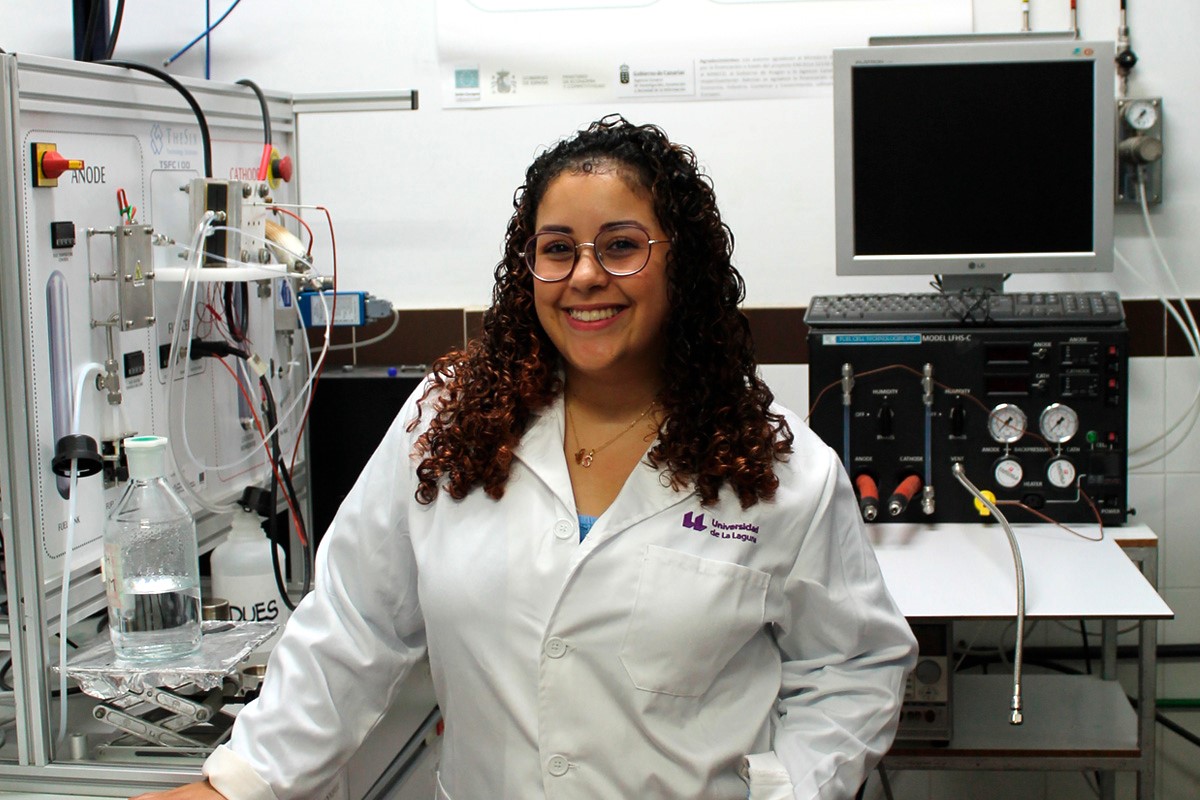
Stephanie J. Martinez, a graduate in Chemistry from the University of La Laguna and currently a doctoral candidate in the Surface Science and Electrocatalysis group of University Institute of Materials and Nanotechnology from the same educational institution has been awarded the prize for best poster at a recent conference.
Under the direction of the professor Elena Pastor, The young researcher has been awarded the prize for best poster, titled “Study of nickel-deposited graphene materials as catalysts towards ORR in alkaline fuel cells,” which was presented at the XLIV Meeting of the Electrochemistry Specialized Group of the Royal Spanish Society of Chemistry + V Mediterranean E3 Symposium, held from July 3 to 5, 2024, in Bilbao. It is noteworthy that this is an interactive poster, with information on the structure of the molecules used, the reactors employed, and the results obtained accessible via QR codes.
Growing concerns about global pollution and increasing energy demands are driving the search for clean energy sources. Hydrogen and fuel cell technologies could improve future renewable energy systems, making them more efficient and allowing for better alignment of electricity demand with consumption, the researcher points out. This technological improvement would help reduce dependence on fossil fuels and decrease CO2 emissions.2.
Optimizing the design of catalysts for the oxygen reduction reaction (ORR) at the cathode of polymer electrolyte membrane fuel cells improves the overall performance of these devices and reduces costs. However, the slow kinetics of this reaction are a significant limitation. Stephanie Martinez's thesis focuses on the search for materials that catalyze this reaction, with the aim of implementing them in electrochemical devices such as fuel cells.
In her doctoral work, she proposes the use of graphene-based materials as a support, since they improve the dispersion and distribution of metallic nanoparticles. Furthermore, doping them with heteroatoms such as sulfur or nitrogen allows for modulation of their properties. In this work, nickel nanoparticles were deposited onto graphene-based materials doped with sulfur and nitrogen by reducing graphene oxide with non-polluting reagents (caffeine and ammonium thiocyanate), and their behavior was studied in a fuel cell station.
The main results with these catalysts show a remarkable increase in the electrocatalytic activity of the graphene material after depositing nickel on its surface and good stability (with losses of only 3 % in power density after 12 hours of continuous operation).

 Spanish
 English
 French