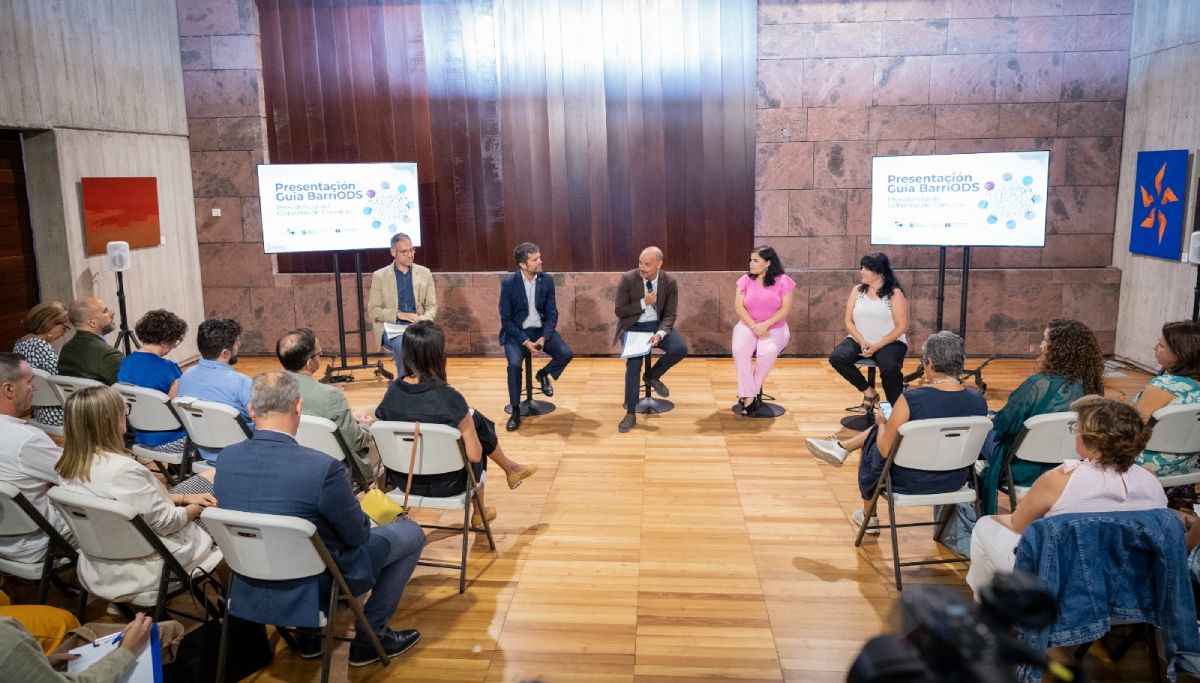
Towns and neighborhoods across the archipelago now have a methodological guide for the local application of the Canary Islands Sustainable Development Agenda 2030. This working document has been tested and validated in eight locations across the islands as part of the 'BarriODS' project, and will serve as a basis for progress towards sustainability in the rest of the archipelago.
The 'Guide to transform our neighborhood (or town)' arises from an initiative financed by the Government of the Canary Islands and promoted by the University of La Laguna through its General Foundation, which has also had the support of the Canary Federation of Municipalities (Fecam) and the municipalities participating in the project.
In this regard, the Deputy Minister of the Presidency, Alfonso Cabello, highlighted during the presentation of this document the importance of implementing the Canary Islands Agenda 2030 at the local level, so that progress towards economic, social and environmental sustainability is not limited to the large population centers of the archipelago.
Cabello reaffirmed the Canary Islands Government's "clear and firm" commitment to working towards "balanced and fair" sustainable development across all the islands and municipalities, ensuring that "no one is left behind, regardless of where they live." As part of this strategy, he highlighted the ongoing dialogue between the regional government and the 48 municipalities with fewer than 10,000 inhabitants facing demographic challenges, as well as the implementation of initiatives such as the 2030 Routes program, which aims to bring innovative projects to smaller communities.
The Deputy Minister of the Presidency also highlighted the effort that the Executive, with the collaboration of public universities, is making to ensure that the roadmap for fulfilling the Canary Islands Agenda 2030 is drawn up through "a participatory process", a collective commitment that "will guarantee the success of the measures we put in place".
During the presentation of the BarriODS Guide, María Brito, president of FECAM, also emphasized the importance of implementing the Canary Islands 2030 Agenda locally through collaboration between public administrations, universities, and citizens. Brito asserted that only citizen participation in decision-making will guarantee progress toward the Sustainable Development Goals (SDGs).
For his part, the rector of the University of La Laguna, Francisco García, referred to “continuity” as a key element for achieving sustainability in towns and neighborhoods. García guaranteed this continuity in the work the academic institution is carrying out to transfer knowledge to inform decision-making regarding the Canary Islands 2030 Agenda.
The presentation of this guide also included the participation of Vicente Zapata, director of the 'BarriODS' project and editor of the guide, who emphasized that "without community there is no sustainability," a motto that underpinned the work to develop this framework. Representatives from the eight municipalities featured in the guide and some of the people involved in the project were also present at the event.
From a more local perspective
The Guide to Transforming Our Neighborhood (or Town) aims to guide the community-based implementation of the Canary Islands Agenda 2030 at the sub-municipal level. It does so through a framework resulting from the work carried out by various steering groups formed in the towns of El Pinar de El Hierro, San José (Breña Baja), Playa de Santiago (Alajeró), La Postura (Adeje), Bañaderos (Arucas), Guisguey (Puerto del Rosario), La Peñita (Tías), and Caleta de Sebo in La Graciosa (Teguise), culminating last November.
This text practically illustrates the so-called process for change, through the organized and illustrated presentation of experiences recorded on all the islands, systematized for collective use by organizing multiple resources and tools for easy application. It also incorporates the lessons learned and the keys to activating local communities in achieving sustainability with the comprehensive vision outlined in the Canary Islands 2030 Agenda.
In addition to the print run of 100 copies, this guide for implementing the SDGs in the neighborhoods and towns of the Canary Islands is available in digital format on the 'BarriODS' project website (https://canariasods.es/) and in the institutional repository of the University of La Laguna (https://riull.ull.es/xmlui/handle/915/38225).
(Note and photo provided by the Government of the Canary Islands)

 Spanish
 English
 French