The ocean is the largest unexplored territory on our planet. Less than 51% of it has been investigated. In its depths, underwater ruins, minerals, and a wide diversity of marine life can be found, including microorganisms, sea plants, invertebrates, fish, and mammals such as whales and dolphins.
On July 23, 1986, the International Whaling Commission proclaimed this date as World Whale and Dolphin Day, with the aim of halting their indiscriminate hunting. The University of La Laguna promotes cetacean research to better understand them and contribute to their conservation. The Canary Islands, in particular, boast a rich biodiversity of cetaceans, with 32 recorded species, according to [source missing]. Patricia Arranz, A marine biologist from the University of La Laguna, she explains that around 400 short-finned pilot whales reside in the Teno-Rasca marine area of Tenerife. Bottlenose dolphins also live there, a species facing serious conservation challenges due to its interaction with human activity.
In addition, the Canary Islands are home to migratory cetaceans such as the Bryde's whale, the spotted dolphin, Blainville's beaked whale, the sperm whale, and the humpback whale. Occasionally, orcas, Risso's whales, and Cuvier's beaked whales can also be found.
“Cetaceans are apex predators and act as regulators of marine ecosystems,” Arranz points out. These animals play a crucial role in regulating the ocean climate through their fertilizing effect. Furthermore, this effect contributes to increased primary productivity in the oceans. On the other hand, migrating cetaceans also transfer nutrients from the poles, where they feed and productivity is higher, to the equator, where they reproduce and productivity is lower.
The effects of global warming are also evident in the oceans. The tropicalization of the Canary Islands' waters has led to an increase in the presence of cetacean species with tropical affinities. Arranz conducted a statistical analysis using data collected over 20 years on sightings of short-finned pilot whales and Bryde's whales in the El Mar de las Calmas area off the coast of El Hierro. "In both cases, we detected an increase," he states. However, other species, such as Blainville's beaked whale, may have been negatively impacted, with a reduction in their distribution.

Patricia Arranz
Beaked whales, extreme divers
Regarding cetacean behavior, Arranz highlights the extreme diving of beaked whales, which measure between five and seven meters: “Blainville’s beaked whale can remain submerged for between 45 minutes and an hour at depths of between 1,000 and 1,500 meters.” Furthermore, a recent study reveals that Cuvier’s beaked whale can dive for three hours and reach depths of up to 3,000 meters.
“For an animal of this body size, it’s a record,” says Arranz. The animal’s body size determines its oxygen reserves for diving: the larger it is, the greater its storage capacity, allowing for longer dives. A larger metabolism tends to be slower, which helps conserve oxygen during a dive. Thanks to their ability to dive deep, beaked whales can access food resources at great depths. This has allowed them to spread across the globe.
Another characteristic of beaked whales is that they remain completely silent below 400 meters, which is when most cetaceans vocalize. This allows them to escape predators at the surface.
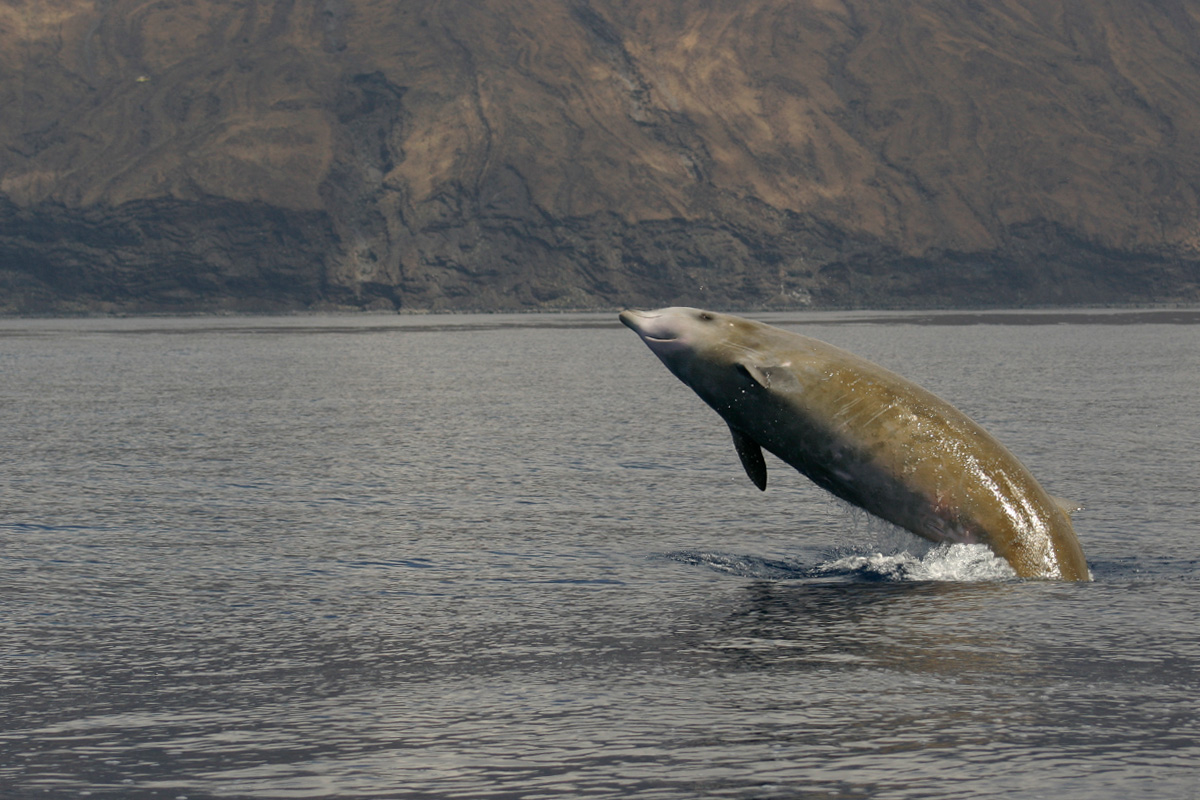
Cuvier's beaked whale (Ziphius cavirostris) leaping in the sea at Las Calmas, El Hierro. Photos by the University of La Laguna under research permission from MITECO.
All these findings were obtained thanks to the use of acoustic tags, a non-invasive technology that attaches to the animal's body with suction cups and can remain in place for approximately 27 hours, providing valuable information about its metabolism and communication, among other things. Arranz has prioritized non-invasive methods for studying deep-diving species, minimizing the impact on the animals and allowing for the study of juvenile specimens or pups.
In addition, autonomous hydrophones have been used to detect the clicks of cetaceans in the Mar de las Calmas and estimate the number of animals present at any given time, complementing this technique with visual sampling from the shore. This method is useful for the long-term monitoring of cetacean populations, as it allows for the comparison of data on their numbers and the evaluation of the effectiveness of conservation measures.
Since 2019, Arranz has developed another line of research using drones, which has allowed him to study the noise responses of tropical pilot whales and track their morphometry, as well as, in a subsequent study, those of beaked whales, Risso's whales, and sperm whales. This technique also minimizes the impact, since the boats can maintain a distance, and the drone's noise is inaudible to the animals underwater.
Technology
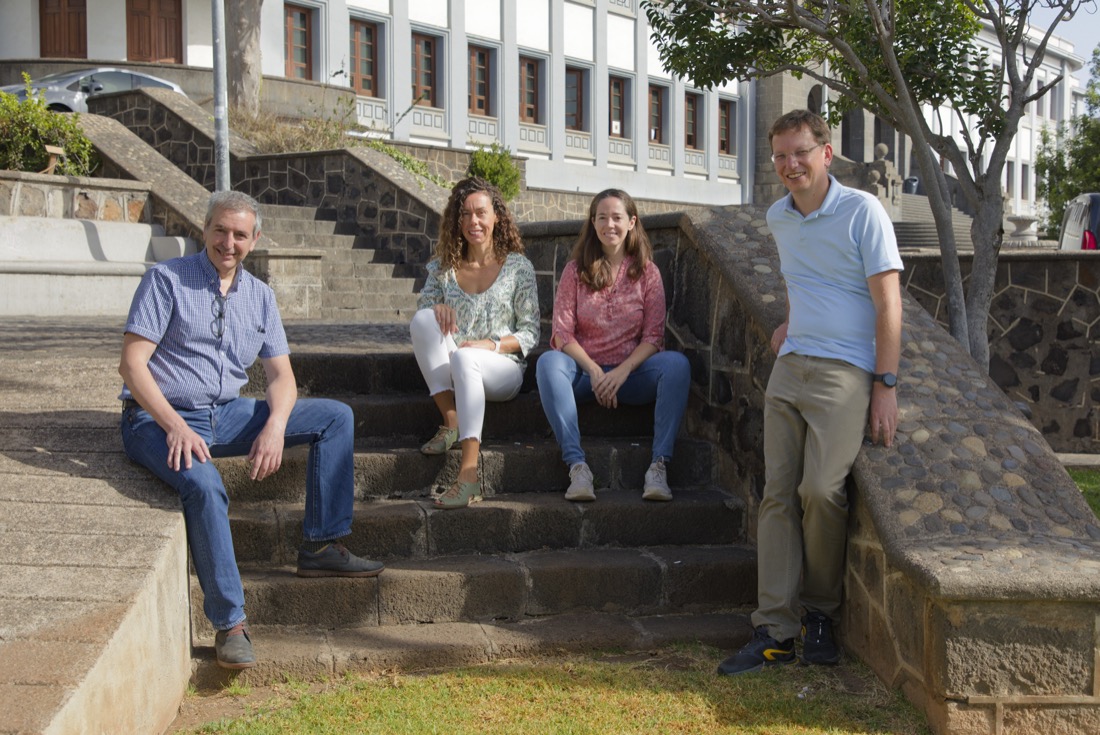
In the development of technologies for the marine environment, the role of engineering is fundamental. Fernando Rosa y Jonah Philipp Luke, Researchers from the Bioacoustics research group

Fernando Rosa.
The physics and distributed multi-sensors team at the University of La Laguna develops value-added technology, generating, where possible, open-source software and hardware. They also manufacture systems with advanced features, such as interaction between researchers and instruments located in the marine environment.
The researchers emphasize that the measuring instruments not only record sounds but also process the data. Sound files are very large, making them difficult to transfer, especially when using multiple sensors simultaneously, as is common in marine environments. Instead of sending all the raw information, the instrument reduces the data to more manageable indicators, allowing researchers to assess the sound environment of the area over time and determine if there is interference with cetaceans.
Rosa explains: “We developed a technology that aims to measure the sound state of different ecosystems over a long period of time.” In this regard, the researchers are part of the project. MARCET, which seeks to transfer and disseminate science and technology from

Jonah Philipp Luke.
vanguard to promote the sustainable development of tourism related to whale watching or whale watching. Therefore, they use sound as an indicator of the health of the marine environment where these animals reside.
In addition, they participate in the CanBio project, A network for monitoring climate change, ocean acidification, and marine noise. This initiative, promoted by Loro Parque and the Government of the Canary Islands, also studies the habitat of critically endangered species and their relationship with biodiversity and ecosystems.
Vast mosaic of marine protected areas
Spain has multiple marine protection designations. Raquel de la Cruz, A researcher with the Fisheries, Tourism, and Natural Resource Management research group at the University of La Laguna analyzes the various marine protected areas. Formal legislative developments aimed at protecting marine resources began in the 1970s. However, it wasn't until 1982 that the first legislation in Spain allowing for the creation of marine reserves was published. In 2001, with the Fisheries Law, the concept of a marine reserve of fishing interest was reinstated, which is the type of marine reserve that exists in the Canary Islands.
In the Canary Islands archipelago, the areas of La Restinga-Mar de las Calmas, La Palma, and Isla Graciosa are designated as marine reserves of fishing interest. These areas protect marine resources to ensure sustainable human activities, such as artisanal fishing. It is worth noting that at the national level, other types of marine protected areas exist, such as Special Areas of Conservation and protected biotopes, among others. However, at the regional level, there are other forms of protection within inland waters.
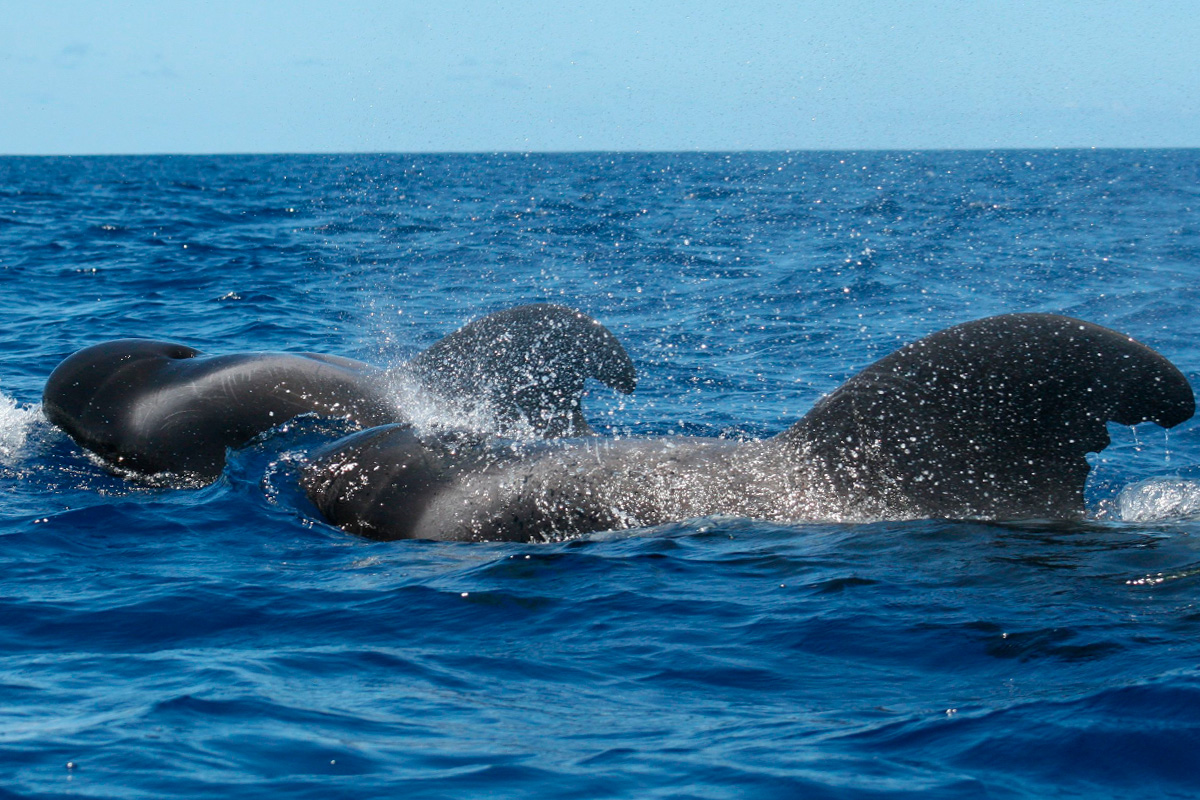
Tropical Calderón. Photos from the University of La Laguna under research permission from MITECO
De la Cruz states that marine protected areas in Spain are quite small and located in coastal zones, which historically has had very little impact on cetaceans. Currently, to protect them, measures have been created that cover much larger areas, such as cetacean corridors. In Spain, the Mediterranean cetacean migration corridor runs from Alicante to Girona, parallel to the Balearic archipelago. These areas aim to reduce marine noise and prohibit new hydrocarbon exploration.
De la Cruz indicates that these marine protection designations, with the exception of marine reserves of fishing interest, do not have a significant practical impact, as they lack regulatory implementation, public oversight, or active engagement with the local population. Furthermore, in the case of cetacean corridors, it is worth noting that it is necessary to involve several autonomous communities or even several countries, making them more difficult to manage. This contrasts with the situation in the La Restinga-Mar de las Calmas marine reserve of fishing interest in El Hierro, where dialogue is only required with local groups (artisanal fishing, shore fishing, and diving) and within the same municipality.
Conversely, in Tenerife, in the special conservation area of the Teno-Rasca marine strip, De la Cruz indicates that it is difficult to govern, since it is necessary to dialogue with several municipalities and it encompasses numerous groups, such as the whale watching tourism sector.
Whale watching
He whale watching This situation has become unsustainable due to the high volume of tourists visiting the islands and the excessive number of licenses issued. The Canary Islands rank fourth worldwide in terms of whale-watching tourism. Therefore, it is essential to implement management measures that guarantee the conservation of resident cetacean populations, which are facing significant pressure.
“The Canary Islands were a pioneer at the national level in implementing regulations for whale watching,” Arranz points out. However, De la Cruz notes that some companies in southern Tenerife comply with the regulations while others do not. In this regard, the Southern Tenerife Cetacean Association is working to ensure that companies respect the regulations and is reporting those that do not, engaging in dialogue with the public administration.
“Whale watching is an educational, recreational and lucrative activity,” Arranz emphasizes, adding that it has enormous potential to raise public awareness about conservation.

Raquel Modino.
These marine animals. Arranz and De la Cruz have collaborated on several projects related to blue tourism. Both researchers participated in a project to implement whale watching, a well-established activity in Tenerife, in the area of La Restinga-Mar de las Calmas off the coast of El Hierro. It is important to note that this area has a greater presence of beaked whales, which are more difficult to spot compared to the short-finned pilot whales that reside in the Teno-Rasca Special Area of Conservation.
Arranz indicates that there is only one company on El Hierro licensed to carry out this activity. Therefore, the researchers were able to collaborate closely with this company to develop educational content, including the short film. “Inhabitants of the blue” and guided activities, whether or not cetaceans were present. They also studied the profile of tourists who visited El Hierro for whale watching.
Finally, an analysis of the impact of boat noise on cetaceans was carried out in Tenerife, the results of which were cited in the journal Nature. Noise was shown to negatively affect the breastfeeding time of tropical pilot whale calves and the rest of the females.
The same experiment was conducted with electric boats. No reduction in nursing or resting time was observed. The effect of two boats operating simultaneously was also evaluated, concluding that if the noise level is low, it does not alter the animals' behavior, highlighting the importance of establishing noise limits for these activities. All this data was submitted to the Tenerife Island Council to support the management and development of new regulations, also taking into account the boats' load capacity, speed, and maneuvering methods around the animals.
NOTE: This report is an initiative framed within the InvestigaULL Commemorations Calendar, a scientific dissemination project promoted by the University of La Laguna.
Scientific Culture and Innovation Unit (Cienci@ULL)

 Spanish
 English
 French