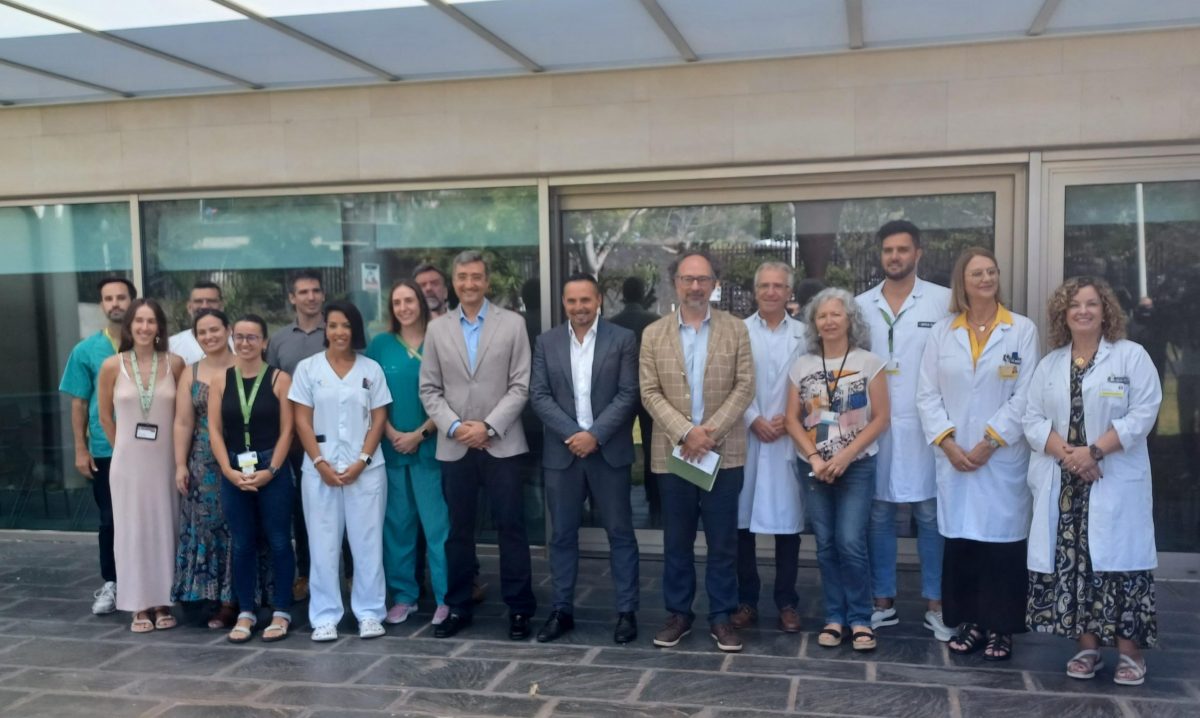
The University Hospital Complex of the Canary Islands (HUC), part of the Canary Islands Government's Ministry of Health, in collaboration with the University of La Laguna, has developed an innovative method for assessing kidney function in a simple, precise, and accurate way that improves the patient experience and optimizes resources. This method was developed by the team led by the researcher Esteban Porrini at the academic institution and the clinical biochemist Sergio Luis Lima, from the Central Laboratory of the HUC.
The press conference to present this method was held yesterday, Wednesday, July 31, at the hospital and was attended by the manager, Adasat Goya; the scientific director of the Canary Islands Health Research Institute, Fernando Gutiérrez; the nephrologist and researcher from the University of La Laguna, Esteban Porrini; the clinical biochemist from the hospital, Sergio Luis Lima; and the head of the Central Laboratory service, Mª Luisa Díez.
The researchers indicated that the most immediate goal is to offer patients who need it a reliable method for assessing their kidney function in daily clinical practice. The method is called "Iohexol plasma clearance with DBS" (Dry Blood Spots). More than 3,000 patients, most of them from the Canary Islands, have benefited from this method.
This group has been awarded a Personalized Medicine Project, the “National Network of Renal Function Laboratories,” funded by the European PERTE program. Its immediate objective is to demonstrate this method to other centers in Spain and Europe so that it can be used on patients. Furthermore, the Renal Function Laboratory at the University Hospital of the Canary Islands (HUC) and the University of La Laguna aim to become a leading center for this method throughout the Canary Islands.
Traditionally, measuring kidney function involved laborious and uncomfortable procedures for the patient, including the need for multiple blood draws after the administration of a molecule used as a marker of kidney function. This method was inconvenient for the patient.
Safe and non-infectious sample
Thanks to this work, the technique has been simplified since micro drops of blood are used, which are extracted after a puncture of the fingertip and deposited on filter paper for later analysis.
This procedure significantly reduces the amount of blood that needs to be drawn from the patient. Furthermore, the blood on filter paper is a safe, non-infectious sample that can be mailed to various laboratories. This makes the iohexol-DBS clearance method useful in our region, as different centers can send their samples to a centralized laboratory.
These advantages make the method useful for patients with chronic kidney disease, particularly children, kidney donors in the Living Donor Program, patients with kidney and other organ transplants (liver, lung, heart), and for better dosing of drugs eliminated by the kidneys. Furthermore, it also represents significant cost savings for the national health system.
The University Hospital of the Canary Islands (HUC) and the University of La Laguna (ULL) have established a collaboration with the Spanish Agency for Medicines and Health Products (AEMPS) and General Electric Healthcare to include a new indication for iohexol in its product information. Therefore, patients in Spain who require a reliable assessment of renal function can benefit from this technological innovation, which is the product of applied transnational research. The recent creation of the Health Research Institute in the Canary Islands provides further support for this type of research.
Unique center
Currently, the HUC is the only center in the world that applies this technique, with the aim of extending its use to all hospitals in the National Network of Renal Function Laboratories, which includes fifteen centers in eight autonomous communities.
The Renal Function Laboratory has a multidisciplinary team, consisting of a research nurse, a laboratory technician, a computer programmer, as well as research staff from different areas of health sciences.
The ultimate goal of the work carried out in this Laboratory is "to give back to society what it has given us to develop our research.".
(Note and photo provided by HUC).

 Spanish
 English
 French